Tukey vs ytZolo: The YouTube Script AI Comparison for 2026
The tool that writes your script in 60 seconds versus the one that reads your retention graph first. Here is why that difference determines whether you grow.
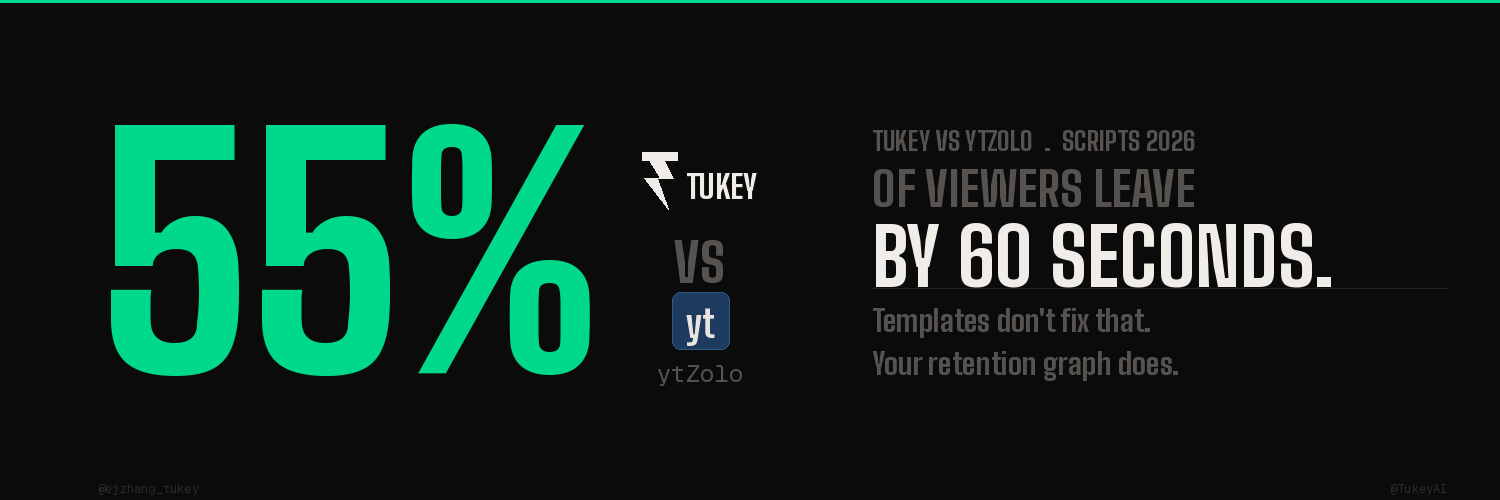
55% of viewers are gone before the 60-second mark. Not because your topic was bad. Not because your thumbnail underperformed. Because the script lost them.
That stat comes from Retention Rabbit's 2025 benchmark report, which analyzed over 10,000 YouTube videos across 1,000+ creators. The average YouTube video retains 23.7% of its audience. Only 1 in 6 videos crosses the 50% retention mark.
If your script is built on generic frameworks instead of your own channel's data, you are writing directly into that drop-off.
This is the core of the tukey vs ytzolo comparison in 2026. Both tools generate AI YouTube scripts. They do it very differently.
How ytZolo Generates Scripts
ytZolo's workflow is fast. Type in a topic, hit generate, and in under 60 seconds you have a complete draft: hook, body, CTA, title, description, and tags. For creators who are stuck at a blank page, that speed has real value.
The framework ytZolo applies is built around documented best practices. Open with a hook in the first 3 seconds. Insert pattern interrupts every 60 seconds. Close with a CTA that drives watch-next behavior. These are reasonable principles.
The limitation is that they are universal principles, not personalized signals. ytZolo does not connect to your analytics. It does not know that your audience exits at the 1:20 mark, or that your viewers watch 40 seconds longer when you open with a data point instead of a question. The script is assembled from templates, not from your retention graph.
That gap matters. According to the same Retention Rabbit dataset, videos with a clear value proposition in the first 15 seconds see an 18% lift in retention at the one-minute mark. But "a clear value proposition in 15 seconds" is not the same across every channel. What counts as a strong hook for a finance educator is different from what holds a gaming audience. Generic frameworks cannot close that gap.
How Tukey's Retention Layer Changes the Output
Tukey connects to your YouTube Studio analytics before it writes anything. It reads your actual retention curves: where your viewers drop, where they re-engage, which structural patterns correlate with your highest watch time videos.
That data shapes the draft. If your retention curve shows a cliff at the 1:30 mark, Tukey restructures the script to front-load the value that typically falls after that point. If your audience re-engages every time you introduce a specific format (a comparison, a real example, a visual demo), Tukey places those elements at the intervals where your data shows viewers are most likely to disengage.
The script is not built from what works on average YouTube. It is built from what works on your YouTube.
This matters because audience behavior varies significantly by niche. Retention Rabbit's 2025 data shows up to a 20.6 percentage point difference in average retention between the top and bottom content categories. Educational How-To videos average 42.1% retention. Vlogs average 21.5%. A script template calibrated to one audience type will actively hurt performance in the other. Tukey sidesteps this problem because it is not using a category average. It is using your channel's own numbers.
Channels that improve average retention by 10 percentage points see a correlated 25%+ increase in algorithm-driven impressions. That is not a marginal gain. That is the difference between a channel YouTube recommends and one it ignores.
Speed vs Quality: What Matters for Growth
The tukey vs ytzolo speed comparison is real. ytZolo generates a script in under 60 seconds. Tukey takes longer because it runs your analytics first.
Here is the relevant question: what is the cost of the faster script if it underperforms?
Retention Rabbit's data shows that only 16% of viewers reach the final 10 seconds of an average video. If your script is losing the audience in the first minute, no upload schedule is fast enough to compensate. Posting twice as often with scripts that bleed viewers early just means twice the wasted production time.
The creators growing fastest in 2026 are not the ones producing the most content. They are the ones producing content that the algorithm rewards with impressions. Improving retention by 10 percentage points drives 25%+ more algorithmic distribution. That is the lever that compounds.
Speed matters for output. Retention matters for growth. They are not the same thing, and optimizing the wrong one is expensive.
Tukey vs ytZolo: Feature Comparison
| Feature | ytZolo | Tukey |
|---|---|---|
| Script generation time | Under 60 seconds | 3-5 minutes (runs analytics first) |
| Retention data source | Generic best-practice frameworks | Your actual channel retention curves |
| Script personalization | Topic input only | Drop-off points, re-engagement patterns, your top-performing structures |
| Hook calibration | Template-based (3-second rule) | Data-driven (keyed to your first-minute curve) |
| Pattern interrupt placement | Fixed interval (every 60 sec) | Placed at your channel-specific fatigue points |
| Full content package (title, description, tags) | Yes | Yes |
| Analytics integration | No | Yes (YouTube Studio) |
| Best for | High-volume creators who need speed and have not yet analyzed their retention data | Channels focused on retention-driven growth and algorithm distribution |
The Fastest Path to Better Retention
The manual workflow most creators use looks like this: write a script in a general-purpose AI tool, check analytics separately in YouTube Studio, try to mentally connect the two, revise manually. Nothing is integrated. The retention insight never reaches the script.
That fragmentation is the real bottleneck. It is not that creators do not care about retention. It is that the tools that generate scripts and the tools that show retention data have historically been in separate workflows with no connection between them.
Tukey closes that gap. The retention graph and the script writer are the same workflow. You put in a topic, Tukey reads your analytics, and the draft that comes out is already shaped by what your audience has been signaling for months.
For channels that have been posting for three months or more and have enough retention data to work with, this is the most direct path to improving watch time without overhauling your production process.
Visit tukey.ai to connect your channel.
A note on why we built Tukey AI
I spent months looking at my retention graphs after posting and thinking, "I already knew that would happen." The drop at 1:30 was always the same. The re-engagement at the question was always the same. But nothing in my script workflow was talking to my analytics.
The insight behind Tukey is simple: your retention data already knows what your audience wants. A script writer should read that data before writing a single word, not after.
tukey.ai
Tukey vs ytZolo Verdict: Which One Is Worth Your Time in 2026?
For creators who need a fast script and are not yet using retention data to inform their writing, ytZolo is a legitimate option. It is fast, it generates a full content package, and it applies tested structural frameworks.
For creators who are serious about retention-driven growth, the tukey vs ytzolo answer is clear. Tukey generates scripts from your actual viewer behavior, not from population averages. The scripts are slower to produce and meaningfully better calibrated to the audience that already watches your channel.
If 55% of your viewers are leaving before 60 seconds, faster scripts are not the solution. Scripts built on your retention data are.
FAQ
What is the difference between Tukey and ytZolo for YouTube script writing? ytZolo generates scripts in under 60 seconds using general best-practice frameworks. Tukey analyzes your actual YouTube retention curves before drafting, so the script is shaped by where your specific audience drops off and re-engages rather than by population averages.
Is ytZolo good for YouTube script writing in 2026? ytZolo is a capable tool for fast script generation, particularly for creators who are still building their channel and do not yet have substantial retention data to work with. It applies structured frameworks for hooks and pattern interrupts. The limitation is that it does not read your analytics, so scripts are not personalized to your channel's viewer behavior.
How does retention data improve a YouTube script? When a script writer analyzes your retention graph, it can identify the exact moments viewers exit and place high-value content or re-engagement triggers at those points. According to the 2025 Retention Rabbit benchmark report, videos with a strong 15-second value proposition see an 18% retention lift at the one-minute mark. That kind of precision is only possible if the tool knows where your specific audience makes its decision to stay or leave.
What is the best AI script writer for YouTube in 2026? For creators focused on growing through algorithmic distribution rather than raw upload volume, Tukey is the strongest option in 2026. It connects directly to YouTube analytics and builds scripts from retention data. For creators who need high-volume fast drafts and have not yet built a retention-analysis workflow, a template-based tool like ytZolo provides a functional starting point.
Does a faster script always mean more videos and faster growth? Not if the scripts underperform on retention. According to data from Retention Rabbit's 2025 benchmark study, channels that improve average retention by 10 percentage points see a 25%+ increase in algorithmic impressions. Posting more frequently with scripts that lose viewers early does not compound into growth. Retention does.
How long does it take Tukey to generate a YouTube script? Tukey takes 3-5 minutes because it runs your analytics before drafting. That is slower than tools that skip the data step, but the output is calibrated to your channel's actual retention patterns rather than generic frameworks.
My name is EJ Zhang, the CEO at Tukey AI, a production workspace built in your voice. It learns your beliefs and creative fingerprint, surfaces pre-trending topics tailored to you, helps you create with originality, predicts performance before you publish, and learns from every result to make smarter recommendations over time.