Tukey vs Writesonic for YouTube Scripts: 2026 Comparison
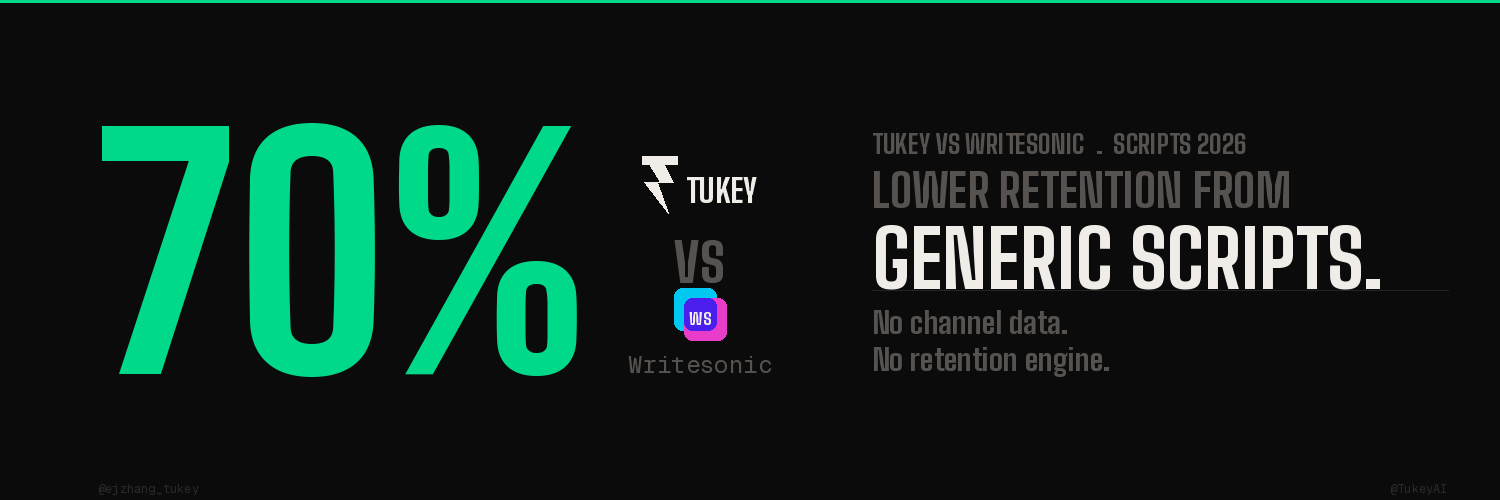
What the 70% retention gap between generic AI scripts and retention-informed scripts actually means for your channel.
Generic AI YouTube scripts average 70% lower audience retention than content built with retention intelligence. That number comes from Retention Rabbit's 2025 benchmark report, which analyzed over 10,000 videos across 1,000+ creators. Writesonic is a general-purpose AI writing platform. It has a YouTube script template. It does not have a retention engine.
That difference is the entire comparison.
This article breaks down what Writesonic's YouTube script tool actually produces, what Tukey AI does instead, and which one belongs in a creator's workflow if retaining viewers past the first minute is the actual goal.
Writesonic's YouTube Script Template: What You Get
Writesonic is an AI writing platform built for volume across formats. It covers 80+ content types: blog posts, Google ads, LinkedIn posts, email sequences, product descriptions, and YouTube scripts. The YouTube Script Writer is one of dozens of templates on the platform.
Here is how the tool works. You enter your video topic in a single field. You select a tone: casual, serious, optimistic, formal. You choose a target content length. You click generate. Writesonic returns a full script with a hook, introduction, body sections, and a call to action.
That is the complete input set. Topic, tone, length.
The tool has never connected to your channel. It has not seen your analytics. It does not know your average view duration, your first-minute drop-off rate, or how your audience responds to slow intros versus fast ones. It writes the same way it generates a LinkedIn post or a product description: from the text you give it.
The output is clean. The structure is logical. The writing is grammatically correct. For someone who needs a fast first draft and plans to revise heavily, Writesonic works.
For a creator trying to move retention numbers on a specific channel, this is where the gap opens.
Generic Template vs Retention-Informed Script
The difference between these two approaches is not writing quality. Both tools produce readable, well-structured English.
The difference is what each tool is optimizing for.
A generic template optimizes for structure. Hook, problem, value, CTA. It assumes a universal viewer who responds to a universal sequence. For some content types, that logic holds. For YouTube, where your specific audience's behavior determines whether the algorithm surfaces your video, a universal structure written without any channel data is a statistical guess.
A retention-informed script optimizes for your viewer's attention at specific moments. It is built around where your audience actually drops off, not where a template assumes they should.
Here is what that looks like in real numbers. Retention Rabbit's 2025 benchmark of 10,000+ videos found that 55% of viewers are gone before the 60-second mark. The same report identified that 35% of videos are structured for the wrong audience type entirely, meaning the hook style, pacing, and framing conflicted with how that channel's actual viewers behave. These channels showed steep mid-video drop-offs that had nothing to do with the topic.
A generic AI template cannot catch that problem. It writes for a hypothetical viewer. Tukey AI writes for yours.
Videos with a clear value proposition delivered in the first 15 seconds see 18% higher retention at the one-minute mark, per the same Retention Rabbit data. That 18% lift does not come from better writing. It comes from knowing what your specific viewer needs to hear in the first 15 seconds in order to stay. That knowledge lives in your retention graph. Writesonic has never seen yours.
Feature Comparison Table
Here is a direct breakdown of what each tool includes for YouTube script creation.
| Feature | Writesonic | Tukey AI |
|---|---|---|
| YouTube script generation | Yes | Yes |
| Channel retention data integration | No | Yes |
| Audience persona analysis | No | Yes |
| Pattern interrupt placement | No (template structure) | Yes (data-driven) |
| Hook calibrated to your specific channel | No | Yes |
| Mid-video pacing guidance | No | Yes |
| Purpose-built for YouTube creators | No | Yes |
| Other content types supported | 80+ (ads, email, blog, social) | YouTube-focused |
| Entry price | Free tier / $16/mo | See tukey.ai |
The single column that determines everything is "channel retention data integration." Without it, every script is written blind. With it, the script reflects what your actual audience has already shown you they respond to.
Writesonic has never claimed to have retention intelligence. It is not hiding a capability. The gap exists because Writesonic is a general-purpose content engine, and general-purpose tools are designed to solve general problems.
YouTube retention is not a general problem.
Who Writesonic Is Actually For (Hint: Not YouTube Creators)
Writesonic earns strong reviews, and for good reason. Content marketers use it to produce blog drafts and ad copy variations at scale. Small business owners use it to generate product descriptions and email sequences without hiring a copywriter. Agencies use it for first-draft throughput across multiple client accounts.
These are real use cases, and the tool handles them well. Output quality for text-heavy marketing content is consistently solid at its price point.
The problem is when YouTube creators pick up Writesonic because it appears on a "best AI script generators" list. The YouTube Script Writer template shares infrastructure and logic with the Instagram caption generator, the Facebook ad writer, and the product description tool. The model writing your YouTube script has never seen a YouTube retention curve. It has never been trained on the behavioral difference between a casual viewer and a dedicated learner, both of whom watch content on YouTube and leave for entirely different reasons at entirely different timestamps.
Retention Rabbit's 2025 data shows that "Casual Entertainees" drop off at 60% within the first 30 seconds when intros are slow, versus only 35% for "Dedicated Learners" in the same scenario. A script that is written without knowing which viewer type dominates your channel will be structured for the wrong one. At scale, that mistake shows up directly in your average view duration.
Writesonic makes sense for creators who produce content across multiple platforms and need fast first drafts across formats. It does not make sense for creators whose primary goal is to lift their channel's retention metrics, because the tool has no mechanism to know what those metrics are.
Verdict
If you are choosing between these two tools specifically for writesonic youtube scripts versus Tukey AI, the answer depends on what you need the script to accomplish.
Writesonic gives you a structurally sound script in under two minutes from three fields. No channel connection, no learning curve, no setup. If you need a starting draft that you will edit into shape, the speed is real and the quality floor is decent.
The ceiling is low. Because Writesonic has no visibility into how your viewers behave, it cannot write a script that addresses your specific retention problems. It will output the same generic hook-and-body structure whether you have 300 subscribers or 300,000, and whether your audience responds to slow burns or needs a payoff in the first eight seconds. The 70% lower retention gap between generic AI scripts and retention-informed content is not theoretical. It is what shows up in the analytics of every creator who ships AI-generated scripts without building them around their actual audience behavior.
Tukey AI is purpose-built for this exact problem. It connects to your channel's retention data, identifies where your audience drops off, and writes scripts structured around closing those gaps. The result is not just a cleaner script. It is a script built for the people who are already watching your content, structured around the moments where you have historically lost them.
For creators who take YouTube seriously as a growth channel, the difference between these two approaches is not subtle.
A note on why we built Tukey AI
I spent months running YouTube scripts through every general-purpose AI tool available. The scripts were readable. They passed the "sounds human" test. The writing was technically fine. Then I would open my retention analytics and see the same thing every time: viewers leaving at the same spots in every video, because the script was written for some imaginary average viewer instead of the actual people watching my channel.
The founding insight for Tukey was simple. A script tool that has never seen your retention graph cannot write a good YouTube script. It can write a good script. Those are two different things, and on YouTube, only one of them moves the algorithm.
tukey.ai
FAQ
Does Writesonic write good YouTube scripts? Writesonic generates clean, well-structured YouTube scripts from basic inputs: topic, tone, and length. For a quick first draft, the output is solid. For creators trying to optimize retention on a specific channel, the scripts lack any audience behavior context. The tool has no connection to your channel data, which means it cannot account for where your viewers actually drop off or what hook style your audience responds to.
What is the best Writesonic alternative for YouTube creators? Creators whose primary goal is improving YouTube retention should use a purpose-built YouTube script tool that integrates with their channel's retention data. Tukey AI is built specifically for this: it connects to your channel analytics and writes scripts around your audience's actual behavior patterns, rather than a generic template structure.
What are the main differences between Writesonic and Tukey for writesonic youtube scripts? Writesonic is a general-purpose AI writing platform with a YouTube script template among 80+ content types. Tukey AI is purpose-built for YouTube and connects to your channel's retention data to write scripts calibrated to your specific audience. The core gap is retention intelligence: Writesonic generates from topic and tone inputs alone, while Tukey generates from your actual viewer behavior.
What is the average YouTube retention rate in 2026? According to Retention Rabbit's 2025 benchmark analysis of over 10,000 videos, the average YouTube video retains 23.7% of its viewers. Only 16.8% of videos ever exceed 50% average view duration. More than 55% of viewers leave before the 60-second mark, making the first minute the most critical scripting challenge for any creator.
Why do generic AI scripts underperform on YouTube? Generic AI scripts are written from topic and tone inputs, not from your channel's behavioral data. Retention Rabbit's 2025 benchmark found that 35% of videos are structured for the wrong audience type entirely, and that generic AI-generated content averages 70% lower audience retention compared to content built with retention intelligence. The problem is not writing quality. It is the absence of channel-specific context.
Is Writesonic worth it as a writesonic video script tool for YouTube? Writesonic is worth it for creators who produce content across multiple formats and need fast, readable first drafts at low cost. It is not the right tool if your primary goal is YouTube retention improvement. A script generated without your channel data cannot address the specific drop-off patterns your audience has already shown you through your analytics.
My name is EJ Zhang, the CEO at Tukey AI, a production workspace built in your voice. It learns your beliefs and creative fingerprint, surfaces pre-trending topics tailored to you, helps you create with originality, predicts performance before you publish, and learns from every result to make smarter recommendations over time.
Follow us on X @TukeyAI or visit tukey.ai
SEO Notes Primary keyword: writesonic youtube scripts LSI keywords used: writesonic for youtube, writesonic video script, writesonic alternative youtube, YouTube script template, retention-informed scripting, AI YouTube script generator, audience retention, YouTube creator tools, channel retention data, watch time optimization, generic AI scripts, average view duration Target featured snippet: "Does Writesonic write good YouTube scripts?"