YouTube RPM by Niche 2026: Finance vs. Gaming Data
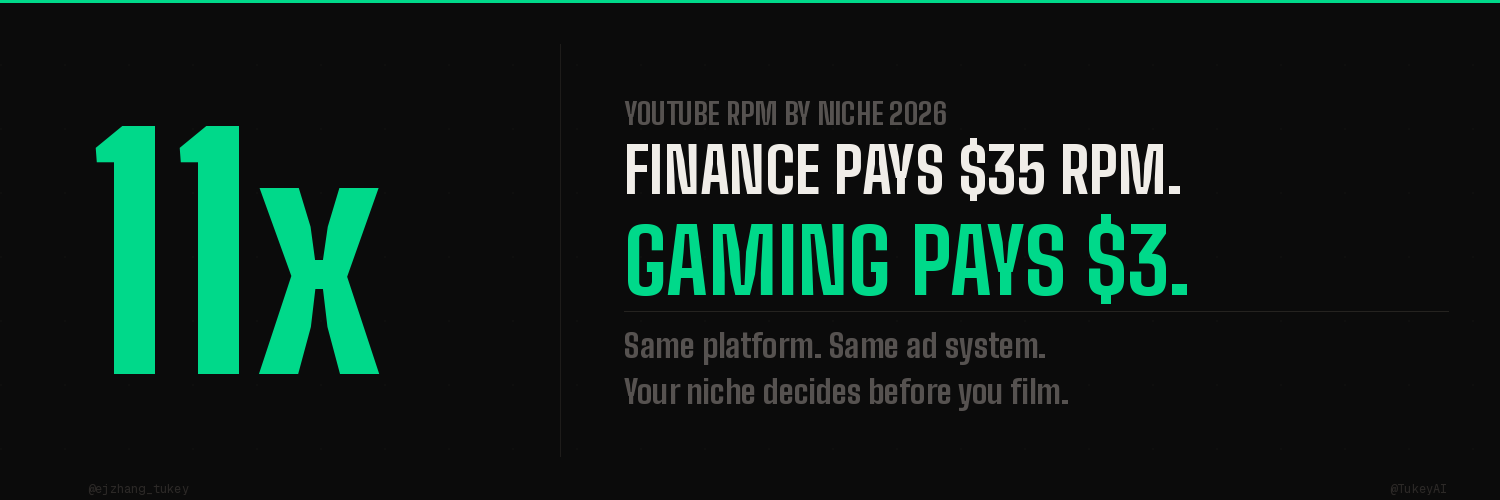
The complete 2026 RPM breakdown by niche, plus the scripting shifts that separate $3-per-thousand channels from $35-per-thousand channels.
Finance YouTube channels average $35 RPM. Gaming channels average $3. That is an 11x difference from the same platform, the same ad system, and often the same view count.
Most creators never do anything about this gap. They pick a niche they like, build a channel, and accept whatever RPM YouTube assigns them. The ones who actually close the gap understand something the others miss: your niche decides your income ceiling before you record a single frame. And once you are in a high-RPM niche, the script structure that made you successful in a low-RPM niche will quietly sabotage you.
This article gives you the real 2026 RPM numbers by niche. Then it goes one layer deeper into how you actually script for the niches where the money is.
Your Niche Is an Income Decision You Are Making Right Now
Most creators treat RPM like weather. It happens to you. You check it in YouTube Studio, you shrug, and you move on.
That is backwards.
RPM is a function of advertiser demand for your specific audience. And advertiser demand is something you can engineer, both by choosing a niche and by scripting for the audience that niche attracts. Every video you upload either increases or decreases the perceived value of your audience to buyers. The top creators in high-RPM niches know this. They script not just for views, but for the kind of viewer their advertisers want.
The 11x gap between finance and gaming RPM is not random. It reflects a fundamental difference in what those audiences do with their attention. Understanding that difference is what this article is about.
Why Advertisers Pay 11x More for One Audience Than Another
YouTube does not set your RPM. Advertisers do.
When a financial services company bids for ad space on a personal finance video, they are paying to reach someone who has a banking account, an investment account, or a credit problem they need to solve. Converting one of those viewers into a customer might generate $500 to $5,000 in lifetime value. So paying $40 to reach 1,000 of those viewers is an obvious ROI.
When a gaming company or energy drink brand bids for space on a gaming video, they are targeting a viewer who might spend $60 on a game or $4 on a drink. The math is different. The CPM they can profitably pay is lower because the LTV of their customer is lower.
This is the mechanism. It has nothing to do with your content quality. A gaming channel can produce better videos than a finance channel and earn 3x less RPM. The advertiser competition for the audience determines the price, not the production value.
Three other forces compound the niche effect:
Geography. A US-based viewer is worth 5 to 8 times more to an advertiser than a viewer from Southeast Asia. A finance channel that draws primarily US traffic can see $30+ RPM. The same channel with a heavy Indian or Southeast Asian audience might land at $5 to $8, even with identical content.
Video length. Videos over 8 minutes unlock mid-roll ads. Mid-roll inventory can double or triple monetized impressions per view. High-RPM niches reward longer content. This is not an accident. The viewers in those niches are in learning mode. They will watch a 20-minute finance deep dive if it gives them what they came for.
Q4 seasonality. Every October through December, advertisers exhaust their annual budgets. RPM across all niches spikes 30 to 50%. A finance channel that earns $20 RPM in August might earn $35 RPM in November. Plan your biggest uploads for Q4.
The 2026 YouTube RPM Data by Niche
These figures represent US-audience channels with at least 50,000 monthly views. Lower-traffic channels often see 20 to 40% lower RPM due to reduced ad competition. Numbers represent average RPM ranges, not peak outliers.
| Niche | Average RPM (US) | What Drives It |
|---|---|---|
| Finance / Investing | $12 to $35 | Banks, brokerages, credit cards bidding for high-LTV leads |
| Insurance | $15 to $32 | Insurance CPMs are among the highest on the platform |
| Legal / Tax | $10 to $28 | Law firms, tax software, financial planners |
| Business / Entrepreneurship | $8 to $20 | SaaS, business tools, courses targeting decision-makers |
| Software / SaaS Reviews | $8 to $24 | B2B software buyers have $10K to $100K+ deal values |
| Health / Medical Information | $6 to $15 | Pharma, supplements, insurance targeting higher-income viewers |
| General Fitness / Wellness | $4 to $9 | Fitness supplements, apparel, apps |
| Technology / Gadgets | $4 to $8 | Consumer electronics, software, services |
| Gaming | $2 to $5 | Game studios, peripherals, energy drinks |
| Entertainment / Comedy / Vlog | $1 to $4 | Broad consumer brands with low conversion specificity |
The gap between the top and bottom is not 10%. It is 1,100%.
A finance channel doing 200,000 views per month at $25 RPM earns $5,000. A gaming channel doing the same 200,000 views at $3 RPM earns $600. Same platform. Same number of views. $4,400 difference every month.
The finance niche specifically. Finance is the most consistently high-RPM category on YouTube because the advertiser competition never stops. Credit card companies, robo-advisors, mortgage lenders, insurance companies, and investment platforms all need the same audience: an adult with financial anxiety and purchasing intent. That competition keeps CPMs elevated year-round. Finance creators who focus on specific high-intent sub-topics, such as Roth IRA conversions, credit score repair, or index fund investing, see RPM at the upper end of the range because search-intent viewers are more valuable to advertisers than browse-intent viewers.
The gaming niche specifically. Gaming is not going away and the view numbers are often enormous. But the RPM floor is real. Gaming CPMs cluster between $4 and $15, which translates to $2 to $5 RPM after YouTube's 45% cut. The exception is gaming content that targets adult, high-income gamers, such as PC build guides or strategy game analysis. Those sub-niches can reach $6 to $10 RPM because the audience skews older and has higher purchasing power.
The software and SaaS sub-niche. This one surprises creators who have not looked at the data. Tutorial and review content for B2B software tools commands $8 to $24 RPM because the advertiser paying for those impressions is trying to reach a decision-maker with a corporate budget. A single conversion from a B2B software ad might generate $10,000 to $100,000 in annual recurring revenue for the advertiser. Paying $20 CPM to reach those buyers is a bargain. If you have any technical background, the SaaS review and tutorial niche is one of the most under-exploited high-RPM opportunities on the platform right now.
Health and medical. Health is wide enough that RPM varies more here than in any other category. Pharma advertisers pay high CPMs for specific medical sub-topics. Senior health, chronic condition management, and prescription drug education channels can reach $12 to $15 RPM. General fitness content targeting younger audiences lands much lower, $4 to $9, because the advertiser paying for that space is selling protein powder, not pharmaceuticals.
The Part Nobody Else Covers: How High-RPM Niches Demand a Different Script
Here is what most RPM guides do not tell you.
If you move from gaming to finance hoping to capture a higher RPM, and you bring the same scripting approach with you, you will fail. Not because your content is bad. Because the audience you are trying to reach watches differently. And the way they watch changes everything about how you need to script.
The viewer intent problem. A gaming viewer opens YouTube in entertainment mode. They want stimulation. The hook that works for them is spectacle: "This $200 weapon is broken." They stay because the content keeps surprising them.
A finance viewer opens YouTube in problem-solving mode. They have a real, often stressful situation. A tax deadline. A debt they cannot figure out. A retirement account they do not understand. The hook that works for them is not spectacle. It is recognition: "If you are contributing to a traditional 401k and earning over $90,000, you are probably making a $40,000 mistake." They stay because the content promises to solve the specific problem they already have.
Same platform. Completely different psychology.
What this means for your hook structure. In gaming, a reaction hook works. In finance, a cost-frame hook works.
Gaming hook structure: Lead with the unexpected or extreme. "This $12 item broke the entire meta." Energy high from frame one.
Finance hook structure: Lead with the cost of the problem. "The average American household loses $4,800 a year to a single banking habit most people never think about." Then immediately demonstrate you have the answer. Credibility signals need to appear in the first 30 seconds: years of experience, credentials, or social proof.
The 2025 retention data backs this up. Over 55% of YouTube viewers drop off within the first minute. Videos that state their specific value proposition within the first 15 seconds show meaningful retention uplift at the 60-second mark. In finance content, that value proposition has to be a problem and its cost. In gaming content, it has to be an emotional peak.
Script pacing is different. Finance viewers, and high-RPM viewers generally, are in learning mode. They will tolerate slower pacing if the information payoff is real. A 20-minute explainer with clear logical progression works in finance. That same pacing in a gaming video kills retention inside the first five minutes.
This is not about being slow. It is about being structured. Finance scripts need a clear argument architecture: here is the problem, here is why it matters to you specifically, here is the mechanism, here is the solution, here is how to implement it. Each section earns the next. Viewers in problem-solving mode stay as long as they believe progress is being made toward the answer.
Mid-roll placement changes. Finance and business content over 15 minutes can support three or four mid-roll placements without destroying retention. The viewer intent is strong enough that they will tolerate an interruption if they believe the video still has value ahead. Gaming viewers are much more sensitive to mid-roll breaks. A gaming video with three mid-rolls at minutes 4, 8, and 12 will see sharp retention drops at each placement. Finance creators can treat mid-roll placement strategically, placing breaks at natural section transitions rather than time-based intervals. Gaming creators often benefit from fewer, shorter ad placements.
The CTA timing is different. In gaming content, CTAs front-load well because the first-minute drop-off is steep and you need to capture the subscriber during peak engagement. In finance content, the CTA often performs better mid-video or at the end, after you have demonstrated credibility and delivered a specific insight. Finance viewers are skeptical. They subscribe when they trust you. They trust you after you have given them something genuinely useful. Push the subscribe CTA too early in finance content and you get silence. Give them a real insight first, then ask, and the conversion rate is higher.
Length strategy. Finance, legal, and business channels consistently see higher RPM on longer videos, above 15 minutes, for two reasons. First, longer videos carry more mid-roll ad inventory. Second, the viewer intent in those niches rewards depth. A finance viewer who found a 25-minute complete guide to backdoor Roth IRA conversions and watched all of it is exactly the advertiser's target, a high-intent, engaged, research-mode adult. That viewer profile commands higher CPM.
Gaming channels can win with 8 to 14 minute videos. Long enough for one mid-roll. Short enough to keep the energy tight. Going to 25 minutes in gaming without a very specific format reason (a full game playthrough, a documentary-style story) usually kills retention and drops RPM per view.
The Fastest Way to Script for High-RPM Niches
Most creators who try to move upmarket into finance, legal, or SaaS content stall out for one reason: they cannot figure out how to connect the topic to their specific audience's problem, and then script it in a way that holds a more demanding viewer.
The manual workflow for this is slow. You research the topic, try to identify what the viewer's real pain point is, draft a hook, rewrite it because it sounds too generic, draft the body, realize the pacing is off, fix it, and upload something that is good enough but not great. Finance and business content is unforgiving. Generic hooks and vague promises send high-intent viewers somewhere else.
Tukey AI is built specifically for this problem. It helps you identify the high-performing topics in your niche, understand what the viewer's actual search intent is, and build a script structure that matches the retention demands of that content category. In a finance video, Tukey knows the hook needs a cost frame and a credibility signal within 30 seconds. In a SaaS tutorial, it knows the viewer wants a problem-solution arc with a clear outcome stated upfront. It does not generate generic outlines. It builds scripts around the specific video concept and the specific audience psychology that concept attracts.
If you are trying to move into a higher-RPM niche or optimize your existing channel's script performance, the fragmented manual approach costs you more in time than it saves. Tukey closes that gap directly.
A note on why we built Tukey AI
I spent two years making YouTube videos in a niche with $4 RPM. I knew finance channels were earning 8x more per view. When I finally tried to make the shift, I realized the problem was not the topic. It was that I kept scripting for entertainment when the audience I wanted came for problem-solving. My hooks were wrong. My pacing was wrong. My structure was wrong. I was copying the format that worked for me before, in a niche where that format did not exist.
Tukey was built because that translation problem is real, it is not obvious, and it kills channels that should succeed. The RPM data tells you where to go. The script structure tells you how to stay there.
tukey.ai
FAQ
What is a good YouTube RPM in 2026? It depends entirely on your niche and audience geography. For US audiences, a good RPM is $8 to $12 in general content and $20 to $35 in finance, legal, or insurance content. Gaming and entertainment channels doing $3 to $5 are performing normally for their category. The better question is whether your RPM is high relative to your niche, not relative to the platform average.
What is the highest RPM YouTube niche in 2026? Finance, insurance, and legal content consistently top the RPM charts in 2026, with finance channels averaging $12 to $35 RPM for US audiences and insurance content sometimes exceeding $30. Software and SaaS review content is the fastest-growing high-RPM category, with average RPM between $8 and $24, because B2B software advertisers pay premium CPMs to reach decision-makers.
Why do finance YouTube channels have such high RPM? Finance channels attract viewers with real financial problems and purchasing intent, which is exactly the audience that banks, brokerages, credit card companies, and insurance firms want. Those advertisers bid aggressively for finance channel inventory because the LTV of a converted customer is $500 to $5,000 or more. High advertiser competition drives CPM up, and RPM follows.
Does scripting style actually affect RPM? Script structure does not directly change your CPM, but it changes which viewers watch and how long they stay. A finance video that hooks problem-solving intent viewers and holds them for 18 minutes generates more ad impressions per view than a finance video that hooks the wrong audience and loses them at minute three. More ad impressions at a higher CPM means higher RPM per view. Scripting for the right viewer intent in a high-RPM niche is one of the most direct levers you have.
Can you improve your YouTube RPM without changing your niche? Yes. The biggest RPM levers outside of niche are: audience geography (content that draws heavily US traffic earns more), video length above 8 minutes (unlocks mid-roll ads), and publishing volume during Q4 (October through December sees 30 to 50% RPM increases across all niches). Within your niche, focusing on high-intent specific sub-topics over broad general content also pulls RPM upward because search-intent viewers are more valuable to advertisers than browse-intent viewers.
How much does a finance YouTube channel with 100,000 monthly views earn in 2026? At an average $20 RPM for a US-audience finance channel, 100,000 monthly views generates approximately $2,000 per month from AdSense alone. Top-performing finance channels with $30 to $35 RPM and strong US viewership reach $3,000 to $3,500 per month at that view count. This is before sponsorships and affiliate income, which in the finance niche often double or triple AdSense revenue.
Conclusion
The 11x gap between finance and gaming RPM is not closing. Pick your niche accordingly, and then learn to script for it like the audience you are actually trying to reach.
My name is EJ Zhang, the CEO at Tukey AI , a production workspace built in your voice. It learns your beliefs and creative fingerprint, surfaces pre-trending topics tailored to you, helps you create with originality, predicts performance before you publish, and learns from every result to make smarter recommendations over time.