YouTube Monetization 2026: Rules, Revenue & $10K/Mo
Marcus had been uploading for seven months.
Forty-two videos. Consistent schedule. Decent production. He had done everything the tutorials told him to do.
His watch hours: 1,200. His subscriber count: 340.
He was not even close to monetization. And he had no idea why.
The answer was not his editing. It was not his thumbnails. It was not his mic quality.
He was making videos on topics nobody was searching for and the algorithm had no reason to push. The entire production stack was built on top of a foundation that was not there.
Month eight, he changed how he chose topics. Month eleven, he hit 1,000 subscribers and 4,000 watch hours in the same week.
Here is the full roadmap he used, and every monetization rule that matters in 2026.
Why Only 3% of Channels Ever Get Monetized
According to current data, just 3% of YouTube channels meet the requirements to join the YouTube Partner Program. Out of every 100 channels started this year, 97 will never earn a single dollar from YouTube directly.
The failure rate is not about effort. Most creators upload consistently. Most invest in equipment. The failure is almost always at the same point: they are creating content nobody is looking for, so the algorithm never pushes it, so the views never come, so the watch hours never stack.
YouTube monetization is not a production problem. It is a demand problem.
The Two-Tier System: How YouTube Monetization Actually Works in 2026
YouTube restructured its Partner Program into two tiers, and most guides only explain one of them.
Tier 1: Early Access (Fan Funding)
Requirements: 500 subscribers + 3,000 watch hours in the last 12 months (or 3 million Shorts views in 90 days) + 3 public uploads in the last 90 days.
What you unlock: Channel memberships, Super Chat, Super Stickers, Super Thanks, YouTube Shopping affiliate. No ad revenue yet.
This tier matters because affiliate links and fan funding have no view threshold. A channel with 600 subscribers and one breakout video can start earning from day one of acceptance.
Tier 2: Standard YPP (Ad Revenue)
Requirements: 1,000 subscribers + 4,000 watch hours in the last 12 months (or 10 million Shorts views in 90 days).
What you unlock: Ad revenue share (55% to creators on long-form, 45% on Shorts), YouTube Premium revenue, all Tier 1 features.
Approval takes approximately 30 days after you submit. YouTube reviews channel content, not just numbers.
Every Revenue Stream, Ranked by Realism
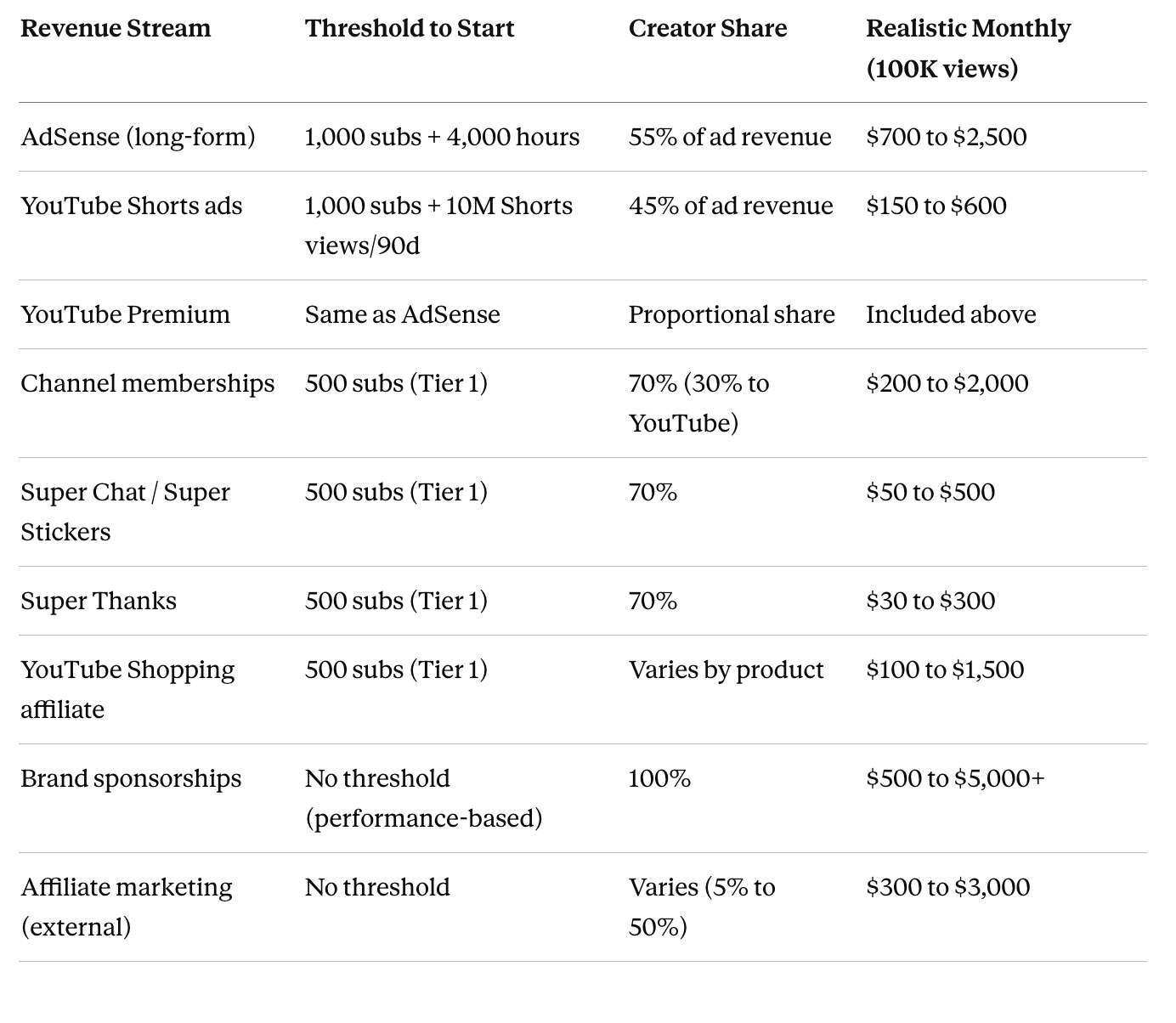
The channels earning $10,000 to $20,000 per month are running four to six of these simultaneously. AdSense alone rarely crosses $3,000 at typical view counts unless the niche RPM is exceptionally high.
What YouTube Actually Pays Per View in 2026
RPM (revenue per mille) is what you receive per 1,000 views after YouTube takes its share. CPM is what advertisers pay. The difference is significant.
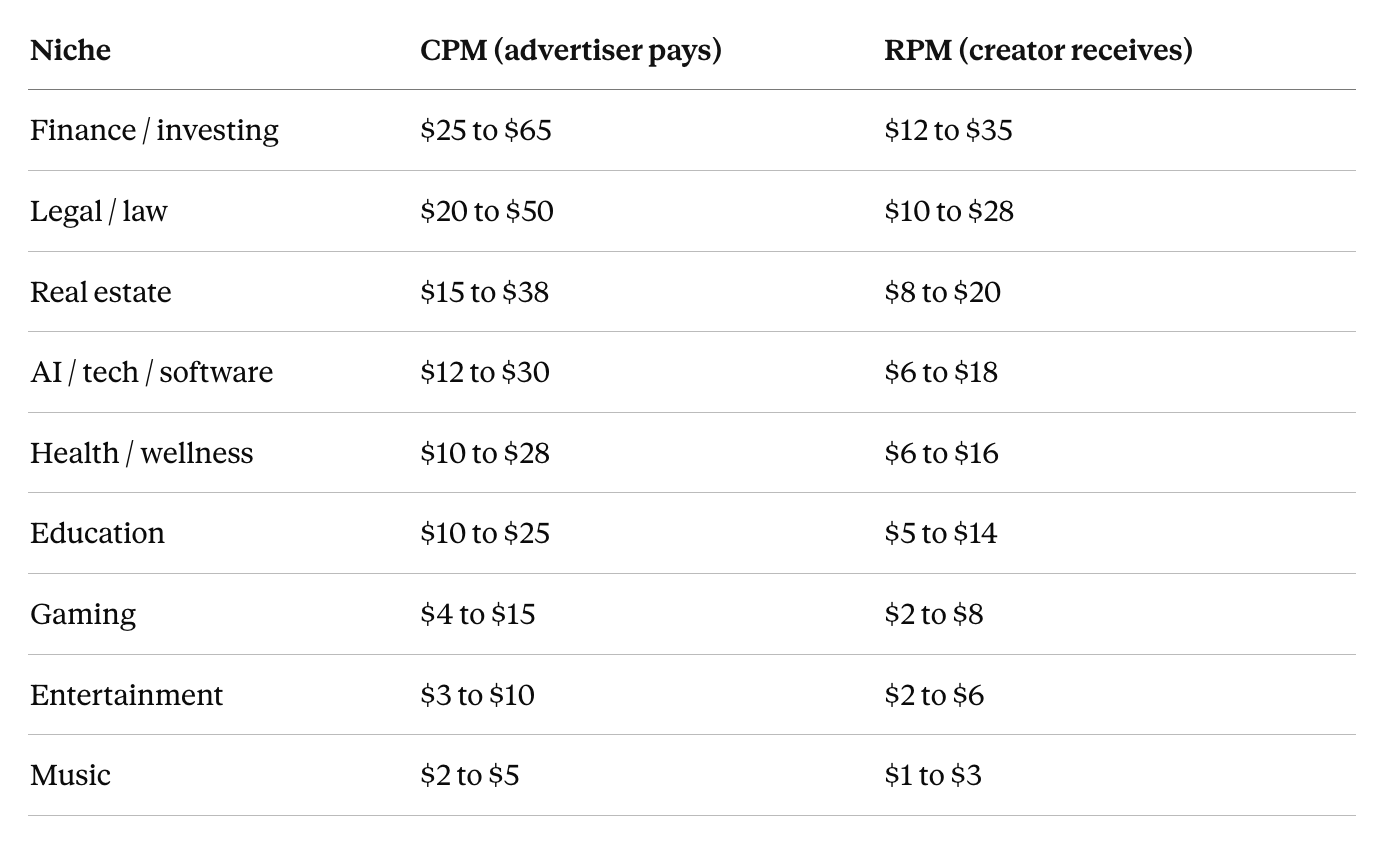
Two more variables that move RPM more than most creators realize:
Geography. US and German viewers generate $10 to $15+ RPM. The same video with traffic from South or Southeast Asia can fall below $1. A finance channel with 80% US traffic earning $18 RPM and a finance channel with 40% US traffic earning $9 RPM have the same niche, different audiences, and completely different income.
Seasonality. Ad budgets peak in Q4, especially November and December. RPMs in top niches can spike 40 to 70% above their annual average. January resets those budgets and RPMs drop 30 to 50% across almost all niches. If you are launching a channel, starting in Q3 so that your early growth lands in Q4 is not a small advantage.
The Brand Deal Layer: What Sponsors Actually Pay in 2026
Once a channel hits 10,000 subscribers with consistent viewership, sponsorships become the highest-margin revenue stream available. YouTube takes 0% of brand deal income.
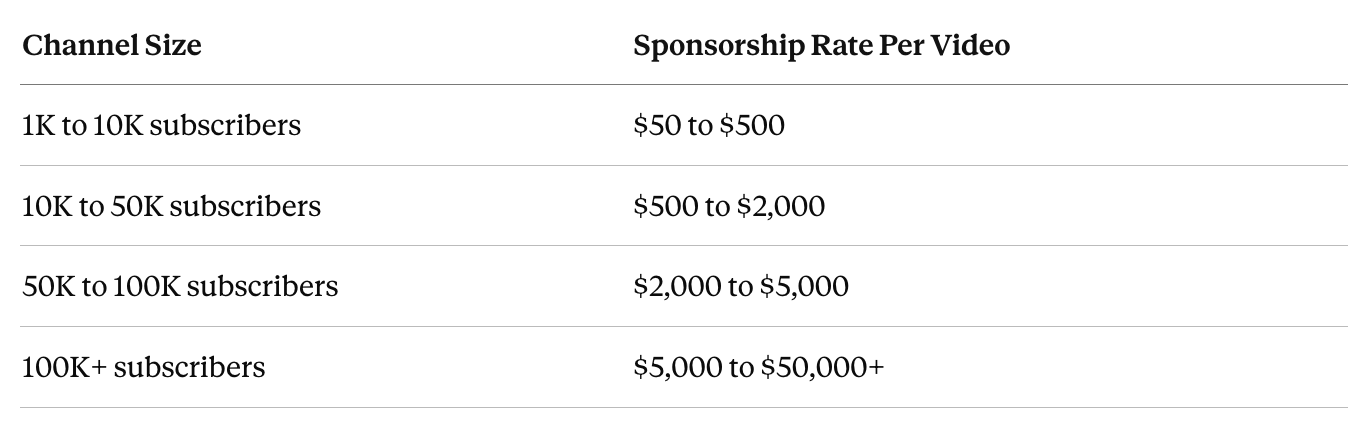
Niche premium: Finance and B2B SaaS channels command $40 to $80 CPM from sponsors. Lifestyle and gaming channels command $15 to $25 CPM from the same brands.
One number brands use that almost no creator tracks: average views per video over the last 10 to 15 uploads. A channel with 200,000 subscribers averaging 8,000 views per video is worth far less to a sponsor than a 30,000-subscriber channel averaging 25,000 views per video. View velocity beats subscriber count every time.
The AI Content Rules Every Creator Needs to Know
YouTube has been enforcing its synthetic content disclosure policy since November 2023, with significant expansion in May 2025 and full enforcement entering 2026.
What requires disclosure: Realistic synthetic voices, deepfake footage, or AI-generated depictions of real people or events. The test is whether a viewer could reasonably mistake the content for real footage.
What does not require disclosure: Using AI tools to write scripts, brainstorm ideas, assist with editing, or generate non-realistic graphics and animations.
What triggers penalties or removal: Mass-produced, low-effort AI content — what YouTube internally calls "AI slop." Identical scripts repurposed across channels, stock footage assembled with generic AI voiceovers and no creative differentiation, templated formats repeated without variation. YouTube's detection systems now evaluate entire channels, not just individual videos.
The compliance path: AI-assisted content that includes genuine human creative direction, unique framing, and proper disclosure where required monetizes without restriction. The disclosure label is a transparency signal for viewers, not a ranking penalty.
The practical implication: the AI channels that survive are not the ones making the most content. They are the ones making the most differentiated content.
The Fastest Realistic Path to Monetization
The median new channel takes 6 to 18 months to reach 1,000 subscribers organically. The gap between the low end and the high end of that range is almost entirely explained by topic selection.
Channels that research what is already winning in their niche before filming, finding the videos that dramatically outperform their channel's subscriber count, identifying the formats and topics the algorithm is actively pushing, consistently reach monetization thresholds in the 3 to 5 month range at two videos per week.
Channels that choose topics by intuition or general interest trend toward the 12 to 18 month end of that range, if they reach monetization at all.
This is why topic research is the leverage point that everything else depends on. A strong script on the wrong topic earns 600 views. A decent script on the right topic can earn 200,000. The production investment is the same. The outcome is not.
Tools like Tukey AI are built specifically for this step: surfacing the outlier-performing videos in your niche, the ones where a small channel is pulling 10x to 70x its expected views, so you can identify what the algorithm is already rewarding before you film a single frame. Research first, then script, then record. Not the other way around.
The 5 Monetization Mistakes That Add 12 Months to the Timeline
1. Choosing topics by intuition. The fastest channels to monetization are the ones using real performance data from their niche to validate demand before they create. Gut feel adds 6 to 12 months on average.
2. Treating Shorts and long-form as the same strategy. Shorts can reach 3 million views in 90 days for early-access monetization, but the ad RPM on Shorts is dramatically lower (45% creator share vs. 55%, and far lower base CPM). Most Shorts-first channels reach early access faster but earn significantly less per 1,000 views than long-form creators at the same subscriber count.
3. Ignoring the Q4 timing advantage. Launching 90 to 120 days before Q4 means your growing audience is monetized during the highest-RPM period of the year. Q1 launches mean your first monetized months are the lowest-RPM months of the year.
4. Single revenue stream dependency. Creators who apply for YPP the moment they hit 1,000 subscribers and wait for AdSense to scale are leaving money on the table from month one. Affiliate marketing starts on day one with no threshold required. Super Thanks and memberships unlock at 500 subscribers. The creators earning $10,000 per month at 300,000 views are running three to five streams simultaneously.
5. Default AI voice, default AI script, default AI format. The same ElevenLabs voice running on 1,000 other channels. A script indistinguishable from any other channel in the niche. YouTube's 2026 systems flag this pattern at the channel level. Differentiation in topic framing, voice choice, and format is not optional. It is what keeps the content eligible for recommendation.
What to Do This Week
Day 1: Pick your niche. Cross-reference your interest with the RPM table above. Finance, tech, and health are not the only options, but they are the niches where the same view count generates 3 to 5 times more income than entertainment or gaming.
Day 2: Research the outliers. Find five videos in your niche where a small channel is pulling dramatically higher views than its subscriber count predicts. Write down what those videos share in format, topic framing, and depth. That pattern is what the algorithm is already rewarding.
Day 3 to 5: Script and record. Use a tool purpose-built for YouTube scripting so your hook, pacing, and structure match what the algorithm rewards, not what sounds good in isolation. Use a distinct voice. Choose stock footage that matches specific visual cues, not whatever fills the gap.
Day 6 to 7: Upload and optimize. Title, thumbnail, and description. Drop affiliate links in the description from video one. Apply for Tier 1 the moment you hit 500 subscribers and 3,000 hours. Do not wait for Tier 2.
The channels earning real income on YouTube in 2026 are not the ones with the best cameras. They are the ones who treated topic selection as a data problem, not a creative guess.
Frequently Asked Questions
How long does it take to get monetized on YouTube in 2026? The median timeline is 6 to 18 months to hit 1,000 subscribers and 4,000 watch hours. Channels that use outlier research to find high-demand topics before filming consistently hit that threshold in 3 to 5 months at two uploads per week. The difference is almost entirely explained by topic selection, not production quality.
How much does YouTube pay per 1,000 views in 2026? RPM ranges from $1 to $3 in low-value niches (music, entertainment) to $12 to $35 in high-value niches (finance, legal, SaaS). US-based audiences generate significantly higher RPM than global-average audiences. Q4 RPMs run 40 to 70% above the annual average. Expect $5 to $10 average RPM across most mid-tier niches with a US-skewed audience.
Can AI-generated YouTube content get monetized in 2026? Yes, with conditions. Properly disclosed AI content faces no monetization penalty. The enforcement targets mass-produced, undifferentiated "AI slop": templated scripts, generic stock footage, default AI voices, zero creative direction. AI-assisted content with genuine human framing, unique topic selection, and proper disclosure where required monetizes without restriction.
What is the fastest path to YouTube monetization? Apply for Tier 1 at 500 subscribers and 3,000 watch hours to unlock fan funding and affiliate features. Build toward Tier 2 (1,000 subs + 4,000 hours) for ad revenue. The fastest documented path is two uploads per week using data-driven topic selection, 8 to 14 minute videos for ad eligibility, auto-captions for mobile retention, and affiliate links from video one.
What niche pays the most on YouTube in 2026? Finance and investing: $12 to $35 RPM. Legal: $10 to $28 RPM. Real estate: $8 to $20 RPM. AI and software: $6 to $18 RPM. Health and wellness: $6 to $16 RPM. But audience geography matters as much as niche. A finance channel with mostly non-US traffic can earn less than an education channel with a US-heavy audience.
Do YouTube Shorts count toward monetization requirements? Yes. The Tier 1 threshold includes 3 million Shorts views in 90 days as an alternative to 3,000 watch hours. The Tier 2 threshold includes 10 million Shorts views in 90 days as an alternative to 4,000 watch hours. However, Shorts ad revenue shares are lower (45% vs. 55%) and the RPM is significantly lower than long-form content.
The research gap is still the single biggest reason YouTube channels stall before monetization. If you are choosing topics by feel rather than by data, you are working twice as hard for half the result.
Found this useful, share it with a creator who is still waiting on the algorithm to notice them.