Why We Built Tukey: The AI We're Afraid Of
What is the secret recipe for a viral account? How do you get a million views from one single video? Those are the questions that followed me around when I was working at ByteDance, where creators were desperately trying to find a path to growth and always believed that TikTok internal people like me might hold the answer. I spent months working with PMs from ByteDance's Ocean Engine team digging for better insights, trying to give creators something real. What I kept coming back to was this: it had nothing to do with one video going viral. It had everything to do with whether a channel lasts. Creativity is the real productivity. Content creation is a marathon, not a 100-meter sprint.
The creators I worked with most closely, especially informational creators in finance, tech, and education, were getting whipped by the traffic cycle. Trapped by the algorithm. Fearing they'd miss every trending topic. They kept their eyes open at all times, scanning competitors, scrolling the internet, trying to catch every idea that might apply to their channel before someone else did.
Here's one recent example. Right after Openclaw came into the market, it wasn't just AI industry creators who panicked. Creators from tech, finance, trading, business, and media were all asking themselves: should this be a video? Will my audience want this? Am I missing the window? After years of building their channel, their ideas felt drained and the pressure had doubled. The channel was becoming a job that didn't pay enough.
You probably think this is where I introduce you to a better analytics tool.
There are already hundreds of them. They analyze what already happened and report it back. Views dropped. CTR fell. Watch time declined. The implicit promise is: use this data to make better decisions. But the whole category is built backward. Creators don't struggle with data access. They struggle with knowing what to do with it. The gap isn't information. It's the translation from information to something filmable.
The same problem lives on the AI script side. You've used one of these tools at least once. Something feels off about what comes out, even when you can't explain why. The reason generic AI scripts don't work has nothing to do with capability. It's training data. An AI trained on all YouTube creators sounds like all YouTube creators averaged together. That average sounds like no one in particular. And an audience, even if they can't articulate it, feels the difference between a creator speaking in their own voice and a creator reading a script that sounds like it came from a search result.
The production gap and the voice problem. Those two things together are the reason we started Tukey.
I'm not going to pitch you. All I want is an honest description of what we're building.
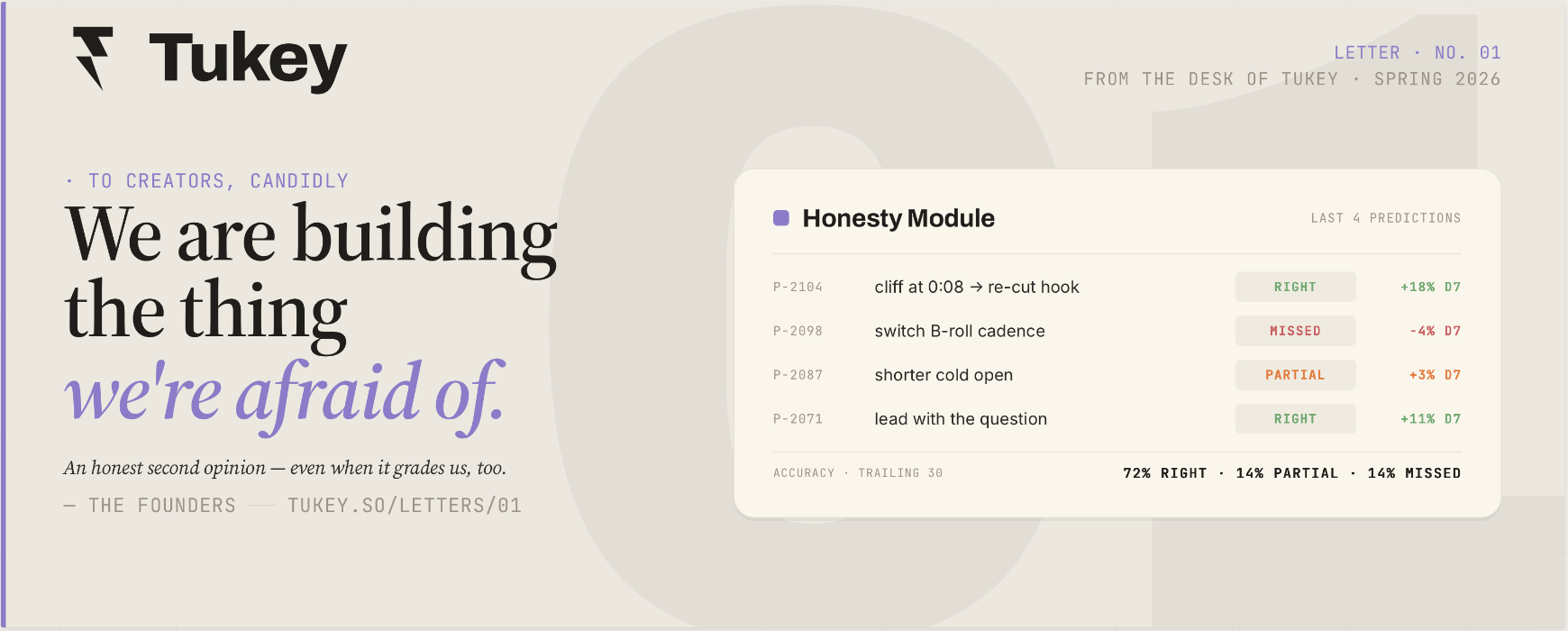
Tukey connects to a creator's channel. It reads their caption transcripts. It runs a dialogue that ends with something filmable: a script in their actual voice, a thumbnail direction scored against their CTR history, and a pre-publish prediction about how the video will perform.
Then it grades itself.
Every prediction logged. Every miss published. Publicly.
We call it the Honesty Module. It's not a feature we added because it tested well. It's the founding idea. An AI that admits when it's wrong is more useful and more trustworthy than one that doesn't.
Here's what actually scares us.
We are building exactly the kind of tool that could make the voice problem worse, if we get it wrong.
If Tukey's voice calibration is mediocre, if the scripts it produces are good but not quite right, creators will publish them anyway. Because the output is close enough and they're tired. And a thousand creators publishing AI-assisted scripts that are 80% their voice will slowly, collectively, sand off the edges of what made each of them distinct.
We are aware of this. We think about it constantly. The Honesty Module is partly our answer to it. A commitment to tell creators the truth about what Tukey is getting right and wrong, so they can use their own judgment about when to trust it and when to ignore it.
But the deeper answer is that the only way to not make this worse is to be obsessed with calibration quality. Not good enough. Indistinguishable from the creator's own voice, or we don't ship it.
If you make YouTube videos and you've ever felt like the tools you use don't actually know you, that your effort and your results aren't connected in the way you'd expect, that you'd rather know the truth about your content than be handed one more cheerleader, then this is for you.
Specifically, the first twenty of you.
We're onboarding the first 20 design partners in June. Free access for three months in exchange for honest feedback. Not beta testers. People whose reaction will shape what Tukey becomes.
If you're a creator in the 10K to 500K range, making finance, education, or tech content, and you want in, click the link to sign up.
No pitch deck. No demo required. Just a real conversation about whether this solves a real problem for you.
I'm building @TukeyAI. It helps YouTube creators find what's already working in their niche before they film. Check what topics are pulling outsized views right now.