Tukey vs VidIQ: Which Actually Writes Better YouTube Scripts?
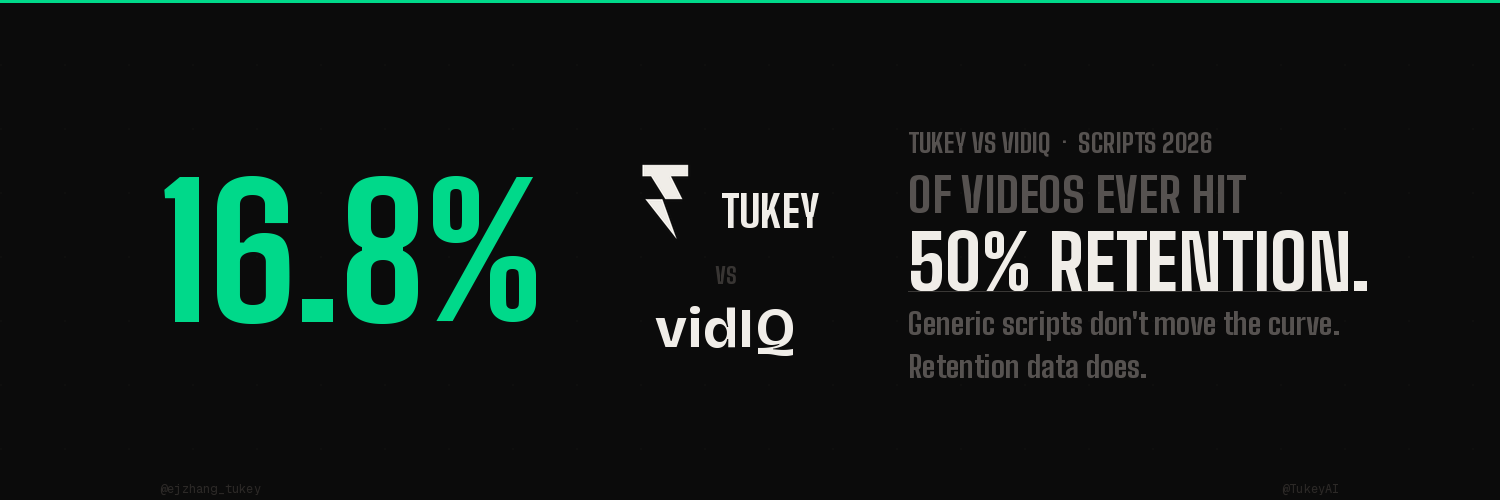
Only 16.8% of YouTube videos ever surpass 50% average view duration. One tool addresses that problem directly. The other generates a draft and hopes for the best.
Only 16.8% of YouTube videos ever surpass 50% average view duration. The other 83.2% lose their audience somewhere in the middle, and in most cases, the script is why.
The question isn't whether you're using an AI script tool. More than 1 million YouTube channels now use AI creation tools every single day. The question is whether your script tool knows anything about YOUR audience before it starts writing.
That's exactly where Tukey and VidIQ split.
What VidIQ Does (and Where It Stops)
VidIQ is primarily a research and optimization platform. Keyword research, competitor analysis, daily video ideas, title scoring: it covers the intelligence layer well. The AI Script Writer is a newer addition, and it works the way you'd expect from a research-first platform.
You input a title or topic. The tool generates a full script in roughly 3 minutes: intro, talking points, transitions, closing call-to-action. You can toggle tone and pacing with a single click. Free users get one script per day. The Boost plan runs $16.58 per month on annual billing.
The output is usable. But independent reviewer analyses flag the same pattern consistently: the scripts read "generic in voice and occasionally repetitive in structure." The most cited verdict: treat it like an outline helper, not a final script.
Here is the deeper issue. VidIQ's script writer uses your channel's niche context and upload history. It does not have access to your retention curve. It cannot see where your specific audience exits at the timestamp level, so it cannot know which hook structures have historically held your viewers past the 2-minute mark.
It writes the same structural script for every channel in your niche. That gets you to a draft. It does not get you to a retention curve.
What Tukey Does Differently
Tukey starts from different data. Instead of generating from a title input alone, Tukey pulls your channel's actual retention analytics and uses them to shape the script from the first sentence.
That distinction matters more than it sounds. A personal finance channel with an audience of 35-to-44-year-old professionals has different drop-off behavior than a personal finance channel targeting recent college graduates. Same niche. Different cliff points. A script written for one audience will leak the other.
Tukey maps your hook to your specific 30-second retention curve. It places pattern interrupts at your channel's actual drop-off timestamps, not at a category average. Research shows that pattern interrupts placed every 90 seconds can lift average view duration by 15 to 25 percent. But only if they land before the exit happens, and that means knowing your timestamps, not the benchmark.
The script isn't a generic draft you customize. It's a retention document built from your audience's demonstrated behavior.
A note on why we built Tukey AI
Before Tukey existed, I was spending hours manually cross-referencing retention graphs with my scripts, trying to figure out where I needed to restructure a hook or add a re-engagement beat. Pull analytics from one tab, write in another, lose track of which drops were flukes and which were structural problems.
The founding insight was simple: every piece of data you need to write a better script already exists in your channel analytics. No one had built a tool that actually read it before writing.
tukey.ai
Head-to-Head: Script Quality Comparison
Let's be specific about the difference.
Input
VidIQ takes a title or topic and generates from broad YouTube knowledge. No channel-specific data enters the generation process.
Tukey takes a title and cross-references it against your channel's retention history. The script gets anchored to real performance data from your own videos.
Hook Construction
The steepest viewer drop-off on YouTube happens between seconds 10 and 20. The effective hook deadline is approximately 15 seconds, not 30. Top-performing videos retain 70% or more of their audience through the first 30 seconds. Reaching that benchmark requires a hook built around your specific cliff point, not the category average.
VidIQ writes an intro. Tukey writes a hook calibrated to your channel's actual 15-second drop-off behavior.
Mid-Video Pacing
Pattern interrupts placed at the right timestamps lift average view duration by 15 to 25 percent. "Right timestamps" means YOUR timestamps, derived from your retention graph, not from what works in a benchmark study.
VidIQ structures content with general best practices. Tukey structures content around your drop-off curve.
Output Quality
VidIQ gives you a workable draft. Expect significant rewriting to match your voice and to place structural beats where your audience actually needs them.
Tukey gives you a script that already accounts for where you lose people, structured to hold them through those moments.
Who Should Use VidIQ, Who Should Use Tukey
Use VidIQ if:
You are starting from scratch and don't yet have meaningful retention data. You need keyword research, title scoring, and competitor trend analysis as a core part of your workflow. You want a rapid draft outline to get unstuck on a topic before investing more time.
Use Tukey if:
You have 10 or more published videos and enough retention data to analyze. You are trying to push average view duration past 40%, where YouTube's recommendation algorithm lift becomes measurable and compounding. You want a script built for your audience's demonstrated behavior, not a niche template.
The practical inflection point is 10 to 20 published videos. Before that threshold, there isn't enough data to optimize against. After it, ignoring that data means leaving your most valuable workflow asset unused.
Can You Use Both? (The Stack Play)
Yes. They serve different stages of pre-production, and they do not compete for the same job.
VidIQ handles the general layer: topic selection, keyword targeting, title performance forecasting, competitive landscape mapping. This is where the platform is genuinely strong, and where most beginners use for the services.
Tukey handles the deeper layer: taking the world context and trending topics into topics tailored for you and producing a script calibrated to retain your specific audience through the video.
The workflow looks like this. Use VidIQ to find the broad search and onboarding, validate the keyword, and benchmark the competition. Then upgrade to Tukey and start from ideation, to data analysis, and then write the script with your channel's retention data built into the structure.
You are not replacing VidIQ. You are adding the one layer VidIQ does not have.
Verdict
VidIQ's script writer gets you to a usable draft fast. If you are early-stage and not yet optimizing against retention data, it does the job well enough to get started.
If you want a script built for your audience and your drop-off curve, VidIQ does not have that capability. Tukey does.
The question isn't which tool writes better scripts in the abstract. It's which tool writes better scripts for YOUR channel. That answer depends entirely on whether the tool can see your data before it writes a single word.
FAQ
Does VidIQ write full YouTube scripts?
Yes. VidIQ's AI Script Writer generates complete scripts from a title or topic input, including intro, talking points, transitions, and a closing call-to-action. Free users get one script per day. The Boost plan runs $16.58 per month on annual billing and unlocks expanded generation capacity. Tone and pacing are adjustable with a single click.
What is the difference between Tukey and VidIQ for scriptwriting?
VidIQ generates scripts using general YouTube best practices and your channel info. It does not have access to your retention curve or timestamp-level drop-off data. Tukey goes deeper in customized understanding your channel, it generates scripts using your channel's actual retention analytics, shaping hooks and pattern interrupts around your audience's specific drop-off behavior. The core difference: category-level structure versus retention-calibrated scripting built from your own data.
Is there a better script writing tool than VidIQ for YouTube?
For retention-optimized scripting built from your channel's actual data, yes. Tukey AI uses your retention analytics to shape pacing, hooks, and mid-video structure at the timestamps where your specific audience exits. VidIQ's script tool is a capable general-purpose drafting aid but does not use your channel's performance history in the generation process. You can try Tukey at tukey.ai.
How quickly does scripting quality affect YouTube retention?
Retention gains from scripting improvements compound over time. Channels that improve average retention by 10 percentage points see a correlated 25% or more increase in impressions from YouTube's recommendation algorithm. The effect compounds further because viewers who stay past the 30-second mark exit at a significantly lower rate through the rest of the video.
One tool knows your niche. One tool knows your channel. That is the only comparison that matters.
My name is EJ Zhang, the CEO at Tukey AI , a production workspace built in your voice. It learns your beliefs and creative fingerprint, surfaces pre-trending topics tailored to you, helps you create with originality, predicts performance before you publish, and learns from every result to make smarter recommendations over time.