Tukey vs Subscribr: Which AI Writes Retention-Optimized Scripts?
One uses your channel's actual retention graph. The other uses niche templates. Here is what that difference costs you.
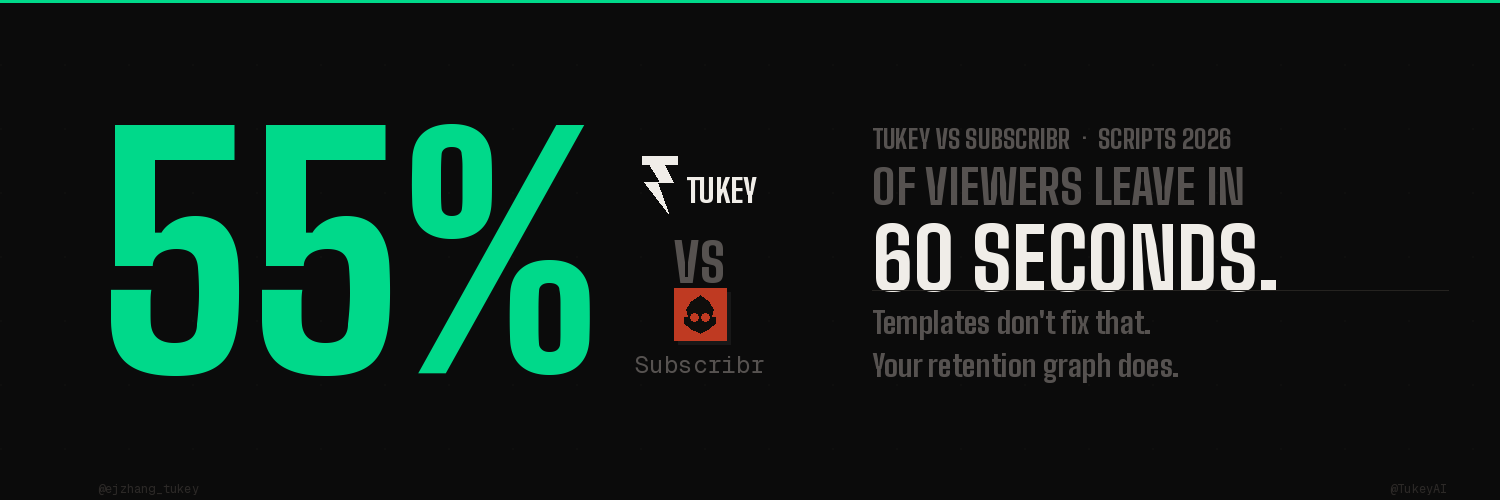
55% of YouTube viewers leave within the first 60 seconds. That is the drop-off window every script has to fight against, and the tool you use to write that script determines whether you win or lose it.
Two AI tools are trying to solve this: Tukey and Subscribr. Both write YouTube scripts. Both claim to improve retention. The way they go about it is completely different.
This is not a feature list comparison. It is a model comparison. The inputs are different. The outputs are different. And depending on where your channel is right now, one of them will be worth the money and one will not.
Subscribr's Approach to YouTube Scripts
Subscribr builds scripts from the outside in.
It starts by analyzing your existing uploads and scanning competitor channels for outlier videos, videos getting 5x to 10x more views than the niche average. From that data, it extracts hook patterns, pacing rhythms, and structural frameworks you can replicate.
The script engine works from one of 157 proven formats: Problem-Agitation-Solution, storytelling arc, educational breakdown, listicle, and more. You pick the framework, feed it your topic, and Subscribr generates a structured draft with a hook, narrative beats, engagement cues, and chapter markers.
It also trains on your voice. After you run a few scripts through the platform, it learns how you phrase things and injects that into future outputs. Most creators finish their first script in 10 to 20 minutes.
The result: scripts that follow patterns which have historically worked in your niche.
The limitation: the patterns come from what worked for other channels, not what works for your specific audience.
A Subscribr user in the game theory niche grew to nearly 11,000 subscribers running scripts through the platform. One creator reported achieving 54% audience retention on their latest Subscribr-assisted video. Those are real results. They are also niche-average results: benchmarked against what the template says should work, not against what your viewers have already told you.
Tukey's Retention-Informed Scripting Model
Tukey builds scripts from the inside out.
The core input is not niche templates or competitor data. It is your channel's actual audience retention graph: the exact timestamps where your viewers drop off, rewatch, or keep watching. That curve is specific to your channel. No other creator on YouTube has the same one.
Tukey reads that graph and uses it to shape the structure of the script before a word is written. Where should the hook land? At the drop-off point your audience hits hardest. Where should the pattern interrupt go? Wherever your retention graph shows the mid-video valley. Where should the payoff arrive? At the moment your data says viewers start checking out.
This is the key distinction. Subscribr calibrates against the niche. Tukey calibrates against your audience.
For a channel at 1,000 subscribers with six months of retention data, that gap is measurable and it shows up in the analytics.
Side-by-Side: Script Quality Breakdown
Here is what the output difference looks like in practice.
| Feature | Subscribr | Tukey |
|---|---|---|
| Hook placement | Template-driven | Positioned at your channel's actual drop-off second |
| Pattern interrupts | Framework-based (157 formats) | Mapped to your mid-video retention valleys |
| Voice matching | Trained on your past uploads | Trained on your past uploads |
| Data source | Competitor outliers + your existing videos | Your channel's audience retention analytics |
| Personalization ceiling | Niche-level | Channel-level |
| Script length supported | Up to 60 minutes | Structured around your data depth |
Subscribr gets you to a solid script fast. If your channel is new and you have no retention data to mine, that is often the right call.
The numbers explain why the ceiling matters. Good hooks hold 80 to 90% of viewers through the first 30 seconds. Poor hooks drop viewers to 40 to 50% remaining at that same mark. Improving your average audience retention by just 10 percentage points correlates with a 25% or greater increase in impressions from the algorithm.
Subscribr places a hook where the template says to place one. Tukey places it at the specific second where your viewers historically make the decision to leave or stay.
That is a different product category wearing the same name.
Pricing Comparison
Subscribr runs on annual billing only. The entry plan is $59 per month, but at that tier the feature set is limited to basic idea generation. The functional plan starts at $99 per month: 20 script credits per month, single channel, single user, full feature access. Tiers scale up from there, topping out around $300 per month for unlimited channels, unlimited users, and 400 script credits. A $7 trial is available for the first seven days.
Tukey pricing is available at tukey.ai. The model is built around channel data depth rather than credit volume. A channel with 50+ published videos and six months of retention analytics will extract significantly more from Tukey than a brand-new channel with nothing to analyze. That context should shape which plan makes sense for where you are.
The honest pricing comparison: Subscribr charges for script volume. Tukey charges for script intelligence. If you are producing 20 scripts a month and want them done fast, Subscribr's credit model makes sense. If you are producing 4 scripts a month and want each one built on what your audience has already shown you, Tukey's data model is the better fit.
Verdict: Which Tool for Which Creator Stage
Choose Subscribr if: Your channel is 0 to 6 months old. You have fewer than 20 published videos. You need a structural framework to learn script discipline before you have meaningful retention data. At $99 per month, Subscribr functions as a production accelerator: blank page to publishable draft, fast, with niche-proven structure.
Choose Tukey if: Your channel has data. You have published 20+ videos and six months of analytics. Your retention graph has a story, and you are ready to use it. If your average view duration is stuck under 40% and you are not sure which part of your script is causing it, Tukey reads the graph and structures the next script around that information.
The honest read: Subscribr makes good scripts. Tukey makes scripts specific to your audience. The difference matters more the longer you have been on the platform.
If you are choosing between them and your channel has real retention data, Tukey wins the comparison that matters: not which tool writes faster, but which tool writes scripts calibrated to the viewers who actually showed up.
A note on why we built Tukey AI
We spent months watching creators hit a wall. They had retention data in YouTube Studio. They had a graph that told them exactly where viewers were leaving. And then they went to write the next script using a template that had nothing to do with that graph.
The founding insight was simple: your channel's retention curve is the most honest feedback your audience can give you. A script AI that ignores it is leaving the most important signal on the table.
Tukey was built to close that gap. The retention graph is not a post-publish report. It is the input.
tukey.ai
FAQ
Tukey vs Subscribr: which is better for YouTube scripts? Subscribr is better for newer channels that need proven frameworks and niche-level structure to get started quickly. Tukey is better for channels with retention analytics to work from, because it calibrates every script element to your specific audience's behavior, not to templates. If your channel has 20+ videos and a readable retention graph, Tukey is the stronger choice for scripting.
What does Subscribr actually do? Subscribr analyzes your existing uploads and competitor outlier videos, then generates full YouTube scripts using one of 157 structural frameworks: Problem-Agitation-Solution, storytelling arc, educational breakdown, and others. Scripts come with hooks, narrative beats, engagement cues, and chapter markers. The platform trains on your writing voice over time and injects it into future outputs. Most users finish a first draft in 10 to 20 minutes.
Is Subscribr worth it in 2026? Subscribr is worth it for creators who need to produce scripts at volume and do not yet have enough retention data to optimize from. At $99 per month for 20 script credits on annual billing, it delivers professional-level script structure efficiently. It becomes less competitive once your channel has meaningful retention analytics, which is the point where behavior-based scripting tools pull ahead. The $7 trial makes testing low-risk before committing to an annual plan.
How does Tukey use retention data to write scripts? Tukey reads your channel's audience retention graph, the curve showing where viewers drop off, rewatch, or stay, and uses those timestamps to determine where hooks, payoffs, and pattern interrupts belong in your next script. Instead of placing a hook at a given timestamp because a framework says so, Tukey places it at the second where your viewers historically decide to leave or stay. The graph is the input. The script is the output calibrated to that graph.
What is the best AI for YouTube scripts in 2026? It depends on your stage. New channels with little data: a template-based script AI with niche-outlier analysis gets you to your first solid scripts fast, and Subscribr does that well. Established channels with six or more months of retention analytics: a data-informed tool like Tukey closes the gap between scripting well and scripting specifically for the people who actually watch your channel. The best AI for YouTube scripts in 2026 is the one with the most specific data about your viewers.
If your channel has the retention data and you are ready to stop scripting by template, Tukey was built for that moment.
My name is EJ Zhang, the CEO at Tukey AI, a production workspace built in your voice. It learns your beliefs and creative fingerprint, surfaces pre-trending topics tailored to you, helps you create with originality, predicts performance before you publish, and learns from every result to make smarter recommendations over time.