Tukey vs Spotter Studio: Ideation Tool vs Script Writer
Why the tool that finds your next video idea and the tool that writes it are solving different problems, and which one you actually need.
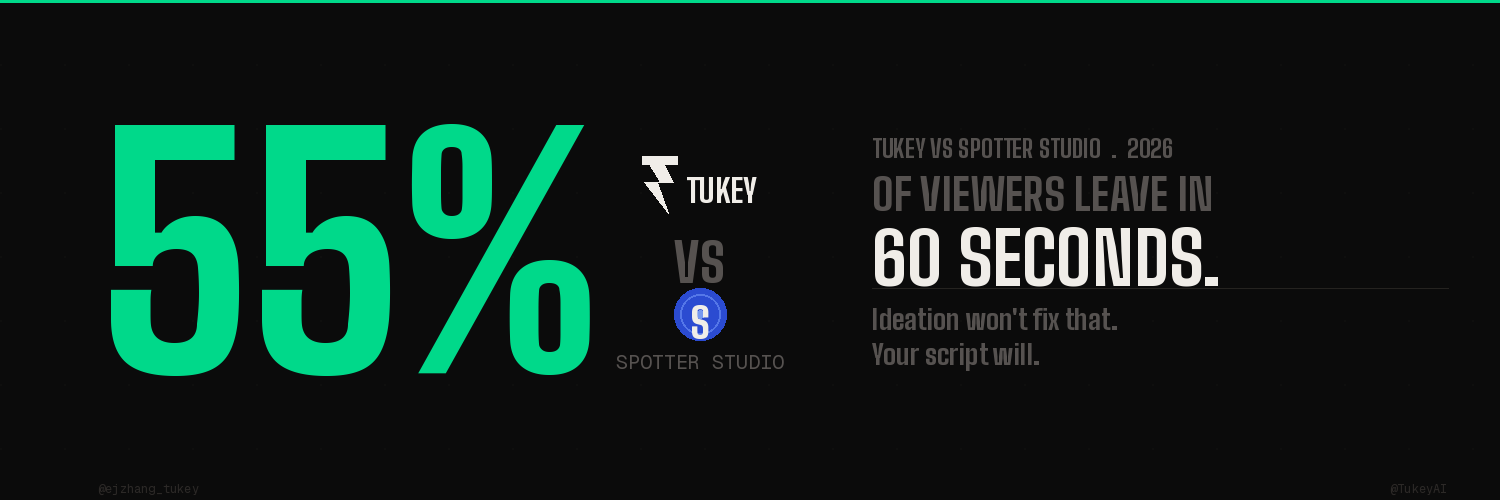
55% of YouTube viewers are gone before the 60-second mark.
That is not a discovery problem. By the time someone bounces in the first minute, they already found you. They clicked the thumbnail, read the title, and gave you a chance. What drove them out was the script.
This is the line that separates Tukey from Spotter Studio in 2026. One answers "what should I make next." The other answers "why are viewers leaving in the first 90 seconds." The most common mistake creators make right now is buying the first tool when the second problem is what is actually killing their channel.
The phrase "tukey vs spotter studio" comes up a lot in creator forums, usually from someone who signed up for Spotter Studio, liked what it did for their ideas, and then realized their retention graph still looked the same. This article is for that creator.
What Spotter Studio Actually Does
Spotter Studio is a YouTube ideation platform. It launched from Spotter, a company that has deployed over $1 billion in creator financing, and the product reflects that institutional knowledge of what makes a channel scale.
The core product is a brainstorming and research layer. You connect a YouTube channel, and Spotter Studio generates AI video concepts, tracks outlier videos (content that significantly overperforms against a channel's historical baseline), and gives you a collaborative workspace for production planning. Title scoring, thumbnail testing, and concept ranking are all built in.
At $49 per month, you get one channel connection, unlimited AI concepts, outlier tracking, a project planner, and 2 collaborator seats. An annual plan runs $299, which works out to about $24.92 per month.
The tool works for what it was designed for. Spotter's own beta data showed creators getting a 49% increase in views during the first 7 days compared to videos made without the platform. That number almost certainly reflects better concept selection upstream, because that is exactly what Spotter Studio was built to improve.
What Spotter Studio does not do: write your script. The moment you have decided what to film, the product has completed its job.
Where Spotter Studio Ends and Scripting Begins
There is a specific moment in every creator's workflow where an ideation tool hands off and leaves you alone.
You have a validated concept. The title scored well. You have a thumbnail direction. You open a blank Google Doc.
Now what?
This is where the retention problem lives. Only 16.8% of YouTube videos ever surpass the 50% audience retention mark. The overall platform average sits at 23.7%. Those numbers are not about topic selection. Nobody finds a video with a great title and clicks it thinking they will stop at 22 seconds. They stop because the script lost them. The hook did not deliver. The setup ran too long. The payoff was buried.
Spotter Studio is designed for the problem that sits upstream of all that. It helps you decide what to make. It cannot tell you how to open your video in a way that locks your specific audience into the next 7 minutes.
This is not a criticism. It is a clear map of what the product was built for. The scripting stage is a different job, and the tools that solve it look completely different from an ideation suite.
Most creators who are comparing spotter studio scripts output with AI writing tools are really asking the wrong question. Spotter Studio does not claim to produce scripts. The search for a "spotter studio scripts" feature is itself the signal that you have run out of room with ideation and need the next layer.
Tukey's Role in the Script Stage
Tukey is an AI copilot that watches your YouTube channel and the reference channels you add to it. Every hook and script it writes draws on what it observes across that content.
That one sentence is doing a lot of work. Most AI writing tools start from a blank context window. They do not know your channel. They cannot see that your top-retention videos all open with the result first, not a question. They do not know that your audience tends to bounce at the setup beat if the payoff is more than 90 seconds away. They have never seen your retention graph.
Tukey builds that profile from your actual data, then writes against it.
The scripting workflow runs beat by beat. You ask for a hook or a full script. Tukey generates a structured, timestamped draft shaped around your channel's retention patterns. You edit inline, and each revision saves as a new version you can step back to. If you are reviewing the M4 MacBook Pro and your top-performing videos open with a direct result statement, the hook Tukey generates reflects that. Not because it was told to. Because it studied what worked.
Tukey also monitors reference channels in parallel. If three channels you track all uploaded on the same topic in the same week, Tukey surfaces the overlap and tells you what has already been said. You write to the gap.
For creators where the script stage is the actual bottleneck, this is the tool designed around that constraint. The spotter studio vs ai writer comparison misframes the problem: they are not competing on the same output. Spotter validates ideas. Tukey writes the video.
A note on why we built Tukey AI
I spent a long time looking at flat retention graphs without understanding exactly why they were flat. The outlier data told me what topics to chase. The thumbnail tools told me what images to test. And then I would sit down to write the script and produce the same video structure I always had, get the same drop-off around the 55-second mark, and go back to the drawing board.
The problem was not that I lacked ideas. It was that nothing had watched my videos and learned from them. Every AI writing tool started from a blank context window with no memory of what had worked. I needed something that built on the data sitting in my own channel's history, not something trained on a generic YouTube formula.
Tukey is what I built instead.
tukey.ai
Pricing: Spotter Studio vs Tukey
Spotter Studio's pricing is public and straightforward. $49 per month for the full product. $299 per year ($24.92 per month) for creators committed to a longer run with it.
At $49 a month, the product is priced for channels where concept validation and team collaboration are worth that line item. The deal-making DNA that built Spotter's brand attracts mid-to-large creators where the ideation layer genuinely pays for itself in fewer wasted production days.
Tukey is in early access. The waitlist is open at tukey.ai, and the product is currently invite-only while the team onboards new users. Pricing is positioned below Spotter Studio's tier, specifically because Tukey handles one stage of the workflow instead of the full ideation and production management stack. Creators who do not need the influencer deal intelligence layer, the team collaboration seats, or the production calendar do not pay for any of it.
For a creator asking whether Spotter Studio is worth it, the right question is not "Spotter versus Tukey." It is "where is my workflow actually breaking." If the bottleneck is picking the right idea, $49 a month for Spotter Studio is a rational decision. If the bottleneck is what happens after the idea is picked, the cheaper and more focused tool is at the scripting stage.
Who Should Use Spotter, Who Should Use Tukey
Use Spotter Studio if you have a team working on content, your bottleneck is deciding which video to make next, and you want structured outlier data to validate concepts before you film. The project planner and collaborative seats make it particularly useful for channels where more than one person is involved in production decisions. If systematic ideation is the problem, $49 a month is reasonable.
Use Tukey if you have plenty of ideas but your retention graph looks like a ski slope in the first 90 seconds. The script stage is where your workflow breaks. You want AI that has watched your videos specifically and writes in your voice. You are at an earlier stage of growth where a full ideation suite feels like overhead you have not earned yet. The scripting problem is real and it is costing you algorithmic reach with every video that drops below the 50% retention mark.
Use both if your workflow has two separate bottlenecks. Spotter Studio to find and validate the concept. Tukey to write the script against your channel's retention patterns. The tools do not overlap and the handoff is clean.
The spotter studio alternative question most creators are actually asking is not about replacing Spotter. It is about finding what comes after Spotter in the workflow.
FAQ
Does Spotter Studio write YouTube scripts? No. Spotter Studio is an ideation and workflow planning tool. It generates video concepts, tracks outlier videos, tests title and thumbnail options, and manages your production calendar. The product stops at the planning stage. Once you know what video to make, script writing requires a separate tool or process. Spotter Studio allows for manual outlining inside the workspace but does not automate script generation. If you are looking for AI-generated scripts, that is a different category of tool.
What is a cheaper alternative to Spotter Studio for scripting? Tukey is built specifically for the scripting and retention stage of YouTube content creation, at a price point below Spotter Studio's $49 per month. Unlike general AI writing tools, Tukey watches your specific channel and writes scripts in your voice based on your actual retention patterns. If scripting is your bottleneck rather than ideation, Tukey is the more focused and more affordable option. Join the waitlist at tukey.ai.
What is the core difference in the Tukey vs Spotter Studio comparison? Spotter Studio is an ideation tool. It helps you decide what video to make next using outlier data, concept scoring, and title analysis. Tukey is a scripting tool. It watches your channel and reference channels, then writes hooks and full scripts based on what has held your specific audience's attention before. They solve problems at different stages of the creator workflow and are not direct substitutes for each other.
Can I use Spotter Studio and Tukey together? Yes. The two tools sit at adjacent stages of the same workflow. Spotter Studio handles the front end: concept validation, outlier research, title scoring. Tukey handles the scripting stage: hook writing, beat-by-beat script structure, retention-matched pacing. The outputs of one feed naturally into the other, and many creators will find the combination is more effective than either tool alone.
Why do 55% of viewers leave in the first 60 seconds of a YouTube video? Audience retention studies from 2026 show the first 60 seconds as the highest drop-off window across the platform. In most cases, this is a scripting failure, not a discovery problem. The viewer already clicked, which means the title and thumbnail did their job. Early drop-off happens when the hook does not deliver on the implicit promise of the title, or when the setup runs long before showing the viewer why they should keep watching. This problem cannot be solved with better ideation. It requires a better script.
Does Tukey work for creators who are earlier in their channel growth? Tukey learns from your specific channel's videos and the reference channels you add. The more content you have, the stronger the pattern recognition. For creators with a few months of consistent uploads and enough data to see what is working, Tukey can build a useful retention profile and write to it. Tukey is designed with growth-stage creators in mind, not just large channels. You do not need to be established to have a scripting problem worth solving.
Two different tools, two different jobs. Which one you need depends entirely on where your workflow is actually breaking.
My name is EJ Zhang, the CEO at Tukey AI, a production workspace built in your voice. It learns your beliefs and creative fingerprint, surfaces pre-trending topics tailored to you, helps you create with originality, predicts performance before you publish, and learns from every result to make smarter recommendations over time.