Tukey vs Google Gemini for YouTube Scripts in 2026
Why the Google-YouTube connection gives Gemini a real advantage for discovery, and why it still misses the one variable that determines whether your audience watches to the end.
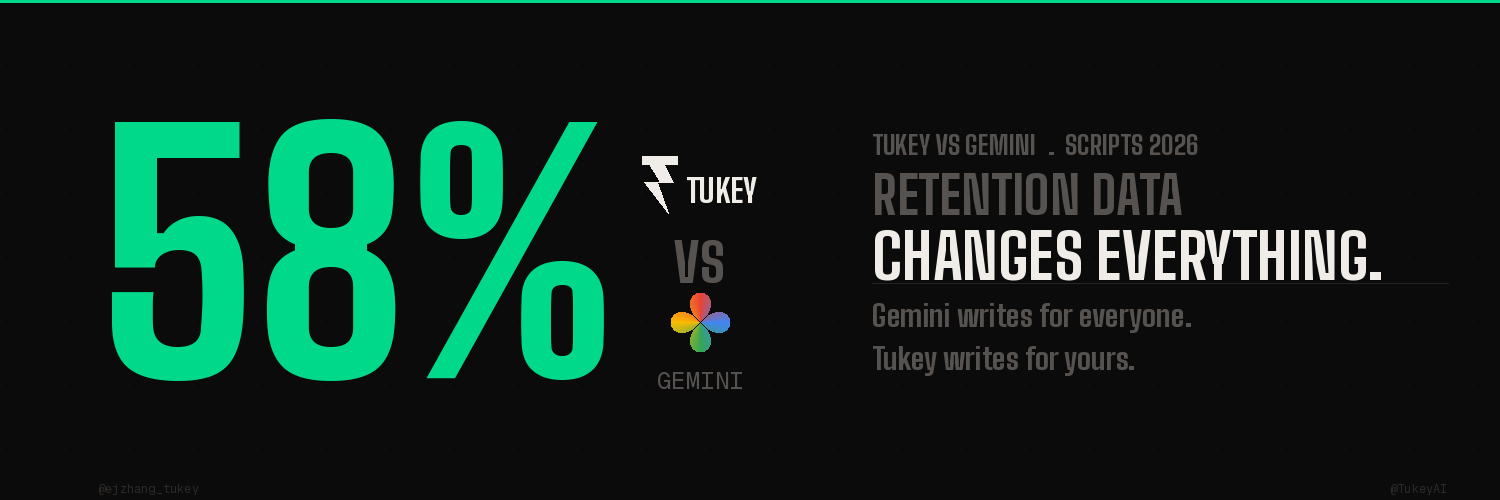
Videos that hold more than 65% of viewers through the first minute see 58% higher average view duration across the rest of the video. That number comes from Retention Rabbit's 2025 benchmark of over 10,000 YouTube channels. Gemini can help you write a compelling first minute. It cannot tell you whether your first minute is currently strong enough, because it has never seen your retention graph.
That single gap is what this comparison is actually about.
Does Gemini Have YouTube-Native Advantages?
Yes. The advantages are real and worth taking seriously.
Gemini is built by Google. Google owns YouTube. In 2026, that relationship is showing up in concrete product integrations.
YouTube's AI-powered auto-dubbing, powered by Gemini, expanded to all creators in February 2026 across 27 languages. During the pilot program, creators saw more than 25% of their watch time come from non-primary language viewers. YouTube Creator Partnerships now uses Gemini to match brands with creators by analyzing channel tone, audience similarity, and subscriber growth across more than 3 million partner accounts. YouTube Topic Insights, Google's open-source trend tool, runs on Gemini's content understanding to turn raw video data into actionable trend signals before you script a single word.
For SEO and discoverability, the structural advantage is significant. Gemini's real-time Google Search grounding means that when you optimize a YouTube title or description, you can pull current search intent data in ways that a standalone general AI tool cannot.
If your goal is getting your video found, Gemini has a legitimate edge.
The question is what happens after someone clicks.
What Gemini Can and Can't Do for Creators
Gemini 2.0 Flash, released with Canvas in late 2025, introduced an interactive drafting environment for YouTube scripts. You generate a first draft, refine sections, adjust tone, change length, and iterate without re-prompting from scratch. For a general content workflow, that is capable and fast.
Here is what Gemini actually does well for YouTube scripts:
Drafts full scripts from a topic prompt. Grounds facts in real-time Google Search. Analyzes YouTube videos you paste in as context. Processes long-form inputs including full transcripts. Iterates quickly through Canvas with tone and format adjustments. Understands general hook principles and YouTube structure.
Here is what it does not do:
Read your channel's audience retention graph. Know where your specific audience drops off. Adjust hook density based on your channel's actual first-minute hold rate. Structure pacing around your personal average view duration benchmark. Flag the specific scene transitions where your viewers have historically stopped watching.
The first list is about what Gemini knows generally. The second list is about what it knows specifically about you.
That distinction is the entire comparison.
The Missing Retention Layer
The Retention Rabbit 2025 benchmark report tracked over 10,000 YouTube videos across more than 1,000 creators. Its data is specific. Videos with a clear value proposition in the first 15 seconds see 18% higher retention at the 1-minute mark. The 23.7% average view duration across YouTube is not a ceiling; it is a baseline that separates channels that understand script structure from those that do not.
Gemini does not have access to your retention graph. It cannot see your channel's current first-minute hold rate. It does not know if your audience typically collapses at the 2:30 mark, just before your first major point lands, or at the 45-second mark where many creators lose their audience right after the hook resolves without a bridge.
A creator with a 35% first-minute hold rate needs a completely different opening structure than a creator holding 72%. The hook format, the value reveal timing, the transition density, and the first pattern interrupt all have to shift based on that behavioral baseline.
Gemini produces scripts based on general best practices for the topic you describe. It is writing for the average YouTube viewer. Not for your audience.
That is not a failure of Gemini. It is simply not what Gemini was built to do. A general-purpose AI with a document editor does not have a mechanism to ingest your channel analytics and reflect that data in script structure. You would have to manually export your retention curves, translate what you saw into prompt language, and re-enter that context every single time you start a new script. Every draft starts from zero behavioral context.
Most creators skip that step. The script looks good. The retention graph tells a different story.
Tukey vs Gemini: Script Structure Comparison
Here is what the two workflows look like in practice.
With Gemini for YouTube scripts: You describe your topic and audience. Gemini generates a script using general YouTube best practices and current Google Search data. You refine in Canvas. You compare to your retention graph after publishing, manually, and try to adjust for next time.
With Tukey: Tukey reads your channel's retention data before writing. It identifies your specific drop-off windows and your hook performance baseline. It generates a script structured around your channel's behavioral history. The hook density, pacing, and pattern interrupt intervals reflect your actual AVD curves. The script starts from what your audience has already told you about how they watch.
| Script Element | Google Gemini | Tukey AI |
|---|---|---|
| Hook generation | General YouTube best practices | Calibrated to your channel's actual first-minute hold rate |
| Section pacing | Template-based structure | Informed by your specific drop-off intervals |
| Pattern interrupts | Manual prompting required | Positioned at your behavioral decline windows |
| Retention grounding | None | Your channel's AVD curves inform structure |
| Trend and SEO integration | Real-time Google Search | Overlaid on your behavioral context |
| Data setup per script | Manual re-entry each time | Connected directly to your channel |
The primary difference is the direction of information flow. Gemini receives topic prompts and returns scripts based on what works generally. Tukey receives your channel data and returns scripts based on what your specific audience has already shown it responds to.
For creators whose average view duration is stuck, the fix is rarely the writing. It is the behavioral context the writing starts from.
Tukey reads your retention curve before generating a line of script. The hook density, pacing, and structure reflect your channel's actual audience behavior, not a general template of what YouTube viewers typically want.
A note on why we built Tukey AI
I spent months writing YouTube scripts with general AI tools, publishing them, and then opening YouTube Studio to see the same drop-off shape repeating at the same timestamps. The tool had no way of knowing my 2:30 mark was the problem. I had to close one tab, open Studio, try to translate the retention graph into words, re-open the AI, and re-prompt from scratch. The data never actually informed the script. It sat in a different window.
Tukey exists because that translation step should not be manual. If the channel data is there, the tool should read it. The script should start from your behavioral baseline, not from a general template of what YouTube creators are supposed to do.
tukey.ai
FAQ
Can Google Gemini write YouTube scripts? Yes. Gemini writes complete YouTube scripts from a topic prompt, and it does this well for general content. You get a structure that follows common hook and pacing principles, iteratable through Canvas, with real-time Google Search grounding for facts and trend accuracy. What it does not provide is script structure based on your channel's specific audience retention data.
Does Gemini have access to my YouTube channel's retention data? Not natively within the script writing workflow. You can review your retention graphs in YouTube Studio and describe what you observed in your prompts, but Gemini does not connect to your channel analytics directly when generating scripts. That manual translation step adds setup friction and loses the precision that comes from actual curve-level data.
What is the difference between Gemini and Tukey for YouTube scripts? Gemini generates scripts based on the topic you describe plus general YouTube best practices. Tukey generates scripts based on your channel's behavioral data, specifically your audience retention curve, your drop-off windows, and your first-minute hold rate. If your average view duration is under 30%, Tukey can structure scripts to address the specific drop-off patterns your own audience shows.
Does the Google-YouTube connection give Gemini a real script advantage? For metadata, SEO, and discoverability, yes. Gemini's real-time Google Search grounding can help optimize titles and descriptions with current search intent. For script structure and retention performance, that connection is not enough on its own. YouTube does not expose individual creator retention graphs to Gemini's script generation workflow.
Is gemini for youtube scripts a good option for beginners? For beginners without enough channel data to run retention analysis, Gemini is a practical starting point. The Canvas interface is accessible, the output quality is solid for general topics, and the real-time search grounding helps with fact accuracy. Once a channel has 90 or more videos and meaningful retention data, a tool that reads that behavioral history will consistently outperform one that does not.
A general AI tool writes a script. Tukey writes your script.
My name is EJ Zhang, the CEO at Tukey AI, a production workspace built in your voice. It learns your beliefs and creative fingerprint, surfaces pre-trending topics tailored to you, helps you create with originality, predicts performance before you publish, and learns from every result to make smarter recommendations over time.
Follow us on X @TukeyAI or visit tukey.ai
SEO Notes Primary keyword: gemini for youtube scripts LSI keywords used: google gemini youtube creator, gemini youtube script 2026, gemini vs ai youtube tool, youtube audience retention, average view duration, first-minute retention, script structure, youtube channel analytics, retention-informed scripting, pattern interrupts Target featured snippet: "Can Google Gemini write YouTube scripts?"