Tukey vs Claude AI for YouTube Scripts: Which Writes Better?
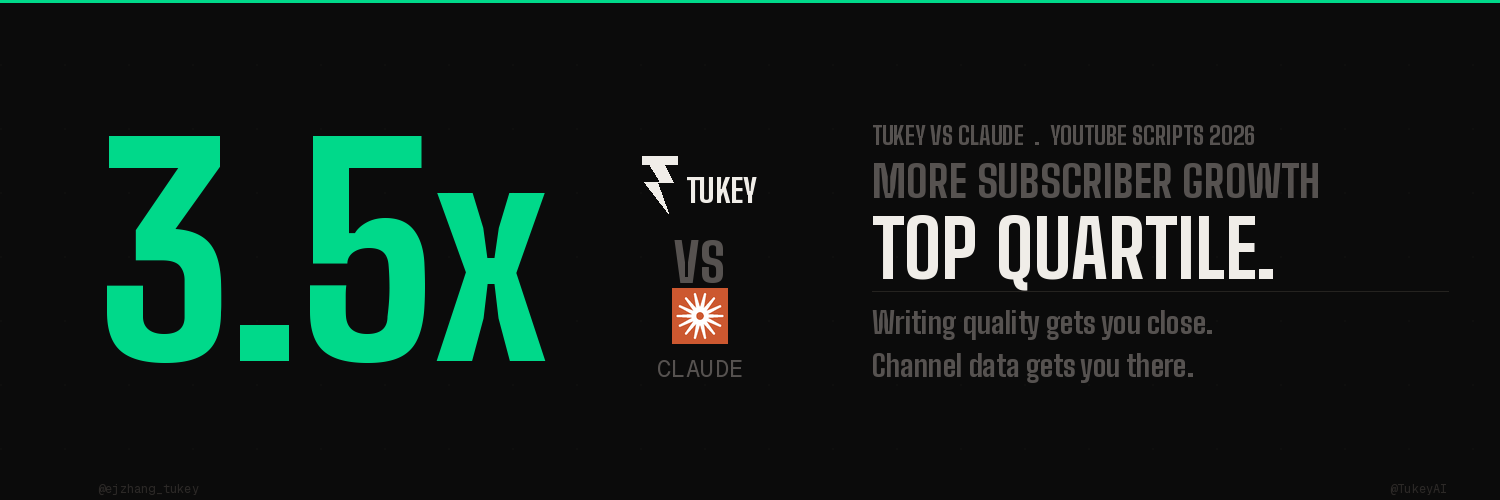
Claude wins on writing quality by almost every measure. Here is why that is not the metric that actually grows your channel.
Channels in the top 25% for audience retention see 3.5x higher subscriber growth. That number comes from Retention Rabbit's benchmark analysis of over 10,000 YouTube videos. The question it raises: which tool puts you in that top 25%?
Claude gets you closer than almost anything else on writing quality alone. Tukey gets you there by combining that writing quality with the behavioral data Claude will never have access to.
This is the full breakdown.
Claude's Strengths as a Writing Model
Claude Sonnet is, by most independent benchmarks, the strongest general-purpose AI writing engine available in 2026.
The technical edge is real. Claude Sonnet maintains thematic consistency across a 20-minute script without losing the argument's thread. It avoids the predictable transition patterns that other models default to. Reviewers consistently find it requires fewer "humanize" edits before a script feels like a person wrote it.
Claude Opus 4.6 goes further. With a 1 million token context window and a 76% score on long-context retrieval benchmarks (up from 18.5% in the prior version), it can synthesize a full channel backlog, a 50-page transcript, or a dense research document into a coherent scripted argument. No other model handles that volume with the same narrative control.
For documentary-style content, video essays, and anything story-driven, Claude is the most capable writing tool on the market. That part is not debatable.
The debate starts when you ask whether writing quality is what determines YouTube performance.
Why Long-Form Quality Isn't Enough for YouTube
YouTube's algorithm doesn't read scripts. It measures viewer behavior.
The platform's baseline is 23.7% average audience retention across all videos. Fewer than 45% of viewers make it past the first minute, regardless of video length. Getting a well-written script does not change those numbers on its own.
What changes the numbers is whether the script structure matches your specific audience's behavioral expectations.
Retention Rabbit's 2025 analysis found that 35% of channels use a structural approach that mismatches their audience type. These are channels writing for a "Dedicated Learner" viewer with slow builds, dense context, and deep dives while actually attracting "Casual Entertainees" who disengage in the first 30 seconds if the pace doesn't match what they came for.
Claude cannot identify that mismatch. It does not know which viewer type subscribes to your channel. It writes for a reasonable generalization of a YouTube viewer, not for the specific people who have already clicked your videos and stuck around.
A 10 percentage point improvement in average retention correlates with a 25% or greater increase in impressions from YouTube's algorithm. That improvement does not come from writing quality alone. It comes from writing that is structurally calibrated to the audience already watching your channel.
Tukey's Retention-Informed Scripting vs Claude's Output
The difference between Tukey and Claude on YouTube scripts is not about writing skill. It is about what information feeds the script before a single word gets written.
Claude works from a blank context unless you provide one. It knows what a YouTube hook is. It knows how to front-load value. It does not know where your audience specifically starts to leave, which pacing signals your viewers respond to, or which structural patterns your top-performing videos share.
Tukey reads your channel data before scripting starts.
It identifies your channel's retention fingerprint: where viewers drop off by the 30-second mark, what percentage make it to your mid-video payoff, which intro structures have produced your strongest retention curves. That behavioral profile becomes the structural specification for the script.
The result is a script built to the viewer who actually watches your channel, not to a generic approximation of a YouTube audience.
Videos with a clear value proposition stated within the first 15 seconds show an 18% higher retention at the one-minute mark, according to Retention Rabbit's 2025 data. Tukey's output is built around this kind of data. It knows your channel's specific version of that first-15-seconds window.
Claude produces the best output when you give it the best context. Tukey provides that context, extracted from your actual channel performance.
Can You Use Claude Inside a YouTube Script Workflow?
Yes. And that is exactly how Tukey is built.
Claude is the writing engine inside Tukey's pipeline. The distinction is that Tukey feeds it your channel's behavioral data as a structural constraint before asking it to write anything.
Without that layer, a single Claude prompt asking for a 10-minute YouTube script produces what the creator community calls the "single-prompt trap": technically complete, structurally sound for an average channel, calibrated to a viewer that is not yours. The output looks like a good script. It performs like a generic one.
With your retention data in the context window, the prompt changes. The script knows your intro window. It knows your audience's attention contract. It knows when to deliver the first payoff because it has seen where your past videos lost viewers before getting there.
The writing quality is still Claude. The structural intelligence is your channel's data.
This is the workflow answer. Not Claude or Tukey. Claude inside Tukey, with your channel's history providing the performance context neither a blank model nor a generic template can replicate.
Verdict: Different Tools, Different Jobs
Claude is the best general AI writing model available. For creators who need high-quality first drafts, narrative consistency, and fewer editing passes, it is the right choice.
It is not a YouTube-specific tool. It has no visibility into your channel's retention curves, your audience's behavioral patterns, or the structural gaps between your best-performing and worst-performing videos. Using Claude alone for YouTube scripting is like hiring the best editor in the world and handing them a blank brief.
Tukey is a retention-informed scripting tool. It uses Claude's writing quality as the output layer, but the input layer is your channel's actual performance data. The script it produces is not just well-written. It is calibrated.
For creators serious about reaching that top 25% retention quartile, where subscriber growth runs 3.5x faster than the platform average, the question is not which model writes better prose. The question is which tool writes scripts that your specific audience watches all the way through.
That answer is not Claude alone.
Your YouTube Scripting Workflow
The fragmented version of this workflow looks like this: pull your analytics manually from YouTube Studio, copy-paste retention numbers into a document, write a prompt that describes your audience based on memory, paste it into Claude, and hope the output structure happens to match what your viewers expect.
That process takes 3 to 4 hours. It misses the behavioral data most creators do not know how to read from their own analytics. And the resulting script is still calibrated to a manual interpretation of your channel, not to the retention curve itself.
Tukey closes that gap directly. It reads your channel data, identifies your retention fingerprint, and produces scripts where the structural decisions, hook length, pacing, payoff placement, mid-video re-engagement windows, are driven by what your actual viewers have already shown they respond to.
A note on why we built Tukey AI
I spent weeks watching the same pattern play out. Scripts that read well on paper, written in Claude, polished, coherent, technically strong. And then the retention graphs came back. The cliff at 40 seconds. The drop at the 3-minute mark. The same structural problems, over and over, because the script was written for a hypothetical viewer instead of the one who actually subscribed.
The founding insight was simple: Claude doesn't know your channel. Your channel data does. The solution wasn't to replace Claude. It was to put your channel's behavioral history in front of it before asking it to write anything.
That's what Tukey does.
tukey.ai
FAQ
Is Claude good for YouTube script writing? Yes. Claude Sonnet is one of the best general AI writing models for long-form content. It produces natural-sounding scripts with strong narrative consistency and requires fewer editing passes than most alternatives. The limitation is that it has no visibility into your specific channel's retention data, audience behavioral patterns, or drop-off points. It writes for a general YouTube viewer, not for the specific audience already subscribed to your channel.
Does Claude use YouTube Studio data when writing scripts? No. Claude writes from the context you provide in the prompt. It does not connect to YouTube Studio, read your retention graphs, or identify where your specific audience drops off. Without that data in the prompt, it defaults to general scripting best practices for an average channel. Tools like Tukey integrate channel analytics into the scripting process before Claude writes anything.
Can tukey vs claude ai youtube performance be improved with better prompts? Better prompts help, but they do not solve the structural data gap. You can give Claude detailed instructions about your audience. What you cannot give it is a behavioral analysis of your actual retention curves, your channel's viewer type classification, and the structural patterns from your top-performing videos. That data has to come from your channel analytics, not from a prompt description.
What is retention-informed scripting and how is it different from standard AI scripting? Standard AI scripting uses a writing model to produce a script based on a topic brief. Retention-informed scripting reads your channel's historical retention data first, identifies your audience's specific behavioral patterns, and uses those patterns as structural constraints before writing starts. The difference shows up in the first 30 seconds of a video, which is where most channels lose viewers and where most AI scripts fail to calibrate correctly.
Does Tukey use Claude AI to write scripts? Yes. Claude is the writing engine inside Tukey's pipeline. Tukey's differentiation is the data layer that feeds into Claude before output is generated. Your channel's retention curves, audience persona signals, and structural performance data become the context for the prompt. Claude writes the script. Your channel data determines its structure.
Which is better for YouTube: tukey vs claude ai for youtube scripting? For raw writing quality, Claude Sonnet is best in class. For YouTube performance, Tukey outperforms because it combines Claude's writing quality with your channel's behavioral data. The two are not in competition. Tukey uses Claude inside its workflow. The question is whether you want Claude writing from a blank context or from your channel's actual retention fingerprint.
My name is EJ Zhang, the CEO at Tukey AI, a production workspace built in your voice. It learns your beliefs and creative fingerprint, surfaces pre-trending topics tailored to you, helps you create with originality, predicts performance before you publish, and learns from every result to make smarter recommendations over time.
Follow us on X @TukeyAI or visit tukey.ai
SEO Notes Primary keyword: tukey vs claude ai youtube LSI keywords used: claude youtube script, anthropic claude youtube creator, claude vs youtube tool, retention-informed scripting, YouTube audience retention, channel data scripting, YouTube script writing AI, viewer retention benchmark, Claude Sonnet long-form, YouTube algorithm scripting Target featured snippet: "Is Claude good for YouTube script writing?"