YouTube Hook Formula: Stop the Scroll in 3 Seconds
How to engineer the first 3 seconds of any YouTube video to stop the scroll, command attention, and send exactly the right signals to the algorithm.
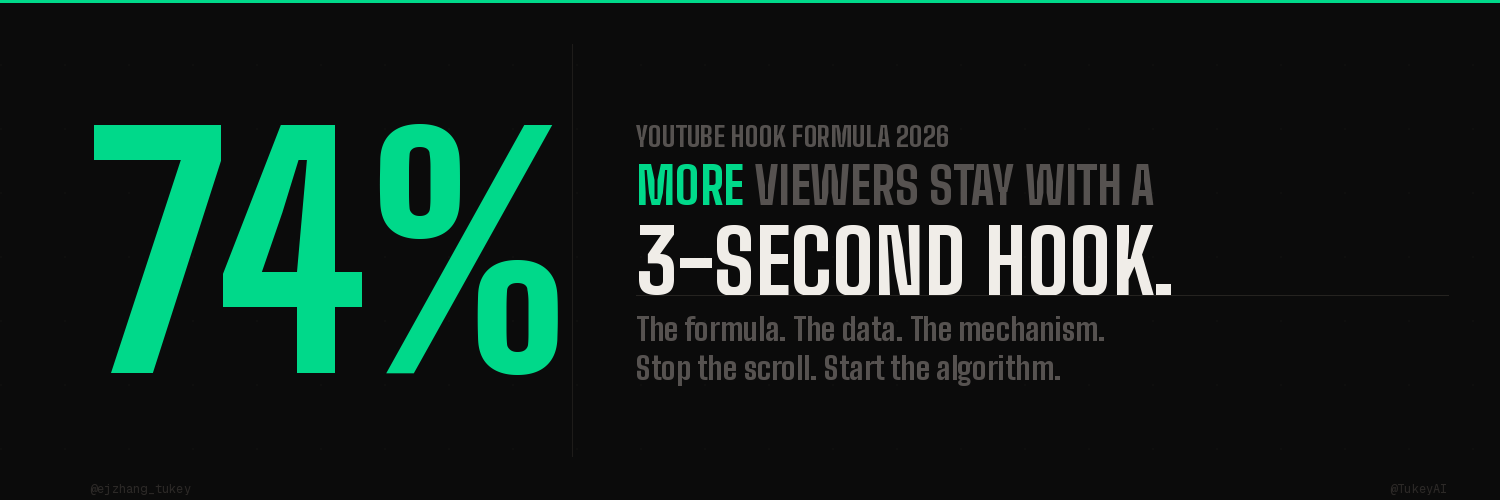
74% more viewers stay past the first 3 seconds when a video opens with a deliberate hook instead of a slow intro.
Most creators spend hours on their thumbnails. They run keyword research for their titles. They re-edit the middle of their video three times. Then they open with "Hey guys, welcome back to the channel."
That sentence is where the video dies.
The YouTube hook formula is not a soft best practice. It is the single highest-leverage decision in video production, backed by audience retention data from millions of videos, and it fits inside 8 to 12 seconds of runtime.
Most Creators Are Losing Half Their Audience Before They Say Anything Interesting
The average YouTube video retains only 23.7% of its total audience. Not across a specific niche. Across all of YouTube.
The first 60 seconds account for most of that damage. A 2025 Retention Rabbit benchmark study tracking hundreds of channels found that 55% of viewers drop out before the one-minute mark, regardless of video length.
Here is the number that matters most: 71% of viewers make their keep-or-leave decision in the first 3 seconds. Not the first 30. Not after the intro music fades.
The first 3.
Shorts data makes this precise. An analysis of 3.3 billion YouTube Shorts found that 50 to 60% of all viewer drop-off happens in that exact window. The videos that cleared it, specifically those achieving a "Viewed vs. Swiped Away" rate between 70 and 90%, saw outsized distribution. Anything under 60% VVSA collapsed quickly in the recommendation system.
For long-form video, the threshold is slightly more forgiving but the principle is identical: if you are not holding 65% or more of your audience at the 30-second mark, the algorithm is reading your video as low-quality content and pulling distribution.
The mistake most creators make is treating the hook as the thing that comes after they greet the audience. The hook is not after the intro. The hook is the intro.
Why the Brain Decides in 3 Seconds
The human brain did not evolve to watch YouTube. It evolved to scan for threats and rewards, fast.
When someone scrolls a feed, their visual cortex processes stimuli at roughly 400 milliseconds per item. Less than half a second per thumbnail. When a video starts playing, the brain immediately runs a binary evaluation: "Is this relevant to me, or is this wasted time?" It does not wait for context. It reads the first signal and assigns a probability.
This is why pattern interrupt hooks work. Research from Stanford's Neuroscience Institute shows that when the brain detects something that violates its expectation, it triggers a 0.3-second attention grab. The brain stops its default processing and reallocates attention to the anomaly. That pause is the hook doing its job.
The curiosity gap works through a different mechanism. When a hook creates an information gap, it triggers what psychologists call an "open loop," a state of unresolved narrative tension that stays active in working memory. This is the Zeigarnik effect: people are compelled to complete what has been left unfinished. A hook that poses a specific, incomplete question keeps the viewer watching because their own brain is actively seeking resolution.
Stanford's dopamine research adds another layer. Uncertainty about reward timing increases dopamine production. A hook that implies a reward without immediately delivering it generates more dopamine than one that explains everything upfront. "I grew my channel 6x without posting more" outperforms "In this video I'll show you how I grew my channel" for this exact reason.
The first version says: there is something unexpected here. The brain wants to know what.
The Data: What Strong Hooks Actually Produce
These numbers come from creator analytics, platform benchmark studies, and multi-channel analysis published between 2024 and 2026.
| Metric | Weak Hook (slow intro) | Strong Hook (first 3 seconds) |
|---|---|---|
| Viewers still watching at 30 seconds | Under 40% | 70%+ |
| Average view duration lift vs. baseline | 0% | +58% |
| Engagement rate vs. baseline | 0% | +340% |
| Retention at 1-minute mark vs. baseline | 0% | +18% |
The +58% average view duration lift comes from the 2025 Retention Rabbit benchmark study. Channels that held more than 65% of their viewers through the intro correlated with that figure across the rest of the video.
The +340% engagement figure comes from a multi-platform analysis of hook-first versus intro-first video openings, comparing like-for-like content from the same creators over a testing period.
For Shorts specifically: videos with an immediate hook in the first 2 seconds retain 19% more viewers compared to those with a slow start. Google's internal data shows that Shorts with average view durations above 85% are twice as likely to be promoted on the Shorts shelf.
One more number worth building your production around: 60% of mobile viewers watch with sound off. If your hook exists only in your spoken words and not in what appears on screen, you are already losing more than half your mobile audience in the first frame.
The 4 Hook Formulas That Stop the Scroll
Not every hook type fits every video. These are the four that data consistently shows working across niches, with the mechanism behind each.
Formula 1: The Pattern Interrupt
Open with something that violates what the viewer expects to see or hear. This does not mean random or chaotic. It means starting at the most unexpected moment in your story, usually the result, before any setup.
Structure: Start in the middle of an action or result. No context. No greeting. No "in this video."
Example opening: "I deleted 247 videos last month. My channel grew faster than it had in two years."
Why it works: The brain expects a greeting. When it receives a result instead, it pauses to process. Casual entertainment audiences show a 60% drop-off in the first 30 seconds when intros are slow, versus only 35% for dedicated learners who arrived specifically for the content. The pattern interrupt closes that gap by removing the slow part entirely.
Formula 2: The Curiosity Gap Hook
Open with an incomplete statement. Give the viewer part of the information, but withhold the key piece. Never fully resolve the hook in the first sentence.
Structure: Hint at something counterintuitive, then create a gap. The gap must be specific, not vague.
Example opening: "The one change that took my retention from 28% to 61% has nothing to do with editing."
Why it works: The brain now has an open loop. It will remain in a state of low-grade cognitive tension until the loop closes. "Nothing to do with editing" rules out the obvious answer, which forces the brain to generate its own hypotheses. Those hypotheses are what keep the viewer watching, because they want to find out if they were right.
Formula 3: The Bold Claim Hook
State something that sounds too specific or too surprising to ignore. Statistics work especially well here because they carry the specificity that makes a claim feel real and the surprise that creates cognitive dissonance.
Structure: Lead with the number. Everything else is context.
Example opening: "74% more viewers stay when you change just the first 3 seconds. Most creators never touch those seconds."
Why it works: The viewer arrives with a prior belief, something like "a few seconds can't matter that much." The specific data point creates dissonance. Dissonance requires resolution. Resolution requires continuing to watch.
Formula 4: The In-Medias-Res Hook
Start your video mid-sentence, mid-action, or mid-story. You are already inside the scene when the viewer arrives.
Structure: No setup. Skip the origin story entirely. Open at the peak of tension or the most interesting moment of the sequence.
Example opening: "...and that is when I realized the whole strategy was wrong." Then: "Let me back up two months."
Why it works: The viewer has been placed inside the story before they decided to enter. Leaving now means abandoning a story they are already inside. The "let me back up" move also functions as a retroactive value promise: the viewer now expects to learn what led to this moment.
The 3-Part Hook Architecture
Every effective hook, regardless of type, has three components. They sometimes collapse into one or two sentences. But all three elements need to be present for the hook to fully function.
Part 1: The Statement. One sentence. Contains your hook type. No warmup. No greeting. The video starts here.
Part 2: The Proof Point. One sentence. A specific number, result, or scene that validates the statement. This converts initial skepticism into genuine attention. Without this, the bold claim becomes a vague claim.
Part 3: The Promise. One sentence. What the viewer gets by watching to the end. This must be specific, not vague. "By the end of this video you will have the exact 3-part hook formula with data" beats "I'm going to show you some cool tips today" by a wide margin.
Total time budget for all three parts: 8 to 12 seconds. That is enough runway to deliver all three without overstaying the welcome in the hook phase. Starting the body of the video sooner is always better than padding the hook.
How to Build the Hook Before You Build the Video
Most creators script the hook last. That is backwards.
The hook is the hypothesis. The rest of the video is the proof. If you do not know your hook before scripting the video, you do not know what you are proving.
Step 1: Define your payoff first. What is the single most useful, surprising, or actionable thing in this video? Write that down in one sentence. That sentence is probably your hook.
Step 2: Choose your hook type. Is the payoff better delivered as a bold claim, or does the journey to it make a better curiosity gap? Pick the type that makes the payoff feel most incomplete in the first sentence.
Step 3: Write the 3-part architecture. Statement, proof point, promise. Budget 8 to 12 seconds. Do not go longer.
Step 4: Validate with your intro retention metric. After publishing, check the audience retention graph in YouTube Studio. Look at the first 30 seconds. Above 65% at the 30-second mark means the hook is working. Below 50% at 30 seconds means the hook is broken, not the rest of the video.
Step 5: Iterate on the hook before changing anything else. The hook is the cheapest variable to test. Unlike the video body, the thumbnail, or production quality, you can test a different opening by re-exporting the first 15 seconds and uploading a corrected edit. Many creators find their hook was the only thing limiting distribution on an otherwise strong video.
The Fastest Path to Finding Hooks That Already Work in Your Niche
Building hooks from first principles is one approach. Analyzing what already works in your specific niche is faster and more reliable.
The manual version: find the top 10 videos from your niche in the last 6 months that significantly outperformed their channel average. Watch the first 15 seconds of each. Note the hook type, the opening sentence structure, and the proof point used. Build a swipe file. Write hooks that follow the same structural patterns, not the same words.
This works. But it is slow. Identifying genuine outliers means cross-referencing video views against a channel's baseline, watching enough of each video to log the hook, and doing this across enough examples to see a pattern. For a creator publishing weekly, that research load competes directly with production time.
Tukey AI is built for exactly this workflow. It surfaces top-performing outlier videos in any niche, shows how much they over-indexed against the channel's baseline, and lets you analyze hook structure and opening frames across a batch of videos in a single session. Instead of spending two or three hours building a hook swipe file manually, you get the niche pattern in minutes and can redirect that time into scripting.
The output is not a list of trending videos. It is structured research into what your specific niche rewards, which makes the hook formulas above something you can calibrate to your actual audience instead of applying generically.
A note on why we built Tukey AI
When I started analyzing top-performing videos for hook patterns, the process was fragmented and slow. Find a video that seemed to outperform. Check if it was actually an outlier against the channel's baseline, or just a lucky upload on an otherwise small channel. Watch the first 30 seconds. Log the hook type. Cross-reference with similar content. Repeat across 20 or 30 videos before a real pattern appeared.
The founding insight was simple: every top creator in a niche is already running experiments on what hooks work. Their retention graphs are public signals. The open question was whether those signals could be read systematically across a whole niche instead of one video at a time.
That is what Tukey does.
tukey.ai
FAQ
What is the YouTube hook formula for the first 3 seconds? The most effective YouTube hook formula has three parts: a statement (using one of four structures: pattern interrupt, curiosity gap, bold claim, or in-medias-res drop-in), a proof point (a specific number or result), and a promise (what the viewer gets by watching to the end). All three should fit inside 8 to 12 seconds total. The statement must land in the first 3 seconds, before any greeting or intro music.
Does the YouTube algorithm actually measure what happens in the first 3 seconds? Yes, and the signal is explicit. YouTube tracks "intro retention" as a distinct segment in your audience retention graph under YouTube Studio Analytics. Channels that hold more than 65% of viewers through the first 30 seconds see, on average, 58% higher average view duration across the rest of the video. For Shorts, the recommendation system weights the "Viewed vs. Swiped Away" ratio, which measures exactly this window. Anything under 60% VVSA on Shorts collapses distribution.
What YouTube hook formula works best for Shorts? For Shorts, the Pattern Interrupt and the In-Medias-Res hook perform best because the scroll speed is higher and the attention window is tighter. A 2025 analysis of 3.3 billion YouTube Shorts found that the optimal "Viewed vs. Swiped Away" range is 70 to 90%. Videos with slow or greeting-based openings consistently fall below 60% in that window. For Shorts, the hook needs to land within the first 2 seconds, not 3.
How do I know if my YouTube hook is working? Open YouTube Studio and check your audience retention graph for the first 30 seconds. Above 65% retention at the 30-second mark means your hook is functional. Below 50% means the hook is the problem, not the video body. You can also check the intro retention segment specifically, which isolates the performance of the opening before the algorithm would start distributing the video more broadly.
How long should a YouTube hook be? 8 to 12 seconds for long-form videos. For Shorts, 2 to 3 seconds maximum. The hook ends the moment you have delivered the statement, proof point, and promise. Starting the main body of the video sooner is always better than extending the hook. Hooks that run 20 to 30 seconds function as slow intros, not hooks.
Can a strong hook compensate for a weak video body? No. A strong hook raises retention in the first 30 seconds but cannot hold viewers through weak content in the middle. What it does is give a good video the distribution it deserves. Many strong videos fail in the algorithm because the hook does not clear the 65% threshold for initial recommendation. A better hook on the same content clears that threshold. The video then has to do its own work from there.
Strong hooks do not save weak videos. But weak hooks bury strong ones every day. The first 3 seconds are the only thing standing between your content and the algorithm's distribution engine. Fix those seconds first.
My name is EJ Zhang, the CEO at Tukey AI , a production workspace built in your voice. It learns your beliefs and creative fingerprint, surfaces pre-trending topics tailored to you, helps you create with originality, predicts performance before you publish, and learns from every result to make smarter recommendations over time.