Popularity Is Not Opportunity: Why Most YouTube Videos Land Flat Before They're Finished
The reason good uploads fail has almost nothing to do with how they look, and almost everything to do with what happens in the first 60 seconds.
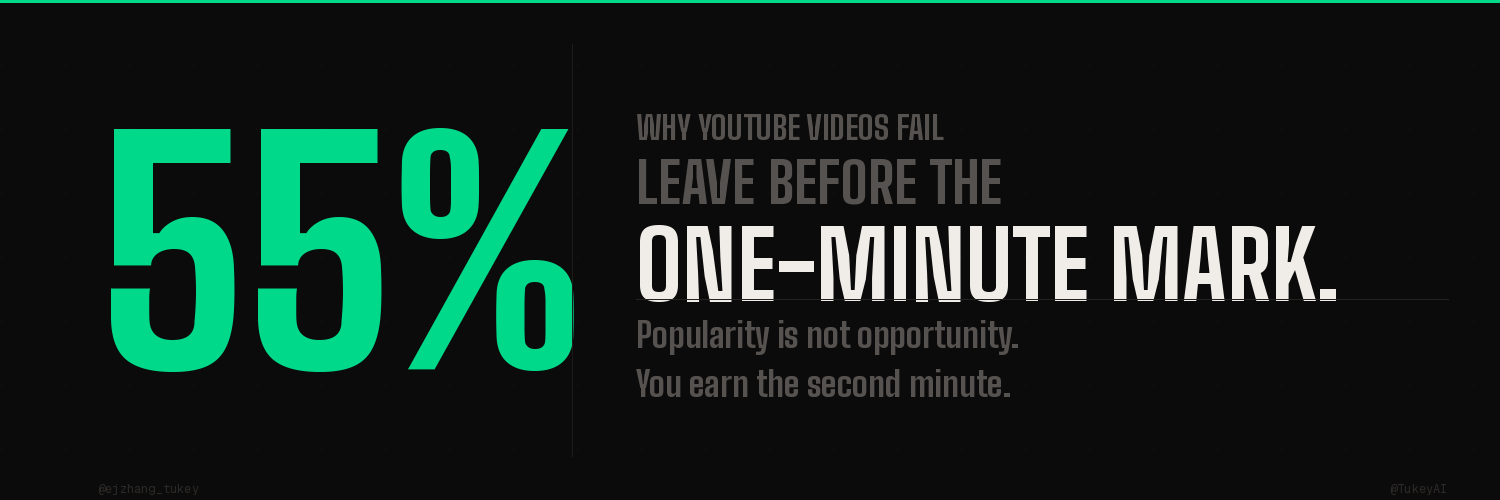
More than half the people who click your video leave before the one-minute mark.
That is not a niche problem or a beginner problem. Across the platform in 2026, fewer than 45% of viewers make it past the first minute, regardless of how long the video is or how clean the production looks. So 55 out of every 100 clicks are gone before the real content even starts.
This is the gap nobody warns you about. You can have a sharp thumbnail, a title that pulls the click, lighting that looks professional, and a video that still goes nowhere. The click happened. The opportunity did not.
That is the whole idea behind a belief we keep coming back to at Tukey: popularity is not opportunity. A click is popularity. A view that stays, finishes, and tells the algorithm "show this to more people" is opportunity. They are not the same thing, and most creators are optimizing for the wrong one.
Why Do YouTube Videos Fail Even With Good Production?
Here is the short answer, because this is the question people actually type and ask out loud: YouTube videos fail when the opening does not deliver on the promise in the title fast enough, so viewers leave before retention can build, and the algorithm stops recommending the video. Production quality does not fix this. A robotic voice, flat pacing, or a weak script structure pushes early drop-off higher even when the camera work is great.
Production is the thing creators can see, so it is the thing they spend on. Retention is invisible until after you upload, so it gets ignored. That mismatch is why polished videos die quietly.
The platform does not rank what looks good. It ranks what holds attention. Those are different skills, and only one of them shows up in the edit.
The Popularity Trap on YouTube
The popularity trap is simple to fall into. You watch a video pull 80,000 views and you assume it worked. You see your own video stall at 2,000 and you assume it failed. Views become the scoreboard.
But views are the least useful number on your dashboard. They tell you a thumbnail and title did their job. They tell you nothing about whether the video earned its next recommendation.
Consider two videos. One has 100,000 views and a 30% average view duration. The other has 10,000 views and a 70% average view duration. The second one is worth far more to your channel, because YouTube reads deep watching as a signal to push the video further. The first one looks popular and is quietly dead.
This is why chasing a viral upload is a bad youtube video strategy. Virality is a spike. Retention is a system. One feeds your ego for a week. The other compounds for a year.
The Mechanism: What the Algorithm Actually Rewards
The recommendation engine is not trying to reward you. It is trying to keep the next viewer happy. Every choice it makes is downstream of that.
When someone clicks your video, the algorithm runs a small test. It shows the video to a limited pool and watches what they do. Do they stay? Do they finish? Do they come back, share, or watch another of your videos right after?
If the early signals are weak, the test ends. The video is not punished in some dramatic way. It is just not promoted. It lands flat, and you never find out why because the views number does not explain itself.
Two numbers carry most of the weight here. Average view duration now sits at roughly three times the importance of total views in how the system reads a video. And viewer satisfaction signals, things like repeat views, shares, and returns, have been pushed above raw watch time as the primary input. Both of those are decided in the part of the video most creators barely script: the opening.
The Data: Where Videos Actually Die
The numbers are blunt once you look at them.
| Signal | What the data shows in 2026 |
|---|---|
| First-minute survival | Fewer than 45% of viewers make it past 60 seconds |
| Weak hook threshold | A 40%+ drop in the first 30 seconds usually means the hook failed |
| Recommendation cutoff | Lose ~70% in the first 30 seconds and the algorithm stops pushing the video |
| Value claim timing | Scripts that deliver a clear value claim by second 15 retain ~52%; those that do not retain ~44% |
| Healthy retention band | Strong videos hold 35% to 75% average retention depending on length and niche |
Read that value-claim line again. The difference between a script that states what the viewer gets by second 15 and one that does not is about 8 points of retention. Eight points decides whether the algorithm keeps testing or quietly shelves you.
None of this is about your camera. All of it is about the first 15 to 60 seconds of your script and how honestly your opening pays off the promise in your title.
The Roadmap: How to Stop Landing Flat
You do not fix this in the edit. You fix it before you record. Here is the order that actually works.
1. Pay off the title in the first 15 seconds. Whatever the title promised, deliver a piece of it immediately. No channel intro, no "before we get started," no slow build. State the value claim out loud early.
2. Script the first 60 seconds line by line. This is the only part of the video where a 5% improvement changes everything downstream. Treat it like the most important 60 seconds you will write all week, because it is.
3. Study retention, not views, on your own videos. Pull the retention graph. Find the exact second where people leave. That timestamp is a sentence in your script that did not earn its place. Fix the sentence, not the lighting.
4. Study what already retained, not what already went viral. Find videos in your niche that held attention, then reverse-engineer their opening structure. A video that went viral on a fluke teaches you nothing. A video that consistently retains teaches you the pattern.
5. Build the whole video to answer one question. Drift kills retention in the middle as much as a weak hook kills it at the start. If every section does not push the viewer toward the payoff, they leave.
The Tools: The Fastest Path From Click to Retention
Here is the honest problem with the usual workflow. You open a keyword tool in one tab, an outlier finder in another, a spreadsheet to track what worked, and a blank document to write the script. None of those tools talk to each other. None of them connect "this opening retained well" to "so write your opening like this."
So you end up doing the synthesis by hand, late at night, guessing. The manual research stack can tell you what is popular. It cannot tell you what will hold attention, and it definitely cannot turn that into a script.
That gap is the reason we built Tukey AI. Tukey looks across channels, not just one video at a time, finds the openings and structures that actually retained viewers, runs the retention analysis you would otherwise do by eye, and turns the pattern into a script you can record. It connects the research to the writing, which is the step every other tool leaves to you.
The point is not to find another popular video to copy. The point is to find the structure that earns the next recommendation, and to write from it. That is the difference between popularity and opportunity, built into the workflow.
A note on why we built Tukey AI
I spent more nights than I want to admit with six tabs open, trying to reverse-engineer why one video held viewers and the next one lost them at second 40. The data was there. It was just scattered across tools that did not talk to each other, and none of them ever turned the answer into a script I could actually record.
The insight that started Tukey was small and a little annoying: every creator is researching popularity when the thing that actually grows a channel is retention, and no tool was built to research that and write from it.
tukey.ai](https://tukey.ai)
FAQ
Why do YouTube videos fail even with good production? Because production quality does not control retention. Videos fail when the opening does not pay off the title fast enough, viewers leave in the first 30 to 60 seconds, and the algorithm stops recommending the video. A weak script and flat pacing raise early drop-off no matter how good the footage looks.
Is popularity the same as opportunity on YouTube? No. Popularity is a click or a view. Opportunity is a view that stays and finishes, which is what tells the algorithm to recommend the video further. A video with 10,000 views at 70% retention is worth more than one with 100,000 views at 30% retention.
What is the popularity trap on YouTube? The popularity trap is treating views as the scoreboard. Views only prove your thumbnail and title worked. They say nothing about whether the video held attention, so creators keep optimizing the click and ignore the retention that actually drives growth.
How much retention is good on YouTube in 2026? Strong videos hold roughly 35% to 75% average retention depending on length and niche. A 40% or larger drop in the first 30 seconds is a sign the hook failed, and losing about 70% in the first 30 seconds usually means the algorithm will stop recommending the video.
Why do my uploads not perform even when they look professional? Most likely your first 60 seconds. Fewer than 45% of viewers get past the one-minute mark, so if your opening does not deliver the title's promise by second 15, you lose more than half your audience before the content starts. Fix the opening script before anything else.
What is a better YouTube video strategy than chasing views? Build for retention. Script the first 60 seconds line by line, deliver a clear value claim by second 15, study the retention graphs on videos that consistently held attention, and write your opening from that structure rather than copying whatever went viral.
Conclusion
Stop counting clicks and start earning the second minute.
My name is EJ Zhang, the CEO at Tukey AI, a production workspace built in your voice. It learns your beliefs and creative fingerprint, surfaces pre-trending topics tailored to you, helps you create with originality, predicts performance before you publish, and learns from every result to make smarter recommendations over time.