How to Find YouTube Outlier Video Ideas That Work
The exact research process top creators use to identify concepts with proven viral demand, before they ever hit record.
500 hours of video are uploaded to YouTube every single minute.
That is 82 years of new content every day. Your next video competes against 30,000 hours of fresh uploads created in the same hour it goes live. In that environment, guessing what to make is not a strategy. It is a coin flip with a very bad payout.
The creators who consistently break through are not more creative than you. They are more systematic. They have built a research process around finding YouTube outlier video ideas before filming starts, using data that is already sitting in public view on the platform.
This is that process.
What a YouTube Outlier Video Actually Is (Most Creators Get This Wrong)
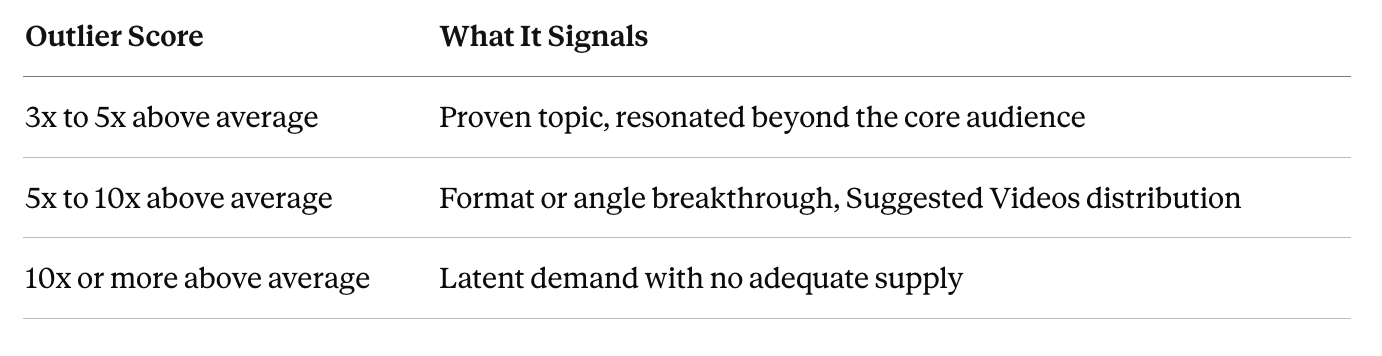
An outlier video is any video that performs significantly above its channel's average. Not just a good video. Significantly above.
The thresholds look like this:
The mistake most creators make is measuring success by raw view counts. A video with 500,000 views on a 10 million subscriber channel is underperforming badly. That same video on a 20,000 subscriber channel is a career-defining moment.
Outlier score is always relative to the channel baseline. That is the only number that matters.
The Mechanism Behind Why Outlier Research Works
YouTube's algorithm does not push content randomly. It amplifies what is already working.
When a video earns a higher click-through rate than other videos on the same topic, the algorithm shows it to more people. When those additional viewers watch a higher percentage of the video, the algorithm pushes it further. The compound effect is what creates the 10x, 30x, and 100x outlier moments.
Here is what most creators miss: an outlier video is proof of demand. It proves that a specific angle, framing, or topic had more latent audience interest than anyone expected. That demand does not evaporate after the original video peaks.
If anything, it deepens. The original creator captured part of the audience. The rest is still out there.
A finance channel with 50,000 subscribers averages 5,000 views per video. One video about 529 college savings plans hit 150,000 views. That is a 30x outlier. The signal is precise: tens of thousands of people were actively searching for this content and finding nothing good.
Every other creator in that niche could have built a series around that signal. Most never looked.
The Data Behind Outlier Performance
Numbers over narrative. Here is what the research shows.
The upload volume problem is worse than most creators realize. In 2007, 6 hours of video were uploaded to YouTube per minute. Today that number sits at 500 hours per minute, an 80-fold increase in under two decades. The platform now hosts over 800 million videos reaching 2.7 billion monthly users who watch more than 1 billion hours per day.
Content without a proven concept behind it is invisible by default.
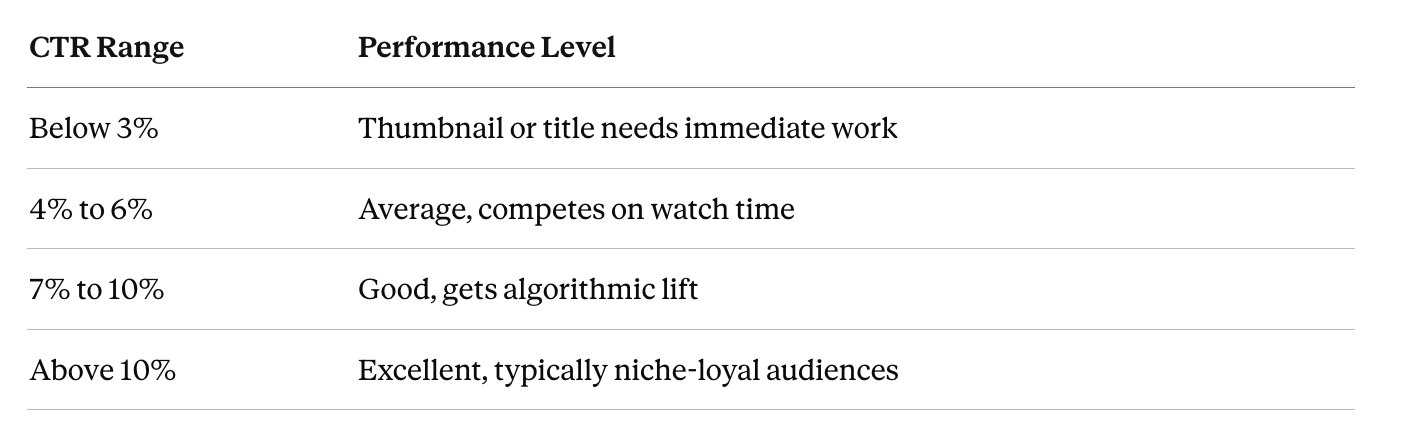
Click-through rate benchmarks by tier:
What each outlier tier means for distribution:
A 5x to 10x outlier typically indicates that a video broke out of the creator's existing subscriber base and started appearing in Suggested Videos for non-subscribers. The algorithm found a broader audience that clicked. That is not luck. That is the topic doing the work.
A 10x outlier or above is rarer and more significant. It means a large audience existed for this idea and was not being well served. The video stepped into a gap. Creators who study these signals consistently find that the same gaps exist across multiple channels simultaneously, which is the cross-channel pattern that makes outlier research so powerful.
How to Find YouTube Outlier Video Ideas Step by Step
This is the actual process. Not theory. The exact steps.
Step 1: Build Your Research Channel List
Search YouTube for 5 to 10 channels in your niche with between 50,000 and 500,000 subscribers. You want channels big enough to have meaningful data, but not so large that their outliers are driven by celebrity brand gravity rather than content quality.
These are your research targets.
Step 2: Establish Each Channel's Baseline
Pull the last 20 to 30 videos for each channel and calculate the average view count. An outlier finder tool like vidIQ, OutlierKit, or ViewStats does this automatically and shows the multiplier next to each video.
You are looking for the floor: what does a normal week look like for this channel? The baseline is the reference point everything else is measured against.
Step 3: Flag the Videos That Broke the Pattern
Sort videos by views, highest to lowest. Any video at 3x or more above the baseline is worth investigating. Any video at 10x or more above the baseline is a priority signal.
Write down the title. Describe the thumbnail. Note the upload date. Note the view count multiplier.
Step 4: Cross-Reference Across All Five Channels
Here is where most creators stop short, and where most of the value is.
One outlier on one channel could be luck, a news cycle hit, or a one-time algorithm quirk. The same topic or angle producing outliers across three different channels is not coincidence. That is latent demand you can go build.
Go through all five to ten channels on your list. Count how many produced outlier results on variations of the same concept. If four out of five channels hit 5x or above on similar ideas, you have found your next video.
Step 5: Find the Angle That Has Not Been Made Yet
Outlier research is not about copying. It is about finding the gap.
Once you know the proven topic, look at the top five videos on that subject. What angle is missing? What did each creator do with their hook, their title, their framing? What version of this idea has not been made?
In 2018, a creator posted a Tokyo capsule hotel tour that hit 59 million views. Creators who spotted that outlier did not remake the same video. They made capsule hotel tours in Seoul, in Singapore, in budget-versus-luxury formats. They took the proven concept and filled the unfilled gaps.
That is the move.
Step 6: Validate With Search Behavior
Before filming, do a keyword check on the topic. Two separate scenarios play out differently.
If the topic has search volume, you have double-distribution potential: the algorithm surfaces it through Suggested Videos and Browse, and new viewers also find it through Search. This is the combination that creates compounding channel growth over months, not just a spike in week one.
If the topic has no search volume, the outlier performance was driven entirely by Suggested and Browse. That still works. But understand the traffic source so you can structure the video accordingly.
The Tools I Use to Find Outliers Faster
Manual outlier research works. It also takes hours per niche, spread across several separate tools that do not talk to each other.
The basic workflow most creators cobble together looks like this: one tool to pull a channel's view history, a second to calculate the baseline average, a third to cross-reference topics across multiple channels, and a spreadsheet to hold everything together. Each step is done separately. Each handoff loses context. By the time you have a confirmed signal, you have spent most of your creative energy on the research rather than the video.
The gap between knowing a topic is an outlier and understanding WHY it outperformed is where most manual tools stop. They show you the multiplier. They do not show you what made the hook land, why retention held at the 40-second mark, or which specific angle drove the algorithm to push it into Suggested.
I use Tukey AI to close that gap. After identifying a candidate topic, Tukey pulls the outlier data across channels, analyzes the retention patterns from comparable videos, and builds a script structure around the angles that actually performed. The research that used to take an afternoon compresses into the first part of the morning, before I have opened a camera app.
That is the difference between a tool that shows you an outlier and a tool that tells you what to do with one.
A note on why we built Tukey AI
I spent about two years doing this research process by hand. Every week, before deciding what to film, I would open five or six browser tabs, pull up competitor channels, manually log view counts, build a spreadsheet baseline, and then try to identify which topics were repeating across channels. When I found a signal, I would write a full script from scratch.
The videos performed. The process nearly killed the channel.
The thing I kept running into was that the research itself was completely systematic. The same steps, the same logic, the same pattern-matching, repeated every single week. There was no creative judgment required in the research phase. The creativity came after, in the script and the angle. But I was burning four hours per video on a process that did not require human intuition at all.
That was the insight behind Tukey. The outlier research method is systematic enough to be automated. The signals are in the data. The patterns repeat. What takes a creator half a day to piece together manually can be compressed into minutes with the right infrastructure behind it.
We built Tukey to handle the research layer so creators can spend their time on the part that actually requires a human: the angle, the hook, the story.
If you want to see how Tukey runs this process for your niche: tukey.ai
Why Most YouTube Channels Never Find a Single Outlier
The platform publishes 800 million videos. The vast majority of creators never look at anything outside their own channel analytics.
They are flying blind in a sky full of navigation data.
The 97 out of 100 channels that never earn real money are not failing because of bad thumbnails or weak editing. They are failing because they keep making videos based on what feels like a good idea rather than what the data shows is a proven idea with real audience demand.
Outlier research flips that. Every video you make starts with a signal, not a guess. The concept has already been tested by real audiences in your niche, across multiple channels, and the results are public. You are not copying. You are reading the market.
That is what separates the top 3% of creators from everyone else.
FAQ
What is a YouTube outlier video? A YouTube outlier video is any video that significantly outperforms its channel's average view count, typically by 3x or more. Outlier videos are not random flukes. They reveal that a specific topic, angle, or format had more latent audience demand than the channel's average content, and they are used by top creators as research signals for future video ideas.
How do I find YouTube outlier video ideas for my niche? Use a YouTube outlier finder tool like vidIQ, OutlierKit, or ViewStats to analyze 5 to 10 channels in your niche. Sort their recent videos by view count, identify any hitting 3x or more above the channel's average, and look for topics that produce outlier results across multiple channels simultaneously. That cross-channel pattern is the demand signal you build your next video around. Tukey AI automates this entire process, including the retention analysis and script structure that comes after.
What is a good outlier score on YouTube? A 3x to 5x outlier score is solid and indicates real audience resonance beyond the core subscriber base. A 5x to 10x outlier signals a format or angle breakthrough with expanded algorithmic distribution. A 10x outlier or above is a strong signal of latent demand, where a large audience was searching for this content and not finding an adequate version of it.
Is studying outlier videos the same as copying other creators? No. Outlier research identifies proven topics and demand signals, not scripts or formats to replicate. The goal is to find what a specific audience wants and then make the best, most original version of that idea. The creators who studied the 59-million-view Tokyo capsule hotel video made completely different videos. They found the unfilled gaps, not copies.
How many channels do I need to analyze to find a reliable YouTube outlier video idea? Analyze at least five channels in your niche. A topic that produces outlier performance on one channel might be a fluke. A topic that produces outlier performance on three or more separate channels is a demand signal you can build a video around with genuine confidence.
Can small YouTube channels use outlier research? Yes, and it matters most for small channels. A channel with 1,000 subscribers cannot absorb 10 consecutive videos that miss. Outlier research compresses the learning curve by starting every video with a concept that has already proven audience demand in the real market, not in theory.
Conclusion
The creators winning on YouTube in 2026 are not guessing. They are reading the data that is already there.