Faceless YouTube Channel Ideas 2026: 15 Niches Ranked by CPM
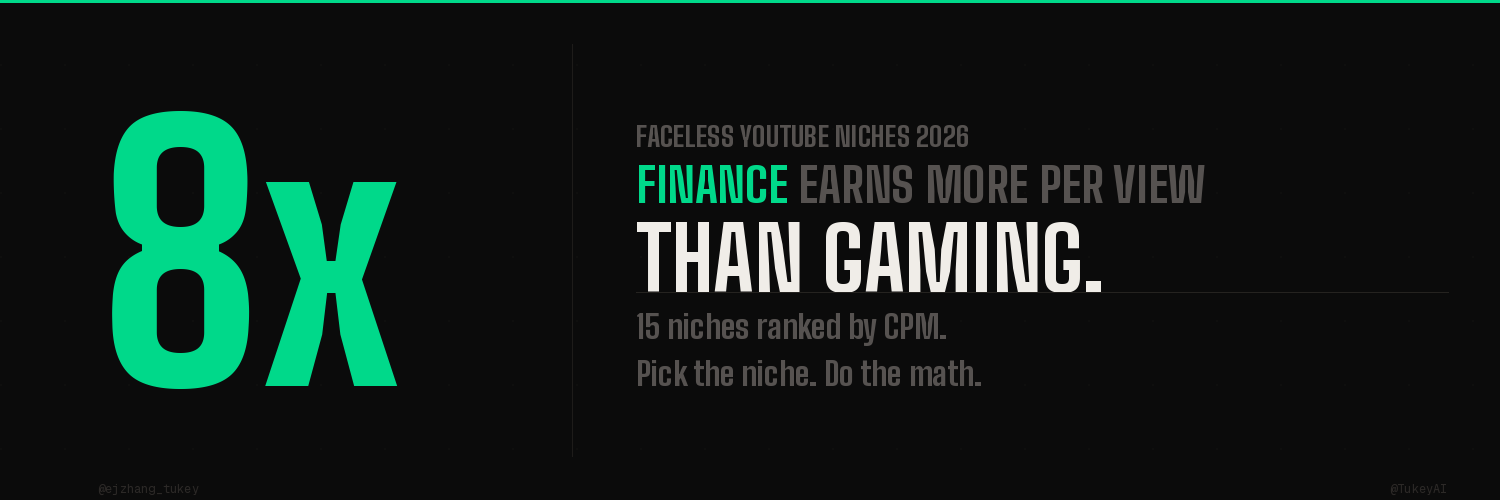
15 niches with real RPM data for each, ranked from $25 creator take-home to $2, so you know exactly what you are choosing before you start.
Finance creators earn $25 RPM per thousand views. Lifestyle creators earn $3. Same platform, same algorithm, same upload schedule. Eight times the difference in pay.
That gap is not random. It is the direct result of niche selection, and most people starting a faceless channel in 2026 make this decision based on the wrong inputs.
This is every major faceless YouTube niche ranked by what advertisers actually pay, with real CPM and RPM data, and the specific opportunity that makes 2026 different from any year before it.
Why 97 Out of 100 Channels Fail Before Making a Dollar
Only 3% of YouTube channels ever reach the platform's monetization threshold of 4,000 watch hours and 1,000 subscribers.
That number sounds like a quality problem. It is not. It is largely a niche problem.
A creator in a $3 RPM lifestyle niche needs 3.3 million views per year to earn $10,000. A creator in a $25 RPM finance niche reaches the same $10,000 with 400,000 views. Same production effort, same subscriber milestone. Eight times less traffic required.
Most new channels burn out chasing volume in low-CPM niches before they ever see what the math actually looks like in a high-CPM one.
This ranking exists to show you the math before you commit.
How CPM Actually Works (And Why the Disparity Exists)
CPM is what advertisers pay YouTube to show 1,000 ad impressions. RPM is what creators actually receive after YouTube takes its 45% cut.
A financial advisory firm promoting an investment platform pays $40+ CPM. Why? Because their average customer lifetime value is measured in thousands of dollars. Acquiring one client through a YouTube ad at $40 CPM is a bargain when that client generates $3,000 in annual recurring revenue.
A consumer brand running a lifestyle campaign pays $4 CPM. They sell $30 products with thin margins. A YouTube viewer is not worth much to them.
The content is not what determines the CPM rate. The advertiser's economics determine the rate.
This means the highest-earning faceless channels serve audiences that financial services companies, B2B software firms, and professional service providers are willing to pay a premium to reach. Not the most popular audiences. The most commercially valuable ones.
The CPM Data Table: 15 Faceless Niches Ranked
Ranked by average creator RPM (your take-home after YouTube's cut), based on aggregated 2025-2026 data:
| Rank | Niche | Creator RPM | Advertiser CPM | Naturally Faceless? |
|---|---|---|---|---|
| 1 | Personal Finance and Investing | $12-$25 | $20-$50 | Yes |
| 2 | Legal and Tax Education | $9-$20 | $15-$40 | Yes |
| 3 | SaaS and Software Reviews | $9-$18 | $10-$25 | Yes |
| 4 | Business and Entrepreneurship Case Studies | $8-$18 | $14-$35 | Yes |
| 5 | AI Tools and Automation | $8-$16 | $10-$25 | Yes |
| 6 | Real Estate Education | $7-$15 | $12-$30 | Yes |
| 7 | Tax and Accounting Explained | $6-$14 | $12-$22 | Yes |
| 8 | Digital Marketing and SEO | $6-$12 | $12-$18 | Yes |
| 9 | Cybersecurity and Privacy | $6-$12 | $12-$20 | Yes |
| 10 | Coding and Developer Education | $6-$12 | $10-$18 | Yes |
| 11 | English Language Learning | $6-$12 | $10-$18 | Yes |
| 12 | Wellness and Sleep Science | $5-$11 | $8-$20 | Yes |
| 13 | Career Development and Salary Negotiation | $5-$10 | $8-$16 | Yes |
| 14 | Literary Analysis and Book Reviews | $5-$9 | $8-$14 | Yes |
| 15 | Gaming Walkthroughs and Lore | $2-$4 | $3-$7 | Yes |
Every single niche on this list can be executed without showing your face. Finance uses charts, animation, and voiceover. SaaS uses screen recordings. Legal uses case narration and text overlays. AI tools uses software demos. Gaming uses gameplay capture.
The format question is a non-issue. The niche question is everything.
Niche Breakdown: What You Need to Know About Each Tier
Tier 1: The Premium Niches ($9-$25 RPM)
1. Personal Finance and Investing ($12-$25 RPM)
Finance is the undisputed top earner on YouTube. CPM exceeds $50 at peak periods (Q4 runs $25+ CPM platform-wide in finance). The audience is financially active and high-intent, which is exactly what banks, robo-advisors, credit card companies, and trading platforms pay to reach.
The challenge: it is also the most competitive high-CPM niche. Established channels have 5-10 years of SEO compounding. A new faceless finance channel in 2026 needs a very specific angle to differentiate.
Best faceless formats: animated explainers, data visualization, narrated market analysis.
2. Legal and Tax Education ($9-$20 RPM)
Criminally underrated. Legal content attracts law firm advertising and financial services brands targeting adults navigating real legal situations. Court case narration, tax strategy breakdowns, and legal rights explainers are all naturally faceless. The audience is engaged and high-value.
A 2024 English-language legal education channel saw 21x growth in under 18 months. The niche is not saturated at the quality end.
Best faceless formats: case narration with text overlays, explainer animation, talking-points-style slides.
3. SaaS and Software Reviews ($9-$18 RPM)
SaaS companies pay premium CPMs because one converted customer means $500-$2,000 in annual recurring revenue. They can afford $15-$25 CPM all day.
The additional layer: affiliate income. SaaS affiliate programs routinely pay 20-40% recurring monthly commissions. A review video that earns $800 in AdSense revenue might generate $4,000 in affiliate income from the same views over 12 months.
Best faceless formats: screen recordings, side-by-side comparisons, workflow walkthroughs.
4. Business and Entrepreneurship Case Studies ($8-$18 RPM)
Business-focused advertisers (software companies, financial services, business education platforms) spend heavily on YouTube. Case study content about company failures, acquisition stories, and founder decisions attracts a high-intent professional audience.
Best faceless formats: narrated storytelling over stock footage, data visualization, B-roll.
5. AI Tools and Automation ($8-$16 RPM)
The biggest 2026 opportunity. Full breakdown in the next section.
Tier 2: Strong Earners ($6-$15 RPM)
6. Real Estate Education ($7-$15 RPM)
Real estate advertisers (mortgage brokers, title companies, real estate platforms) pay significant CPMs to reach buyers and investors. Content about market analysis, investment strategies, and property evaluation works well in faceless format.
7. Tax and Accounting Explained ($6-$14 RPM)
Closely related to legal/finance but distinct enough to own as a standalone niche. Tax content is evergreen, annual, and always in search demand around filing season. Accounting software companies pay strong CPMs to reach this audience.
8. Digital Marketing and SEO ($6-$12 RPM)
B2B advertisers dominate this niche's ad inventory. Marketing agencies, software platforms, and education companies targeting business owners spend heavily here. The content is naturally faceless (screen recordings, analytics breakdowns, campaign walkthroughs).
9. Cybersecurity and Privacy ($6-$12 RPM)
B2B software companies in the security space pay $15-$25 CPM to reach IT decision-makers and privacy-conscious consumers. The content is perfectly faceless: terminal demos, tool walkthroughs, explainers on real security incidents.
10. Coding and Developer Education ($6-$12 RPM)
Software development tools, cloud platforms, and developer education companies spend heavily on YouTube. A developer audience is high-value to B2B advertisers even at mid-size subscriber counts.
11. English Language Learning ($6-$12 RPM)
One of the most underrated faceless niches. Education advertisers pay strong CPMs, and the global English-learning audience is massive. The content (text overlays, pronunciation guides, grammar explainers) is fully faceless by design.
Tier 3: Moderate Earners ($5-$11 RPM)
12. Wellness and Sleep Science ($5-$11 RPM)
Wellness brands (supplement companies, sleep tech, health platforms) pay $16-$20 CPM for a health-aware audience. Sleep soundscape and guided meditation channels are among the easiest to produce with zero face time.
13. Career Development and Salary Negotiation ($5-$10 RPM)
HR platforms, professional education companies, and recruitment advertisers target this niche. Resume and salary content has strong evergreen search demand. The niche skews toward young professionals, which attracts financial services advertisers as well.
14. Literary Analysis and Book Reviews ($5-$9 RPM)
$5-$9 RPM with almost zero competition at the quality level. Book content uses book covers, text overlays, and narration. No face. No camera. Publishers and online education platforms advertise here regularly.
The Cautionary Tier: Why Gaming Is Last
15. Gaming Walkthroughs and Lore ($2-$4 RPM)
Gaming has 8 million active creators fighting over $2-$4 RPM ad inventory. Consumer brands and game publishers pay low CPMs because the audience, while enormous, skews young and low-purchase-intent.
A faceless gaming channel generating 500,000 views per month earns $1,000-$2,000 in AdSense. A faceless finance channel at the same views earns $6,000-$12,500.
Gaming is not a bad hobby. It is a bad business model for most new channels.
The 2026 Opportunity: Why AI Tools Is the Sleeper Pick
Personal finance has the highest CPM. It also has 10 years of compound SEO from established channels, brand channels with million-subscriber head starts, and an audience increasingly skeptical of faceless finance content.
The AI tools niche in 2026 is what personal finance looked like in 2018. Nobody has dominated it yet.
CPM runs $10-$25, close to finance. Competition is a fraction of the finance niche. The content format is almost perfectly faceless by design: screen recordings of software, AI voiceover, workflow demos, tool comparison videos.
The key driver: AI companies are burning venture capital on user acquisition. A single SaaS company might pay $20-$40 CPM to reach a technical audience that is actively evaluating tools. That is finance-tier CPM without finance-tier competition.
The affiliate layer compounds the math further. Most AI tools and SaaS products pay 20-40% recurring commissions. A review video that earns $800 in AdSense might generate $3,000-$5,000 in affiliate income from the same views.
Three types of AI tools content consistently outperform in this niche:
Tool comparison videos ("5 AI tools that replace your entire workflow"). These attract buyers who are evaluating, not just browsing.
Workflow automation walkthroughs. Showing how to connect tools, build automations, and cut a specific workflow from 4 hours to 20 minutes attracts both creators and business owners. Dual audience, one video.
Niche-specific AI tool breakdowns. "AI tools for lawyers." "AI tools for real estate agents." "AI tools for YouTube creators." These combine the AI tools CPM with the high CPMs of the target niche's own advertisers. Double premium.
Why Most Faceless Channels Pick the Wrong Niche
The mistake is optimizing for "content I can make easily" instead of "advertiser I want to attract."
Most new channels look at what already has views on YouTube: gaming, lifestyle, commentary, reaction content. They are not looking at who buys the ads running against that content.
Finance companies collectively spent $14.7 billion on digital video advertising in 2024. B2B software companies added another $8 billion. Every dollar of that budget eventually reaches content where their target customers spend time.
That is why a 50,000-view finance video regularly outearns a 500,000-view gaming video. The CPM math is the math.
How to Pick Your Niche: A Four-Question Filter
Run your top two or three niche candidates through these questions before committing.
Question 1: Who advertises to this audience? If the answer is consumer brands and mobile game companies, expect $3-$5 CPM. If the answer is financial advisors, software companies, or law firms, expect $10-$25 CPM.
Question 2: Can the content be made without showing your face? Every niche in this list can. Finance uses animation and narration. SaaS uses screen recordings. Legal uses case narration with text. The format question is easier than people think.
Question 3: Is the content evergreen? Finance, legal, career, coding, and AI tools all have deep evergreen search demand. A video explaining how index funds work still earns traffic in year three. A trend-response video dies in week two.
Question 4: Does the niche have affiliate income upside? SaaS tools, investing platforms, legal services, and real estate companies all run affiliate programs paying 20-50% recurring commissions. The channel earning $5,000/month in AdSense in a software niche might generate $15,000/month total once affiliate links are live.
The 90-Day Roadmap for a New Faceless Channel
Weeks 1-2: Niche lock and content audit
Pick your niche from the CPM table above. Do not pick based on passion alone. Search the niche on YouTube and study the highest-performing videos from the past 12 months. Look for what formats work (comparison, tutorial, explainer, ranked list, case study). Build a list of 40-50 specific video ideas before producing anything.
Weeks 3-4: First three videos (private)
Make three videos before publishing any of them. These are your production training run, not your public debut. The objective is to develop a repeatable workflow. Expect them to be rough.
Weeks 5-12: Publish on a sustainable weekly cadence
One video per week is better than three per week for four weeks and then stopping. Faceless channels in search-driven niches take 3-6 months to see compounding returns from accumulated indexed content. Channels that burn out at week 8 would have hit real traction at week 14.
Month 4+: Add affiliate income
Once you have 5-10 videos live, add affiliate links to every relevant video. Finance channels should link to the platforms they mention. SaaS channels should apply to the affiliate programs of every tool they review. AI tools channels have an unusually strong affiliate ecosystem right now.
The Research Phase Is Where Most Channels Lose Time
Most new faceless channel operators spend their first three months doing research manually: opening 20 browser tabs, pulling view counts by hand, guessing which topics have search demand.
That research phase is compressible.
A YouTube outlier analysis tool can show you in minutes which videos in your niche massively overperformed their channel's baseline. That signal, a video getting 10x or 20x the views of its neighbors on the same channel, is the algorithm telling you what it wants to surface.
The workflow that consistently produces winning video ideas:
- Find your niche's outlier videos (10x+ their channel's average view count)
- Identify the specific angle, hook, or format that made them pop
- Build your version targeting the same search intent with your own perspective
Doing this manually takes 4-6 hours per research session. With the right tool, the same research takes 20 minutes.
Tukey AI is built specifically for this loop. It surfaces outlier videos across your niche, scores titles and thumbnails against what is actually working, and identifies the content patterns that drive algorithmic pickup, not just what has the most subscribers. For a new faceless channel trying to find its first 10 videos worth making, it compresses weeks of research into a single session.
A note on why we built Tukey AI
I spent the first six months of building content doing research the slow way: 20 browser tabs, manual view count comparisons, trying to reverse-engineer why one video hit 400,000 views while the next video on the same channel sat at 8,000.
The insight that changed everything was simple: the algorithm already tells you what it wants. It tells you through outliers. Videos that massively overperform their channel's baseline are not accidents. They are signals. The problem was that finding those signals manually took longer than making the actual video.
Tukey closes that gap. Find the signal. Then make the video.
tukey.ai
The 2026 Policy Reality: What YouTube Actually Changed
In early 2026, YouTube suspended thousands of faceless AI-generated channels under its inauthentic content policy. This panicked a lot of new creators.
It should not have.
YouTube did not ban faceless channels. It targeted low-effort, mass-produced channels with no original perspective: channels pushing out 50 AI-generated videos per week using generic voiceover and stock footage with zero research behind them.
Quality faceless channels doing original research, covering specific topics with a clear point of view, and building content that serves genuine search intent were not affected. The policy cull actually removed a significant layer of low-quality competition from several high-CPM niches.
For a new channel doing real research and making content that answers real questions, 2026 is a cleaner environment than 2025, not a worse one.
FAQ
What are the best faceless YouTube channel ideas for 2026?
The highest-earning faceless YouTube channel niches in 2026 are personal finance and investing ($12-$25 RPM), legal and tax education ($9-$20 RPM), SaaS and software reviews ($9-$18 RPM), and AI tools and automation ($8-$16 RPM). For new channels, AI tools offers the strongest combination of high CPM, low competition relative to finance, and a growing affiliate income layer.
Which faceless YouTube channel ideas make the most money?
Personal finance and investing channels consistently generate the highest CPM ($20-$50 from advertisers) and creator RPM ($12-$25 per thousand views). At 200,000 monthly views in the finance niche, a channel earns $2,400-$5,000 from ads before affiliate income. In gaming at the same traffic, the same channel earns $400-$800.
How much can a faceless YouTube channel make per month?
It depends almost entirely on niche selection and traffic. A finance or SaaS channel at 200,000 monthly views earns $2,400-$5,000 from ads alone. A lifestyle or gaming channel at the same traffic earns $400-$1,000. Affiliate income in high-CPM niches can add 2-3x the ad revenue on top. Top faceless channels in high-RPM niches generate $10,000-$80,000+ monthly.
How long does it take a faceless YouTube channel to make money?
Most faceless channels take 6-12 months to reach YouTube Partner Program requirements (1,000 subscribers and 4,000 watch hours). Channels in high-search-demand niches like finance, legal, and AI tools, publishing once per week, typically hit those thresholds faster than gaming or lifestyle channels competing for the same slots. The 3-6 month mark is when accumulated search-indexed videos start compounding traffic.
Can faceless YouTube channels still make money after YouTube's 2026 policy changes?
Yes. YouTube's 2026 inauthentic content policy targeted mass-produced, low-effort AI channels publishing dozens of generic videos per week with no original research or perspective. Faceless channels with real research, a specific point of view, and content serving genuine search intent are not affected. The policy reduced low-quality competition, which benefits new quality channels entering high-CPM niches now.
Which faceless YouTube niche is best for beginners in 2026?
AI tools and automation is the strongest pick for most beginners in 2026. The CPM is high ($8-$16 RPM), the competition is significantly lower than finance, the content format is naturally faceless (screen recordings, software demos), and the affiliate ecosystem pays recurring commissions on every tool reviewed. A beginner channel can differentiate with niche-specific angles (AI tools for a specific profession) before the space consolidates.
The data is clear. Finance, legal, SaaS, and AI tools are where the advertiser budgets concentrate.
Pick one niche from the top half of the table. Go 50 videos deep. That is the full strategy.
My name is EJ Zhang, the CEO at Tukey AI , a production workspace built in your voice. It learns your beliefs and creative fingerprint, surfaces pre-trending topics tailored to you, helps you create with originality, predicts performance before you publish, and learns from every result to make smarter recommendations over time.