YouTube Algorithm 2026: You're Optimizing the Wrong 30%
Most creators treat YouTube like a search engine.
They spend hours on keywords, tags, descriptions. They upload on schedule. They watch the subscriber count like it means something.
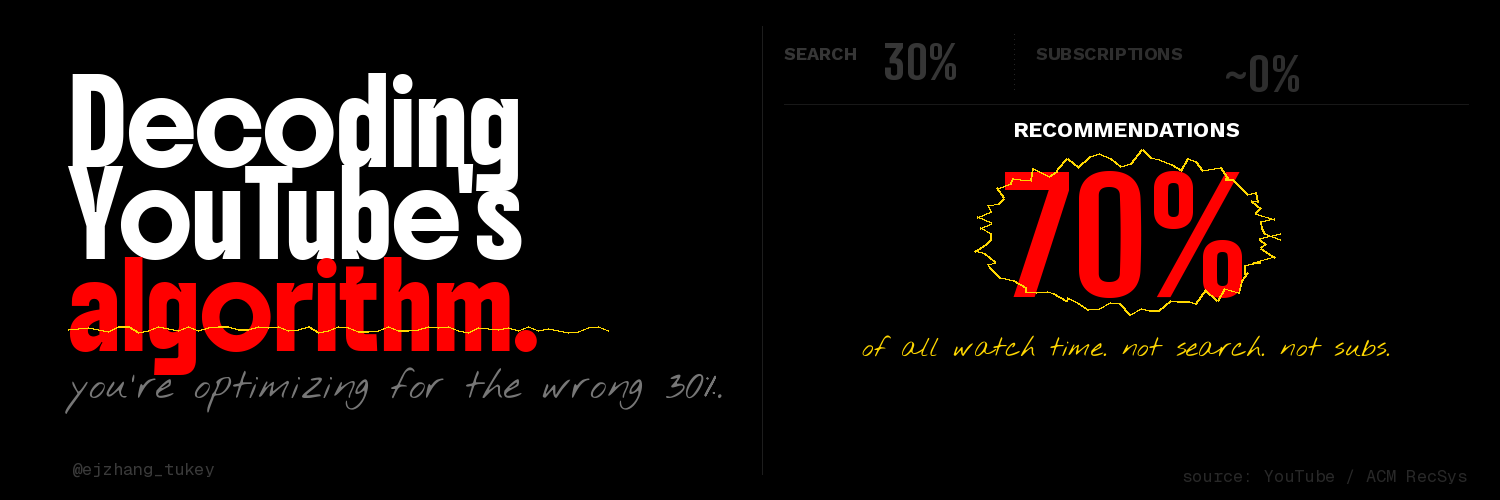
70% of all YouTube watch time comes from the algorithm. Not from search. Not from subscriptions. You've been optimizing for the other 30%.
Here is what is actually running your reach in 2026.
The Numbers Most Creators Never Look At
Before anything else, here is the data that should change how you think about the platform:
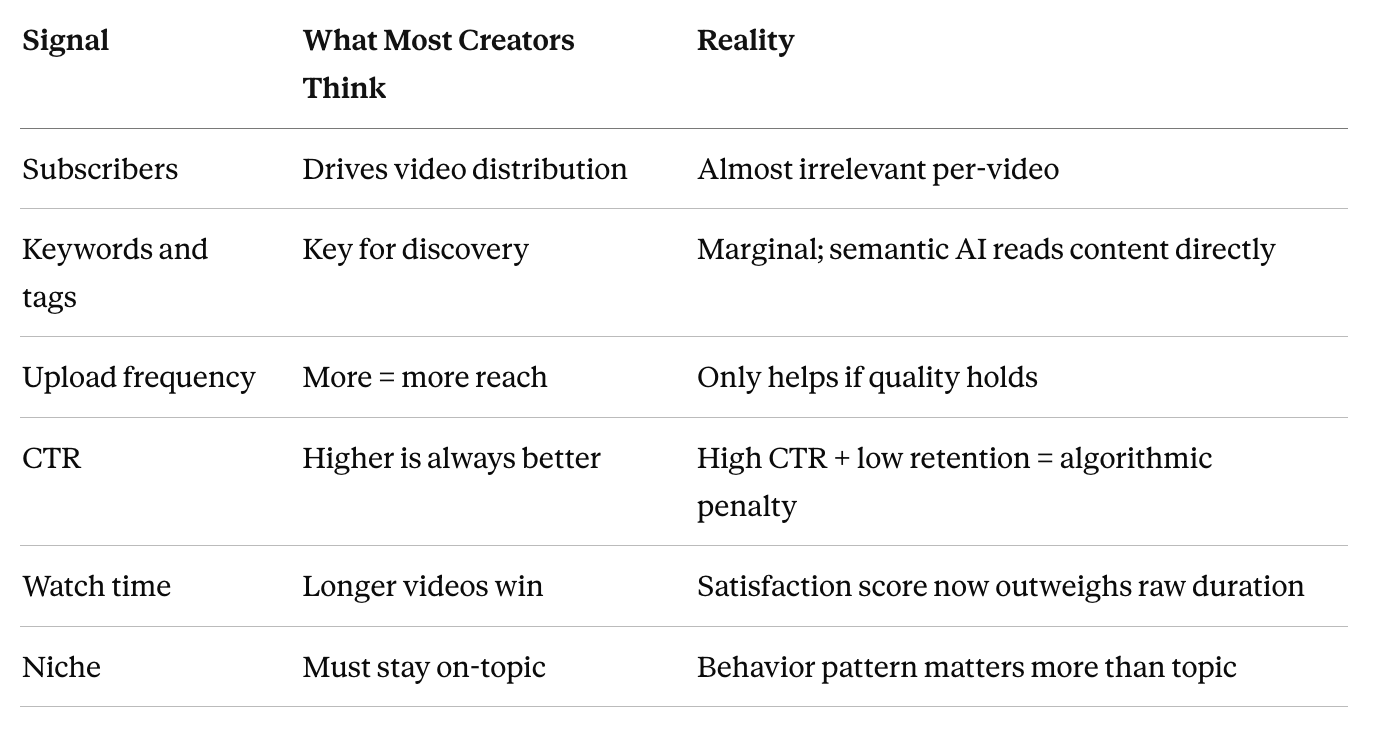
The platform processes over 80 billion signals daily to decide which videos appear on whose screen. Every assumption in that left column is either wrong or far more complicated than most creators realize.
How YouTube's Algorithm Actually Works
YouTube's recommendation system architecture was published in a landmark 2016 Google Research paper (Covington, Adams, Sargin, ACM RecSys) and has been updated continuously since. The core structure has three stages:
Stage 1: Candidate Generation The system reduces hundreds of millions of videos down to a few hundred candidates for each viewer. It uses approximate nearest-neighbor search on user embeddings built from your watch history, search behavior, and interaction patterns. This stage is fast and broad.
Stage 2: Ranking A heavier neural network scores each candidate using granular viewer-to-video relationship data unavailable in Stage 1. This is where CTR, watch time, satisfaction signals, and session behavior all come in. The score is a weighted combination of predicted probabilities for every possible action: click, watch, like, share, leave, report.
Stage 3: Post-Ranking Final adjustments for diversity (YouTube uses Determinantal Point Processes to ensure you never see 10 videos from the same channel in a row), freshness, and platform policies. In 2024, YouTube confirmed a deliberate redistribution at this stage to surface smaller creators alongside dominant channels.
One thing almost no creator talks about: the algorithm is video-first, not channel-first. Every video is evaluated independently against its own behavioral signals. A new channel can outrank a channel with 2 million subscribers on the same topic if its video performs better in the test window.
The 5 Signals That Actually Determine Your Reach
1. CTR and retention together, not separately.
Click-through rate and average view duration are only meaningful in combination. This is where most creators have it completely backwards.
A video with 6% CTR and 80% retention will outperform a video with 12% CTR and 30% retention. The algorithm detects the mismatch between a high-promise thumbnail and low-satisfaction viewing and reads it as a sign the content is misleading. Clickbait creates a feedback loop that suppresses your distribution and trains the system to distrust your channel's signals.
YouTube's official documentation explicitly states: "Clickbait videos tend to have low average view duration and therefore are less likely to get recommended."
The CTR benchmark to know: YouTube's official range is 2 to 10%, with most channels sitting between 4 and 6%. Anything below 3% tends to see significantly reduced promotion. Anything above 7% on a broad rollout is strong.
2. A satisfaction survey you never see.
This is the biggest algorithmic change of 2026 and almost nobody is talking about it.
YouTube runs post-watch surveys to a subset of viewers after videos. The prompts are simple: "Did you enjoy this video?" and "Was your time well spent?" Those responses feed directly into the ranking model. In 2025, YouTube officially elevated satisfaction signals above raw watch time as a primary ranking factor.
You cannot see these responses in Analytics. You cannot A/B test them. The only thing you can control is whether your video actually delivers on its promise. A 4-minute video that fully satisfies the viewer will outperform a 20-minute video that leaves them feeling like they wasted time.
End strong. Weak endings tank satisfaction scores even when the body of the video was solid.
3. Session contribution, not just video watch time.
Most creators optimize for per-video metrics. The algorithm is increasingly weighting something different: what happens after your video ends.
If a viewer finishes your video and closes YouTube, that is a neutral to negative signal. If they keep watching, whether that is your next video, someone else's, anything, that is called session contribution and it carries significant weight in Suggested Video placements.
The practical implication: end screens, playlist recommendations, and related video suggestions are not just navigation features. They are ranking signals. Videos that reliably end viewing sessions get throttled. Videos that keep people on the platform get promoted.
4. The launch window.
Every video receives a test rollout to a small seed audience within the first 24 hours. Creator analyses (widely reported but not officially confirmed by YouTube) estimate this at approximately 1,000 initial impressions. Based on how that test performs, YouTube decides whether to scale distribution or stop promoting the video entirely.
The approximate thresholds based on industry analysis:
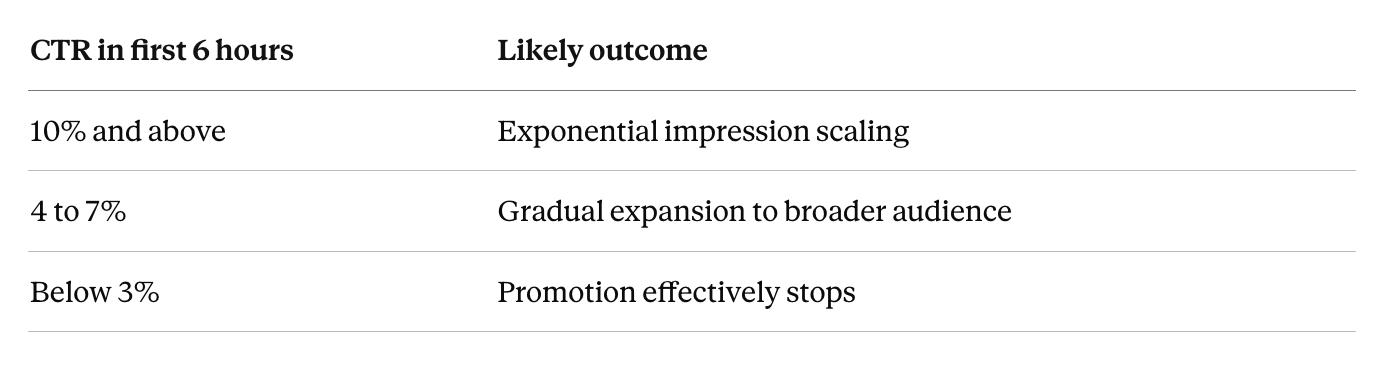
A video under 3% CTR at the 6 hour mark rarely recovers, even after a thumbnail change. The algorithm has already classified it.
What this means practically: stop publishing when you finish editing. Open YouTube Analytics, go to the Audience tab, and find "When your viewers are on YouTube." Post at the peak of that window. Be in the comments for the first 20 minutes replying to everyone who shows up early.
5. The behavior pattern behind your niche.
Staying in your niche does not mean what most creators think it means.
YouTube does not cluster viewers by topic. It clusters them by behavior style. A viewer who consistently watches 15-minute detailed tutorial content about tech might get your 15-minute detailed tutorial about cooking. Not because they like cooking. Because the algorithm identified them as a "long form deep dive learner" and your video matches that behavioral pattern.
The real niche penalty is audience mismatch, not topic mismatch. If your existing subscribers do not click your new video, the algorithm reads that as your video being bad, not as your audience being wrong. Format consistency and depth consistency matter more than staying locked to a single subject.
The 2025 Algorithm Updates You Need to Know
YouTube made several confirmed changes in the past 12 months:
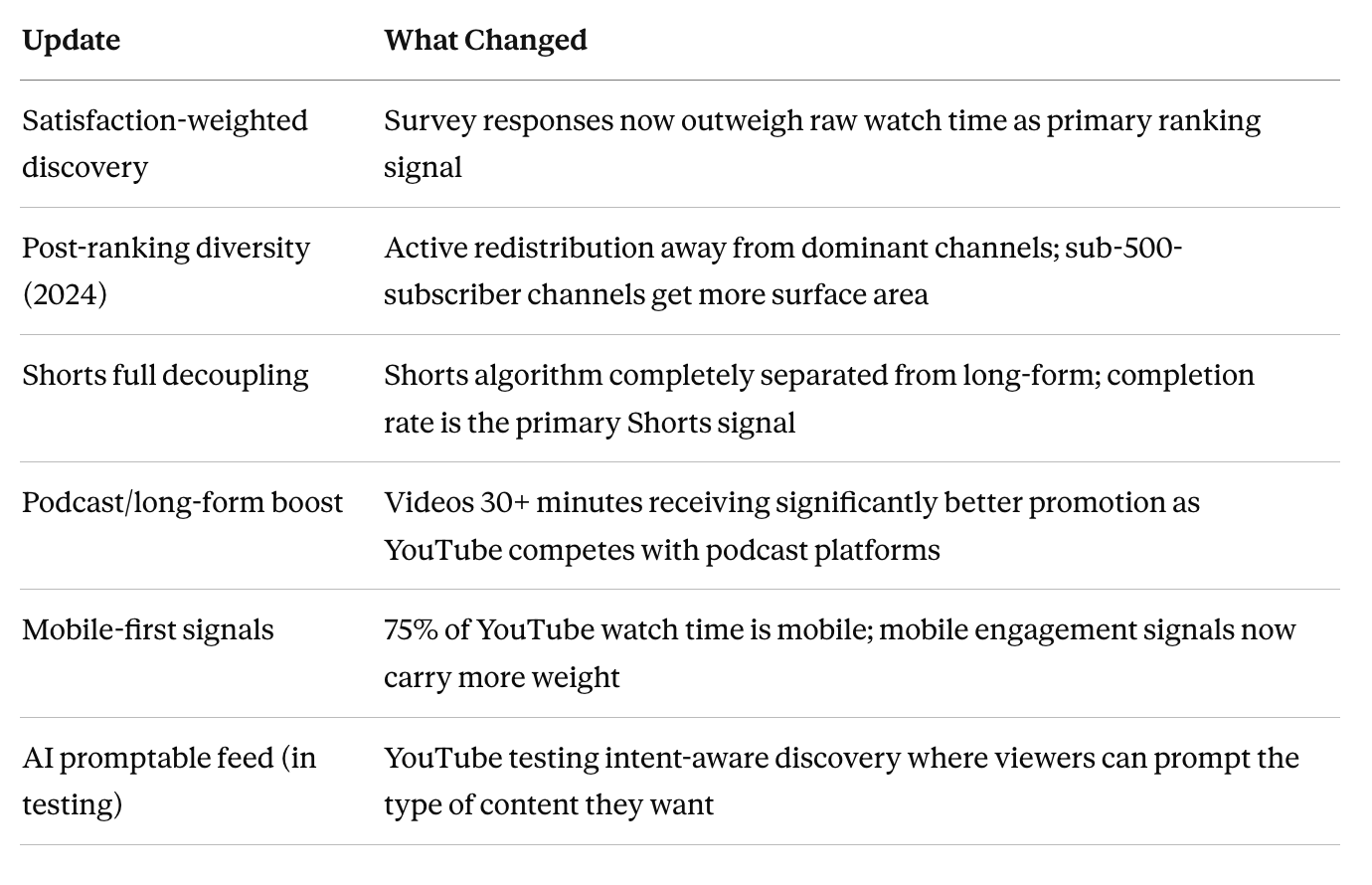
The Shorts decoupling is underappreciated. Many creators assumed Shorts would feed subscribers to their long-form content. In 2026, the two algorithms do not talk to each other. Growing a Shorts audience does not lift your long-form recommendations.
What to Actually Do Starting Today
Pull up your last five videos in YouTube Analytics. Look at CTR and average view duration side by side, not separately. If your CTR is strong but watch time is weak, your thumbnail and title are overpromising. If your watch time is strong but CTR is low, your packaging is the bottleneck. These are different problems with different fixes.
Find "When your viewers are on YouTube" in your Audience tab. That is your publish window. Post at the peak and stay in the comments actively for 20 minutes. Reply to every comment in that window. Every author reply you generate is the highest-quality engagement signal you can create.
The last thing: your subscriber count tells you almost nothing about a video's potential reach. Every video gets independently tested. A channel with 500 subscribers can win the test window against a channel with 500,000 subscribers if the video performs better in those first hours. The algorithm is not rewarding history. It is rewarding the video in front of it right now.
Frequently Asked Questions
Does posting more frequently help you grow on YouTube? Only if quality holds. An analysis of 5 million channels (June 2024 to June 2025) found that creators posting 12 or more times per month got 53% more views than those posting 1 to 3 times. But creators who scaled back and improved quality often saw higher per-video engagement. YouTube does not reward cadence. It rewards aggregate engagement signals. More uploads give you more chances to win the test window.
How long does it take to grow a YouTube channel? There is no fixed timeline. Documented cases show channels growing from a few hundred to tens of thousands of subscribers in 4 to 8 months. The consistent pattern across fast-growing channels: above average CTR paired with above average retention, both sustained across multiple videos. The breakthrough is threshold-based on signal quality, not time or video count.
Does YouTube suppress new channels or new videos? No. YouTube explicitly does not suppress new content. Every video gets a test rollout. New channels with no history have less behavioral data for the system to use, which is a disadvantage, but YouTube has confirmed it runs internal efforts to surface content from channels under 500 subscribers alongside established creators.
Do hashtags help with YouTube discovery? Less than most creators think. YouTube's ranking model uses semantic AI to understand your content directly. Tags and hashtags are a marginal signal and can trigger spam filters if overused. Clean, accurate titles and descriptions that describe what the video actually delivers matter far more.
What is the most important metric to track on YouTube? CTR and average view duration together, then session contribution. Watch those two combinations for every video and you have a direct read on both your packaging (CTR) and your content quality (retention). Subscriber counts, likes, and view counts are vanity metrics compared to these signals.
Sources: Google Research ACM RecSys 2016 (Covington, Adams, Sargin), YouTube Help Center, Hootsuite YouTube Algorithm 2025, VidIQ algorithm analysis (June 2024 to June 2025), Hashmeta confirmed 2025 algorithm changes, marketingagent.blog satisfaction signal breakdown, OutlierKit YouTube algorithm updates 2026, Subscribr CTR analysis, Focus Digital CTR benchmarks 2025.
I'm building @TukeyAI. It helps YouTube creators find what's already working in their niche before they film. Check what topics are pulling outsized views right now.