ChatGPT Starts From a Blank Page. Your Channel Doesn't. Here's What Gets Lost.
ChatGPT for YouTube creators feels fast because it skips the one input that decides whether a video holds attention: everything your channel has already proven about your audience.
Short answer: Is ChatGPT good for writing YouTube scripts? ChatGPT is good for a blank page. It is a strong first draft engine when you have nothing else, and a poor finishing engine once your channel has data. Every new chat starts with zero access to your retention graphs, your audience behavior, and your best-performing structures. For a brand-new channel that is fine. For any channel with months of uploads, ChatGPT is writing for a generic YouTube viewer while your actual audience sits in your analytics, unread.
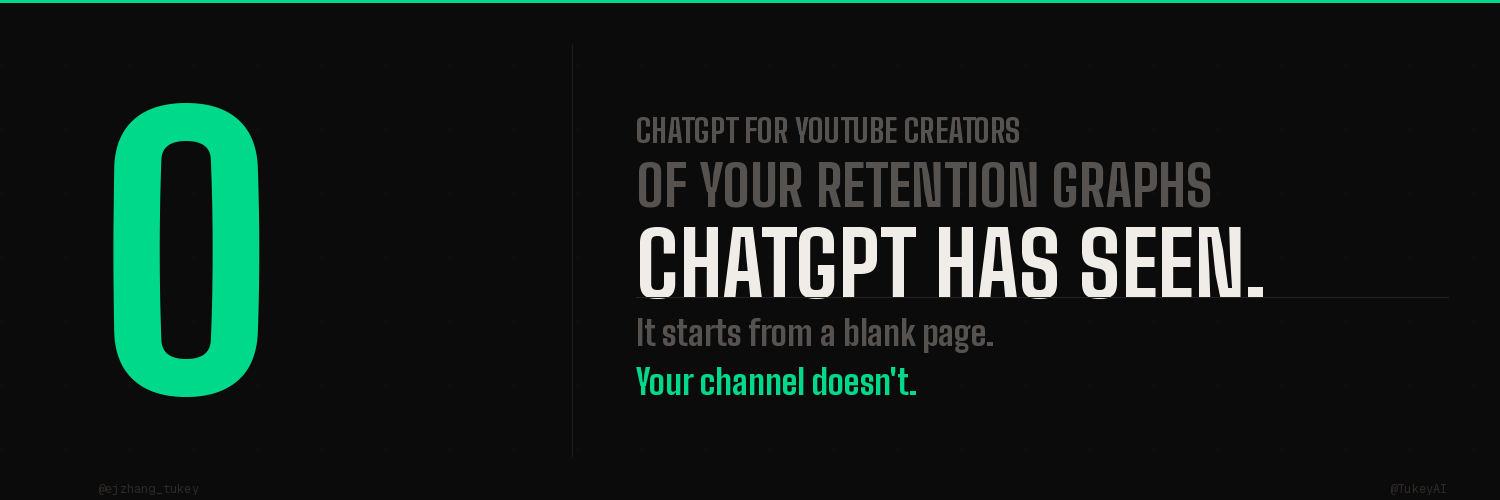
ChatGPT has opened 0 of your retention graphs.
Not one. Not a summary. Not a single average view duration curve from a single one of your videos. The model that just wrote your hook has never seen the moment your last upload lost half its audience.
That is not a knock on the model. It is the definition of a blank page. ChatGPT for YouTube creators is a tool that begins every task with nothing about your channel and ends it with a clean, confident draft built for nobody in particular.
Here is exactly what that blank page costs, and what gets lost in the gap.
Is ChatGPT Good for YouTube Creators, or Just Fast?
Both can be true. ChatGPT is fast, and for a specific job it is good.
If you have never published a video, you have no audience data to lose. A blank page is the correct starting point because you are also starting from blank. ChatGPT will hand you a structurally reasonable script in under a minute, and that is a real head start.
The problem begins the moment your channel accumulates a track record. Channels publishing weekly reach YouTube's monetization threshold of 4,000 watch hours, which is 240,000 minutes of recorded viewer behavior, in about 14 months on average. That is 240,000 minutes of data about what your specific audience does, where they stay, and where they leave.
ChatGPT works from none of it. It works from a composite of the public internet, frozen at a training cutoff, with no line into YouTube Studio.
So the honest answer to "is ChatGPT good for YouTube creators" is conditional. It is good at producing a competent draft. It is structurally incapable of producing one shaped by your channel, because the shape lives in data the model cannot reach.
Doesn't ChatGPT Remember Me Now?
It remembers some things. As of the Dreaming V3 update OpenAI rolled out on June 4, 2026, ChatGPT carries memory across conversations and can recall facts you have told it about yourself. So yes, it might remember that you run a finance channel and prefer a casual tone.
That is memory of what you said. It is not access to what your audience did.
There is a hard line between the two. ChatGPT can store "I make 12-minute personal finance videos" because you typed it. It cannot store the fact that your audience reliably drops at the 90-second mark when you front-load context, because that fact does not live in your words. It lives in your retention curve, and the model has never been allowed to see a retention curve.
This is the trap in the upgrade. Better memory makes ChatGPT feel like it knows your channel. It knows your description of your channel. The two produce very different scripts.
What Actually Gets Lost on the Blank Page
When a script starts from zero channel context, five specific inputs go missing. Each one maps to a place creators lose views.
Your retention fingerprint. Every channel with 10 to 15 uploads has a repeatable pattern of where viewers stay and where they bail. A blank-page tool writes pacing for an average video, not your video.
Your hook that already works. Your top 3 videos opened a certain way for a reason. ChatGPT cannot reuse a pattern it has never seen, so it reaches for a generic hook instead of the one your audience has already rewarded.
Your audience type. A finance channel and a gaming channel get nearly identical structures from the same blank-page prompt, because the model is drawing from the same general training data, not your subscriber base.
Your topic-to-performance map. You have videos that overperformed and videos that flopped. That history is a roadmap for what to make next. The blank page ignores it and optimizes for what is generally popular.
Your spike moments. The timestamps where your audience rewinds or re-watches are gold. They tell you what structure to repeat. ChatGPT has no idea they exist.
| Channel input | Lives in | Visible to a blank-page tool |
|---|---|---|
| Retention curve | YouTube Studio analytics | No |
| Audience drop-off points | Studio retention graph | No |
| Best-performing hook pattern | Your top videos | No |
| Topic performance history | Your channel record | No |
| Re-watch and spike timestamps | Studio engagement data | No |
| Your stated tone and niche | Your prompt | Yes |
Only the last row survives the blank page. It is also the only row that does not determine retention.
Why This Shows Up as "AI Slop"
The cost of blank-page output is now visible at platform scale. A December 2025 Kapwing study built a fresh YouTube account and logged the first 500 Shorts it was shown. More than 20% of them, 104 videos, were primarily AI-generated low-quality clips. Another 33% were repetitive filler.
That is what blank-page production looks like in aggregate. Content that is technically fine, structurally generic, and indistinguishable from the next channel doing the same thing.
The platform-wide average retention rate sits at 23.7%. More than 55% of viewers are gone before the 60-second mark. Only 16.8% of videos ever cross 50% average view duration. Flooding the system with more blank-page scripts does not move any of those numbers. It just adds to the pile the algorithm is already learning to filter out.
The way out is not better prose. It is context the blank page never had.
How to Put Your Channel Back on the Page
You can close part of the gap manually. The steps are simple to list and slow to run.
Step 1: Pull your retention data. Open YouTube Studio, go to Content, and sort by average view duration. Find your 5 best and 5 worst videos.
Step 2: Map the pattern. Watch where the best videos hold and where the worst ones drop. Note the timestamp of your earliest reliable drop-off. That is the window every script has to survive.
Step 3: Extract your winning structure. Look at how your top 3 hooks open. Write down the move they share. That is your hook template, earned from real data, not guessed.
Step 4: Feed it in every session. Before you ask for a script, give the tool your niche, your audience, your typical length, your drop-off window, and your proven hook pattern. Every session, because the blank page resets every session.
Step 5: Edit against the curve, not the vibe. Judge the draft by whether it front-loads payoff before your known drop-off point, not by whether it reads well.
This works. It also takes 20 to 30 minutes of setup before you write a single line, and it has to be repeated every time, because the page is blank again tomorrow.
The Fastest Path: Stop Rebuilding Context From Scratch
The manual workflow above is really one task repeated forever: telling a blank-page tool what your channel already knows.
That is the job Tukey AI was built to remove. Instead of starting from nothing and asking you to describe your channel in words, Tukey starts from your channel. It reads your retention data, your audience behavior, and your top-performing structures, then writes the script around your curve. The context is loaded once. It does not reset when you close the tab.
The difference is not that Tukey writes better sentences. It is that Tukey starts from your data and ChatGPT starts from a blank page. One of those is shaped by what your audience has already proven. The other is shaped by the average of everyone.
For a new channel with no data, a blank page is fine, and a general tool is a reasonable start. For any channel with a retention history, the question is whether your next script uses it.
You can see how it works at tukey.ai.
A note on why we built Tukey AI
I spent two years watching creators ask the same question: is ChatGPT good for YouTube scripts? The real answer was never about the model. It was about the blank page. Every session, they were retyping their channel context, and the tool still could not see the one thing that mattered, which was their actual retention data.
The waste was the repetition. Smart creators rebuilding the same context every single time, and still ending up with a script written for a generic viewer.
Tukey was built so the channel is the starting point, not an afterthought you paste in. The data loads once. Every script after that already knows your audience.
tukey.ai
FAQ
Is ChatGPT good for writing YouTube scripts? ChatGPT is good for a blank page. It produces a competent draft fast, which helps most when your channel is new and has no retention data to lose. For a channel with months of uploads, ChatGPT writes for a generic YouTube viewer because it has zero access to your analytics. The draft is fine. It is just not built from your audience.
What is the main limitation of ChatGPT for YouTube creators? It starts every task with no channel context. ChatGPT cannot read your retention graphs, your drop-off points, or your best-performing hook patterns, because that data lives in YouTube Studio and the model has no line into it. You can describe your channel in a prompt, but a description is not the same as the model seeing your actual numbers.
Doesn't ChatGPT remember my channel now that it has memory? It remembers what you tell it, not what your audience does. The June 2026 memory update lets ChatGPT recall facts from past chats, like your niche or tone. It still cannot see your retention curve, so the structural decisions that drive views are made blind.
Why do AI YouTube scripts still feel generic if everyone uses AI? Because most tools write from general best practices, not from individual channel data. A December 2025 study found more than 20% of videos shown to new YouTube users were AI-generated low-quality clips. High AI adoption with no channel context produces high volumes of average content, which is why platform retention has not moved.
How do I get a script that actually fits my channel? Feed the tool your real data: your drop-off window, your top hook pattern, and your audience type, pulled from YouTube Studio. You can do this manually every session, or use a channel-aware tool like Tukey AI that loads your retention data once and writes from it. The structural layer is what determines retention, and that layer has to be channel-specific.
Can I still use ChatGPT as part of my workflow? Yes. Many creators use a channel-aware tool for the structure and hook, then use ChatGPT to expand phrasing or brainstorm angles. Keep the retention-critical decisions with the data. Let the blank-page tool handle the parts where generic is fine.
ChatGPT starts from a blank page. Your channel doesn't. The only question is which one your next script is built on.
More to read:
3% of YouTube Channels Reach Monetization. Here's the Call They Made Differently.
Popularity Is Not Opportunity: Why Most YouTube Videos Land Flat Before They're Finished
My name is EJ Zhang, the CEO at Tukey AI, a production workspace built in your voice. It learns your beliefs and creative fingerprint, surfaces pre-trending topics tailored to you, helps you create with originality, predicts performance before you publish, and learns from every result to make smarter recommendations over time.