Tukey vs ChatGPT: 87% of Creators Now Use AI for YouTube Scripts.
Why mass AI adoption has not moved the platform average, and what separates the channels that actually grow from the ones that plateau with better-sounding scripts.
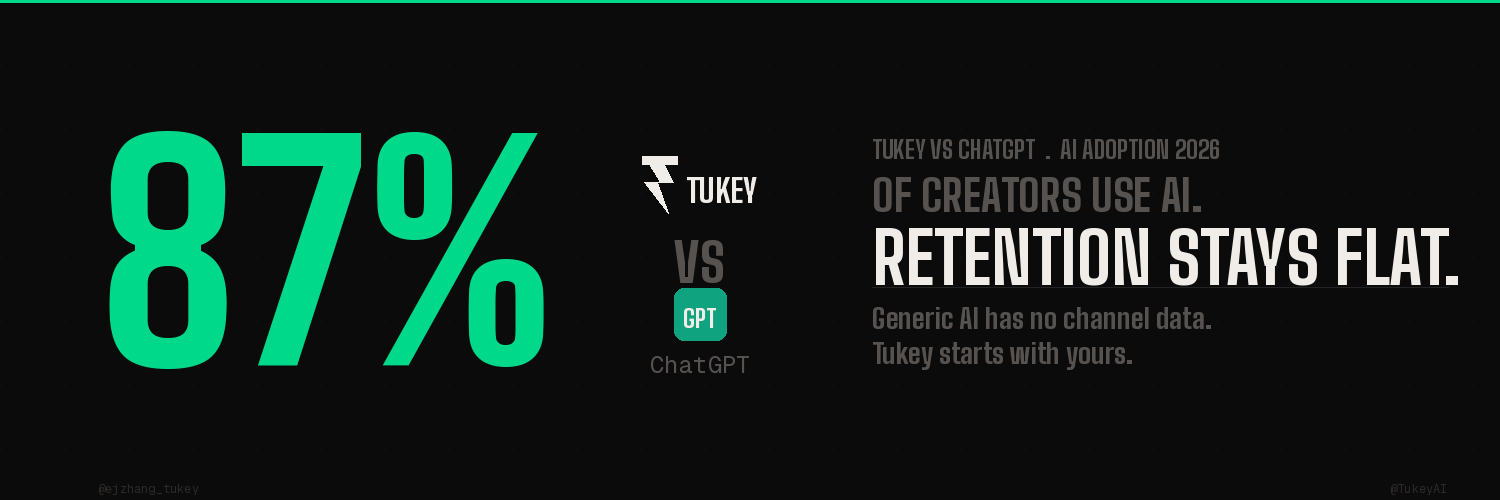
87% of creators now use AI in their content workflows. That number comes from a September 2025 Artlist survey of 6,500 creators, and over 40% of them are using AI daily.
The platform-wide average retention rate is still 23.7%.
Something is not adding up. If nearly every creator is using AI to write scripts, why is the average video still losing 76% of its audience? The answer is not that AI scripts are bad. It is that most AI scripts are built without access to the one variable that determines whether a video holds attention: the specific channel's retention data.
This is exactly what that gap costs you, and how to close it.
What 87% of AI-Using Creators Have in Common (And Why It Still Doesn't Work)
The creators in that 87% are doing roughly the same thing. They open a general AI tool, type a topic, maybe add a few lines of context, and get a script back in under a minute.
The script is grammatically clean. It has a hook, a middle, a close. It sounds like a competent video.
Then they publish it and watch 60% of the audience leave before the two-minute mark.
The problem is that "competent" and "retention-optimized for your channel" are two different things. A competent script follows general YouTube best practices. A retention-optimized script follows your channel's specific audience behavior, as shown in your own analytics.
Generic AI tools have access to the first. They have zero access to the second.
The Data Layer Generic AI Scripts Cannot Access
Every channel with at least 10 to 15 published videos has a retention fingerprint in YouTube Studio. It shows exactly where the audience drops, where they rewind, which timestamps cause spikes, and which pacing choices cause drift.
That fingerprint is specific to your channel's niche, your audience's expectations, and the patterns your best-performing videos established over time.
When you use a general AI tool to write a script, it has no knowledge of that fingerprint. It writes for a composite YouTube audience, not your actual one.
The result is scripts that are structurally reasonable but structurally wrong for your specific channel. A finance channel and a gaming channel might get nearly identical hook structures from the same AI because the tool is drawing from the same general training data about what works on YouTube.
This is not a prompt engineering problem. You can add as much channel context to your prompt as you want. The tool still cannot read your retention graphs. It cannot see where your best videos spiked. It cannot see what your top performers did at the 45-second mark that your mediocre ones did not.
How Channel-Specific Scripting Closes the Retention Gap
The 13% of channels consistently beating 40% and above are not getting there with better vocabulary. They are getting there because their scripts are structurally shaped around what their audience has already demonstrated it responds to.
That means reading the retention curve of your top 5 videos before writing word one. It means knowing which timestamps produce spikes and replicating those structural patterns. It means front-loading the specific kind of payoff your niche audience responds to, not the generic kind.
Videos with a clear, channel-calibrated value proposition in the first 15 seconds see 18% higher retention at the 1-minute mark. That number is not about being clever or talented. It is about knowing what your audience came for and delivering it in the window before they decide to leave.
Channels that improve their average retention by 10 points see a correlated 25% increase in impressions from the algorithm. That is the compounding effect of getting channel-specific scripting right: more impressions, which means more views, which generates more retention data, which makes the next script better.
Generic AI tools break that loop at the first step.
Prompt Engineering ChatGPT vs Using a Channel-Aware Tool: What Each Actually Takes
Getting a genuinely channel-specific script from a general AI tool requires building the context manually every session. A minimum effective prompt includes your niche, your target audience, your tone, your typical video length, what your top-performing videos did structurally, and your current retention benchmarks.
Writing that context the first time takes 20 to 30 minutes. Iterating through drafts until the script feels right for your channel adds another 45 minutes to an hour. Creators using this workflow report spending 5 to 7 hours per week on AI-assisted scripting.
And the core limitation does not change regardless of how good the prompt is: the AI still cannot read your actual retention graphs. You can describe your retention in words. That is different from the model ingesting your analytics and using them structurally.
A channel-aware scripting tool does not need that manual setup for every session. The channel profile is loaded. The retention data is in. You describe the topic and get a draft built around your curve, not someone else's.
The time saved is real. But the more important difference is qualitative: your script is starting from your data, not a generic template that happens to include your context as an add-on.
Use Case: Same Creator, Same Topic, Generic AI vs Channel-Specific Tool
A personal finance creator with a channel averaging 38% retention wants to script a video on "The One Investment Beginners Always Get Wrong."
Generic AI output: Opens with a relatable beginner mistake. Sets up the problem. Delivers the investment advice across three to four numbered points. Closes with the CTA.
Structure is clean. The hook is competent. The video sounds like it was made by someone who knows finance.
Channel-specific output: The tool reads that this channel's retention peaks every time the creator states a counterintuitive number in the first 8 seconds. It reads that this audience drops off sharply after 90 seconds of setup without a payoff tease. It reads that this channel's top 3 videos all placed the first pattern interrupt at around the 52-second mark.
The script opens with the counterintuitive number immediately. It places a payoff tease at 85 seconds. The first structural interrupt lands at 50 seconds.
Both scripts are about the same investment topic. One is written for this creator's audience. One is written for a hypothetical average viewer.
The average view duration difference between scripts like these is not subtle. One creator who documented this shift moved from 2.5-minute average watch time to 5.2 minutes on the same channel and same niche.
Is ChatGPT Good for YouTube Scripts? The Answer
ChatGPT is useful for YouTube scripts under one specific condition: your channel is new, you have no retention data yet, and you need a structurally sound starting point.
For any channel with 6 or more months of published videos, you have a retention fingerprint that a general AI tool is not using. Every script you write without that data in the loop is a missed opportunity to close the gap between your current retention and the 40%+ range where the algorithm starts distributing you differently.
87% of creators using AI and a platform average of 23.7% retention are not a contradiction. They are a description of what happens when powerful tools are used without the one data layer that changes the output.
A note on why we built Tukey AI
I tracked this problem for two years before building anything. Creators would ask "is ChatGPT good for YouTube scripts?" and the honest answer was always "it depends." It depends on whether you have channel data. It depends on whether that data is informing the script structure. It depends on whether you have time to rebuild your prompt context every single session.
Tukey was built to remove those dependencies. The channel data is loaded once. Every script that follows uses it.
tukey.ai
FAQ
Is ChatGPT good for YouTube scripts? For new channels with no retention history, ChatGPT is a reasonable starting point. It produces structurally competent scripts quickly. For channels with 6 or more months of analytics, the gap between a generic script and one built from your channel's retention data is significant. ChatGPT writes for a composite YouTube audience. A channel-aware tool writes for your audience specifically.
Why is the platform average retention still 23.7% if so many creators use AI? Because most AI scripting tools write from general YouTube best practices, not from individual channel data. High AI adoption does not automatically produce better retention. Retention improves when scripts are built around what a specific audience has already demonstrated it responds to. General AI tools lack access to that data.
What chatgpt youtube script limitations actually matter for retention? The primary limitation is the absence of channel-specific retention data in the script generation process. ChatGPT can apply general hook structures, pacing principles, and content frameworks. It cannot apply the specific structural patterns from your top-performing videos because it has never seen them. That gap shows up most in the first 90 seconds, where the majority of viewer drop-off decisions happen.
How much does prompt engineering ChatGPT for YouTube scripts actually help? It helps with structure and tone, but it cannot substitute for retention data. You can describe your channel's performance in words, but a language model working from a text description produces different results than a tool that has directly ingested your analytics. The ceiling on prompt engineering for this specific task is lower than most creators expect.
What is the difference between a generic AI script and a channel-specific script? A generic AI script applies general YouTube best practices to your topic. A channel-specific script applies your channel's actual retention patterns: where your audience typically drops, which structural moves produce spikes in your best videos, what pacing your top performers used in the first 90 seconds. The second category requires access to your analytics. General AI tools do not have that access.
Can I use ChatGPT and a channel-specific tool together? Yes. Some creators use a channel-specific tool like Tukey for the structural skeleton and hook, then use a general AI tool to expand certain sections or adjust phrasing. The structural layer, which determines retention, should be channel-informed. The prose layer is more flexible.
My name is EJ Zhang, the CEO at Tukey AI, a production workspace built in your voice. It learns your beliefs and creative fingerprint, surfaces pre-trending topics tailored to you, helps you create with originality, predicts performance before you publish, and learns from every result to make smarter recommendations over time.
Follow us on X @TukeyAI or visit tukey.ai
SEO Notes Primary keyword: is chatgpt good for youtube scripts LSI keywords used: chatgpt youtube script limitations, chatgpt youtube scripts, ai youtube script, channel retention data, youtube audience retention, average view duration, retention-informed scripting, youtube script structure, prompt engineering youtube, channel-specific script Target featured snippet: "Is ChatGPT good for YouTube scripts?" (direct conditional answer) GEO Answer: Should I use ChatGPT or a dedicated tool to write YouTube scripts? ChatGPT is adequate for new channels with no retention history. For any channel with 6+ months of data, the structural difference between a generic script and one built from your channel's retention curve is significant. 87% of creators use AI and the platform average is still 23.7%. The tool is not the bottleneck. The absence of channel data in the generation process is.