ChatGPT YouTube Scripts: 5 Things It Gets Wrong
How to stop burning your audience in the first 30 seconds and write AI scripts that the algorithm actually promotes.
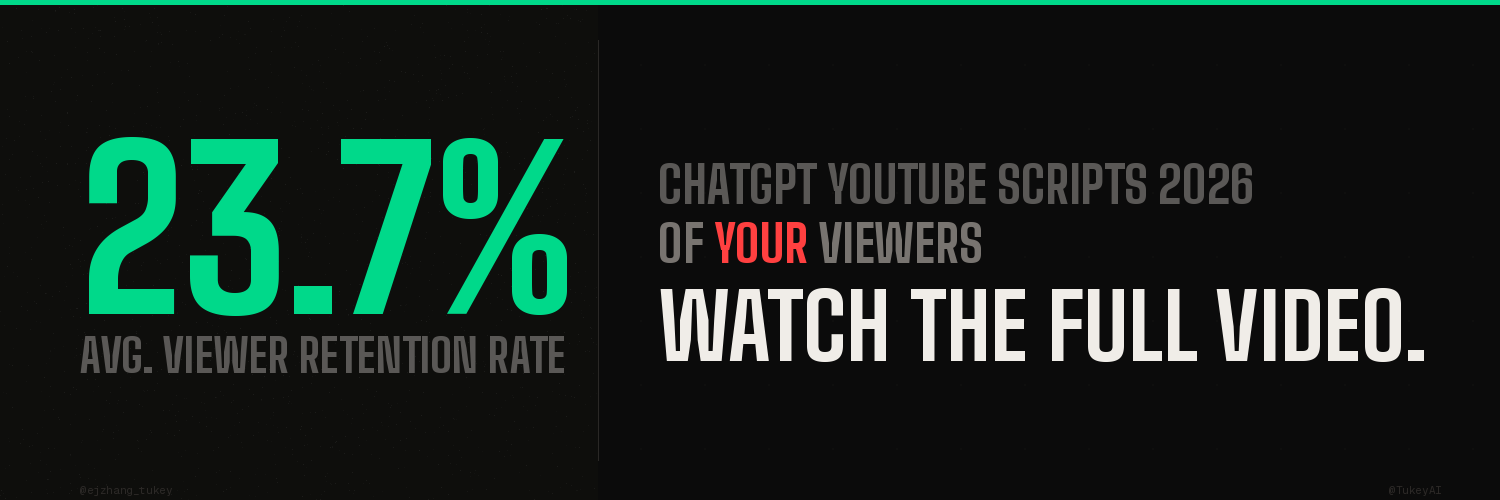
The average YouTube video retains 23.7% of its viewers. That number has gotten worse every year since 2022. And AI-generated scripts, written without any understanding of how YouTube retention actually works, are a significant part of why.
If you have asked an AI tool to write your YouTube script and felt something was off, you were right. Not because AI cannot help. Because most creators are prompting it the wrong way, for the wrong structure, without any of the context that separates a watchable video from a video the algorithm quietly buries.
This is exactly what goes wrong. And the exact prompts to fix each problem.
Why the Default ChatGPT YouTube Script Quietly Kills Your Views
When you ask for a YouTube script without giving context, you get the same output every time.
A warm-up introduction that burns 45 seconds before saying anything interesting. Three to five numbered points delivered in order, with no tension between them. A conclusion that wraps everything up cleanly before telling viewers to like and subscribe.
This structure works fine for a term paper. It does not work for YouTube.
The reason is simple: viewers do not behave like readers. Readers stay committed after the first sentence. Viewers are scanning constantly. They have another video one tap away, and they are evaluating whether yours is worth their time every 15 to 20 seconds, not just at the open.
A script that does not account for that scanning behavior will bleed viewers at every milestone. Most AI-generated scripts are built entirely around the assumption that the viewer is already committed.
They are not.
The 5 Mechanics That Break Retention (And Why ChatGPT Gets Each One Wrong)
Wrong #1: The Hook Kills Attention Instead of Capturing It
Default AI hooks sound like one of these:
"In today's video, we're going to be talking about..."
"Welcome back to the channel! Today I want to share with you..."
"Have you ever wondered why..."
Every one of these signals to the viewer: nothing important is happening yet. And 30 to 40% of viewers leave within the first 30 seconds when the hook does not immediately deliver value.
The algorithm notices. A high click-through rate followed by a steep early drop triggers a pullback in distribution. That video quietly stops getting recommended.
AI tools write warm-up hooks because they are trained to be helpful and polite. Politeness is exactly the wrong instinct on YouTube.
Wrong #2: No Open Loops
An open loop is a question or promise you plant early in the video and answer later. Videos that use open loops see a 32% increase in watch time compared to videos that deliver information in a straight line.
AI writes linearly by default. It gives you all the context upfront, then the information, then the conclusion. This is the opposite of how retention-optimized scripts work.
A retention-built script creates at least one or two unresolved tensions in the first 60 seconds and pays them off in the second half. AI does not do this unless you tell it to. Explicitly.
Wrong #3: No Pattern Interrupts
Viewer attention resets roughly every 60 to 90 seconds. When the delivery stays flat, energy steady, topic consistent, people drift. They do not always click away. They just stop actually watching.
Pattern interrupts break this cycle. A surprising cut, a stat that reframes everything, a direct question fired at the viewer. Videos that include a pattern interrupt within the first 5 seconds have a 23% higher retention rate on average.
AI writes a script as a continuous flow of sentences. It does not think in terms of energy pacing, delivery rhythm, or where the human attention cycle needs a hard reset.
Wrong #4: It Saves All the Payoff for the End
Most AI scripts front-load context and back-load the reward. The best information arrives in the final third.
On YouTube, this is backwards.
Retention-optimized scripts deliver micro-payoffs throughout: a small reveal at around the 1-minute mark, a bigger one near the midpoint, the main payoff around 70% through, and a strong close. Saving everything for the end assumes viewers will wait.
Most will not.
Wrong #5: It Ignores the 2026 Algorithm Shift
This is the one almost no one is prompting around.
YouTube confirmed in late 2025 that viewer satisfaction has replaced raw watch time as the primary ranking signal. The algorithm now runs real-time post-viewing surveys, tracks repeat views, and measures whether people return to the channel. A 3-minute video that gets watched start-to-finish and earns a like now sends a stronger signal than a 20-minute video with 40% retention.
General-purpose AI was trained before this shift. It does not know to write scripts that optimize for satisfaction rather than runtime completion. It does not know to build the micro-emotional moments that drive shares and return visits.
What the Retention Numbers Actually Say
The 2025 YouTube Audience Retention Benchmark Report puts hard numbers on all of this.
The average video retains 23.7% of viewers from start to finish. Only 1 in 6 videos, about 16.8%, ever break the 50% retention mark.
Educational how-to content with strong script structure hits 42.1% average retention. That is nearly double the baseline. The gap is not explained by production quality, niche selection, or subscriber count. It is explained almost entirely by whether the script was built for how viewers actually behave.
A video that loses more than 70% of viewers in the first 30 seconds does not recover algorithmically. YouTube stops recommending it. The video stalls regardless of how good the content is from minute two onward.
The difference between a 23% retention rate and a 42% retention rate is structure. Specifically, it is whether the scriptwriter, human or AI, understood that the viewer is not committed.
The 5 Prompts That Fix Each Problem
Here is how to give a general-purpose AI the context it needs for each specific failure.
Fix #1: The Cold Open Prompt
Instead of:
"Write a YouTube script about [topic]."
Use:
"Write a 15-second cold open for a YouTube video about [topic]. Start with the most surprising fact or counterintuitive claim related to this topic. Do not introduce me. Do not say 'in this video.' Drop the viewer directly into the most interesting moment. End the hook on an unresolved question."
Fix #2: The Open Loop Prompt
After the cold open, run this as a separate turn:
"Now write a 30-second bridge that plants two open loops: one promise about what I will reveal in the first half, and one bigger promise about a counterintuitive insight that comes near the end. Do not reveal either thing yet. Create curiosity, not explanation."
Fix #3: The Pattern Interrupt Prompt
"Write this section of the video for [topic point]. Every 90 seconds, insert a pattern interrupt. This can be a direct question to the viewer, a stat that reframes the previous point, a brief concrete story, or a transition phrase that shifts energy. Mark each one with [INTERRUPT] so I know where to plan an edit or delivery shift."
Fix #4: The Micro-Payoff Structure Prompt
"Structure the body of this script in three-act format with a micro-payoff at each act transition. Act 1 ends with a small revelation that changes how the viewer sees the problem. Act 2 ends with the biggest insight of the video. Act 3 delivers the practical application and closes strong, not with a summary."
Fix #5: The Viewer Satisfaction Prompt
"Rewrite the final 60 seconds of this script to optimize for viewer satisfaction, not just completion. Include one moment where the viewer feels they got something other videos in this niche do not give them, one authentic opinion or recommendation, and a close that makes them want to return to this channel, not just subscribe."
The Fastest Path to Scripts Built for Retention
These prompts work. Running them one by one is still slow.
Each prompt is a separate conversation turn. You have to manually track where the open loops were planted to make sure they get resolved. You have to remember which pattern interrupt landed at which timestamp. You are assembling a script from separate pieces with no unified retention map holding them together.
The creators who are outperforming right now are not running five separate prompts and stitching outputs together by hand. They are working inside tools where the entire retention architecture is built in from the start, not bolted on after the fact.
Tukey AI was built specifically for this. It analyzes which videos in your niche are overperforming relative to their channel size, surfaces what those scripts are doing structurally, and generates scripts that mirror those retention mechanics for your topic. You do not prompt separately for open loops. You do not track pattern interrupt timing in a spreadsheet. The structure comes out correctly because the tool was trained on what actually retains viewers, not on how to be a helpful general assistant.
A script built in Tukey takes about 12 minutes from topic to final draft. Running the five-prompt sequence manually takes closer to an hour. And the manual version still requires you to audit for the mechanics Tukey builds in by default.
A note on why we built Tukey AI
I spent months scripting YouTube videos with general-purpose AI tools. The output was readable. It sounded fine. And then I watched the retention graphs.
The 30-second drop was consistent. Not catastrophic. But consistent enough that the algorithm was clearly not recommending the videos the way I expected given the click-through rates. High CTR, weak distribution. The hook was working. The script was losing people.
The problem was not the AI. The problem was that no general-purpose tool has any idea what a YouTube retention curve looks like, or which structural decisions are correlated with the videos that beat it. That data exists. It just was not being used.
We built Tukey to close that gap. Scripts built around what actually works in your specific niche, not around what makes a structurally polite document.
tukey.ai
FAQ
Does using ChatGPT for YouTube scripts hurt retention? Not by itself. The problem is asking a general-purpose AI to write a YouTube script without giving it the structural context retention actually requires. A default prompt produces content built for reading, not for viewer behavior. The result misses open loops, pattern interrupts, and micro-payoffs. Each gap shows up as a drop on the retention graph.
What is a good YouTube viewer retention rate in 2026? The 2025 benchmark average is 23.7% across all video types. A retention rate above 50% is considered strong. Educational how-to content with solid script structure averages 42.1%. If your retention sits below 30%, script structure is the first variable to address before anything else.
What are open loops in a YouTube script and why do they matter? An open loop is a question or promise introduced early in the video that only gets answered later. Research shows they produce a 32% increase in watch time compared to linear delivery, because viewers stay to get the resolution. Most AI scripts skip them because general-purpose AI writes from context to conclusion, not from tension to payoff.
How often should a YouTube script include pattern interrupts? Every 60 to 90 seconds is the target. A pattern interrupt can be a direct question, a reframing stat, a short concrete story, or a deliberate pacing shift. Videos that include a pattern interrupt within the first 5 seconds have a 23% higher average retention rate.
What changed about the YouTube algorithm in 2026? YouTube confirmed that viewer satisfaction now outranks raw watch time as the primary distribution signal. The algorithm runs post-viewing surveys, tracks repeat views, and reads comment sentiment. A short video that gets watched all the way through and earns genuine engagement now outranks a long video with mediocre retention. Scripts optimized only for runtime completion are misaligned with how the algorithm actually works today.
Can you still grow a YouTube channel using ChatGPT scripts? Yes, if you use the right prompting structure. The five prompts in this article cover the main gaps: cold open, open loops, pattern interrupts, micro-payoff structure, and satisfaction engineering. The key shift is treating AI as a structured writing assistant rather than a one-shot script generator. Feed it your retention data, prompt for specific mechanics, and review the output against the retention curve rather than whether the text reads cleanly.
The script you get from a default AI prompt is a first draft. Add the structure YouTube actually rewards, and it becomes something else entirely.
My name is EJ Zhang, the CEO at Tukey AI , a production workspace built in your voice. It learns your beliefs and creative fingerprint, surfaces pre-trending topics tailored to you, helps you create with originality, predicts performance before you publish, and learns from every result to make smarter recommendations over time.