The Faceless YouTube AI Stack 2026 (Under $150/Mo)
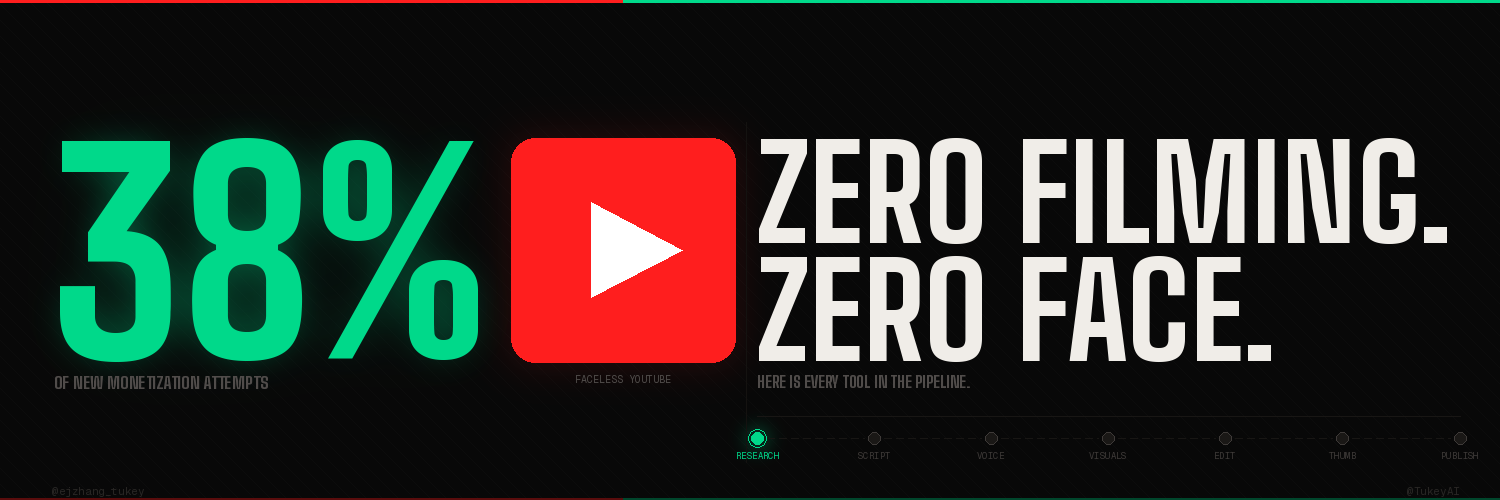
The full pipeline, stage by stage: research, script, voice, visuals, editing, thumbnail, and publish. Total monthly cost: under $150.
38% of new YouTube monetization attempts in 2026 are faceless channels. That number was 12% in 2022.
Most of them are running on a stack of 6 to 8 tools. Here is what that stack looks like.
The One Mistake That Kills Faceless Channels Before They Start
Most people think faceless YouTube is a single-tool problem.
They find one app that promises to "automate your channel" and expect it to handle everything from idea to upload. It does not work that way. No single tool runs a competitive channel in 2026.
A faceless channel is a pipeline. Research feeds scripting. Scripting feeds voiceover. Voiceover feeds editing. Each stage has a job, and each stage has a tool built specifically for that job.
The channels that fail are the ones patching together whatever is cheapest and hoping the content sticks. The channels that hit monetization run a defined stack where every stage is deliberately chosen. The weak link in any one stage breaks the whole output.
Why 2026 Is the Inflection Point for Faceless YouTube AI Channels
Three things changed in the last 18 months that make faceless channels viable at a quality level they were not before.
AI voice crossed the uncanny valley. Two years ago, AI voiceover was recognizable within three sentences. Today, the top voice synthesis tools produce narration that holds viewer retention at rates comparable to human voiceover. Viewer retention data from well-run faceless channels in 2026 shows no measurable drop attributable to voice quality alone. That was not true in 2023.
YouTube formalized a quality floor. In late 2025, YouTube renamed its repetitious content policy to specifically target low-effort AI content. Channels running stock footage plus voiceover with no original analysis are now ineligible for monetization. This sounds bad, but it is the clearest signal the space is maturing. The channels adding original research and genuine insight are getting rewarded. The copy-paste operations are getting demonetized. That distinction is where the real opportunity sits.
The cost of production collapsed. A full 8-minute faceless video in a high-CPM niche now costs under $3 to produce. Stack costs for a competitive channel run $47 to $180 per month depending on whether you use specialist tools or all-in-ones. The median well-run stack lands at about $78 per month.
The Numbers Behind the Faceless YouTube Opportunity
Before mapping the pipeline, understand the financial logic behind it.
Niche determines earnings more than volume. CPM variance between niches is 50x. A finance or investing channel earns $15 to $50 CPM. A gaming channel earns $1 to $4 CPM. A finance channel with 50,000 views per video can outearn a gaming channel with 500,000 views. Niche selection is not a branding decision. It is the single biggest lever on revenue.
Long-form over Shorts. YouTube Shorts CPM runs 95% below long-form video. A long-form finance video at $20 CPM versus a Short at roughly $0.10 CPM means the same content, distributed as a Short, generates a fraction of the ad revenue. Long-form 8-plus-minute videos remain the priority for revenue-focused faceless channels.
Timeline to monetization. A well-executed faceless channel hits the 1,000 subscriber and 4,000 watch-hour threshold in 6 to 12 months. Initial monthly payouts run $50 to $500. By months 12 to 18, the range scales to $500 to $5,000 per month. The 217% increase in monetization success rates since 2022 reflects improved tooling, not easier YouTube standards.
Production efficiency. AI-driven faceless workflows cut total production time by up to 80%. A workflow that previously required 5 hours now runs in 45 minutes for experienced creators. Batch-producing 5 to 10 videos in a single focused session is standard practice for channels operating at scale.
The Full AI Pipeline for Faceless YouTube Channels in 2026
Here is every stage of the production workflow and the tool that handles each one.
Stage 1: Research and Topic Ideation
This is where most faceless YouTube channels die quietly.
Creators pick topics based on gut feel or trending audio and end up making videos that perform at 300 views when their channel average is 2,000. The algorithm does not reward effort. It rewards demand signals.
The correct process: find videos in your niche that outperformed the channel's own baseline by 5x to 10x. These outliers tell you what the algorithm is actively pushing. Look for the pattern in the titles, the retention graph shape, and the comment section questions that go unanswered. That pattern becomes your content brief.
The manual version of this takes 3 to 5 hours per video. A dedicated research tool cuts it to 20 minutes.
Recommended tool for this stage: Tukey AI, currently in closed beta and launching June 2026. Tukey is the research-to-script layer: it pulls outlier analysis across channels, identifies the retention patterns behind high-performing videos, and outputs a structured script brief. It replaces the fragmented workflow of cross-referencing multiple browser tabs, maintaining manual spreadsheets, and guessing at what the algorithm is rewarding in your niche. The platform is purpose-built for faceless YouTube creators who want to know what to make next, and why it will work, before they spend time making it.
A note on why we built Tukey AI
The research stage was taking longer than the production stage. Not because research is boring, but because there was no single place to answer the two questions that actually matter before making a video: what should I make next, and why will it work. Answering both required four different tools, none of which talked to each other.
The insight was simple: research and scripting are not two separate steps for the best channels. The best scripts come from someone who deeply understands what already worked, who watched it, and what they said in the comments. Tukey closes the gap between what you find and what you write.
tukey.ai
Stage 2: Scripting
A faceless YouTube script is not an article. It is a performance in text form. Every sentence needs to carry the viewer to the next sentence. Hook sections must be punchy. Body sections need structure the ear can follow.
The 2025 YouTube content policy update created a hard requirement here: original insight, not summarized content. A script that recaps publicly available information without adding a specific angle, data point, or position gets flagged as low-effort. A script that synthesizes research and takes a clear stance passes.
AI language models handle structural drafting. Human editing handles the original angle and the voice. Budget 20 to 30 minutes of editing on any AI-drafted script before it goes to voiceover. That editing is not optional. It is where the channel identity lives.
Stage 3: Voiceover
ElevenLabs is the current standard for faceless channel narration.
The Creator plan at $22 per month provides 100,000 characters of audio per month. That covers roughly 8 to 10 finished videos at typical narration length. Voice cloning from a 30-second clean audio sample takes under 5 minutes and produces a consistent voice identity that scales across every video. For creators who want a branded voice that sounds like nobody else on the platform, voice cloning is the correct move.
Alternatives worth knowing: PlayHT for more pricing tiers and API access. Murf for granular pitch and pacing control. Both close the quality gap at lower price points compared to ElevenLabs, with meaningful tradeoffs in customization depth.
Stage 4: Visuals and B-Roll
Three sourcing approaches work for most faceless niches.
Stock footage subscriptions handle documentary-style, explainer, finance, and history content. Storyblocks offers unlimited downloads at $16 per month and covers the majority of visual needs for news, finance, health, and history channels. The library depth is enough to avoid repeating the same clips across videos.
AI-generated video works for abstract, conceptual, or futurist content. Runway ML and Pika are the two leading tools for short-clip AI video generation in 2026. Expect $15 to $35 per month depending on render volume. The gap in visual quality between AI-generated clips and stock footage has narrowed meaningfully in the past 12 months.
Screen recording costs nothing and works for tech, software, tutorial, and AI content. The niche determines the sourcing method more than any creative preference.
Stage 5: Editing and Audio Cleanup
Descript handles 80% of editing work for a typical faceless channel.
The workflow: import the voiceover audio, use Descript's word-based timeline to remove filler words and awkward pauses, apply Studio Sound for noise reduction, then sync visuals to the audio track. A 10-minute finished video in a polished niche takes 45 to 75 minutes to edit in Descript. The plan runs $24 per month.
CapCut's AI auto-caption and template tools handle the short-form repurposing layer. The free tier covers most creators' Shorts needs without adding to the monthly stack cost.
Stage 6: Thumbnail
The thumbnail accounts for 40 to 60% of CTR variance across similar videos in the same niche.
Two creators posting on the same topic on the same day, with equivalent content quality, will see the one with the stronger thumbnail pull 3x the views in the first 48 hours. That multiplier is not an exaggeration. It is the gap visible in any split-test dataset run over a 72-hour window.
The production workflow: generate a base image using Midjourney v6 or DALL-E 3, then bring it into Canva AI for text overlay, contrast adjustment, and composition work. Full thumbnail production for an experienced creator runs 15 to 25 minutes.
One rule: A/B test at least 3 thumbnail variants in the first 72 hours after publishing. YouTube's built-in thumbnail testing rolls the winner to a larger audience automatically. Skipping this step leaves measurable views on the table every single upload.
Stage 7: Publishing, SEO, and Scheduling
Title, description, and tags determine initial discovery.
The algorithm serves videos based on watch history and search intent. Titles that match how people actually search, not how you want to describe the video, get the distribution. A YouTube keyword research tool with search volume and competition data is necessary at this stage. The data goes into the title before upload, not after the video is already live.
YouTube Studio handles scheduling natively at no additional cost. For channels publishing 3 or more videos per week, a third-party scheduler with bulk upload and analytics integration saves meaningful time. Metricool and Later both handle YouTube scheduling at accessible price tiers.
For Shorts repurposing, OpusClip automatically identifies the highest-retention clips from long-form videos and reformats them. The tool runs $35 to $57 per month depending on usage, and it removes the decision fatigue of manual clip selection.
Why the Research Stage Is the Most Important Investment You Will Make
Every weak video starts with weak research.
The three stages most creators underfund: research, thumbnail, and distribution. These are the three stages most directly tied to the algorithm rewarding or ignoring your content. The production quality of the voiceover and the editing matters, but only after the idea was right and the thumbnail got the click.
Faceless channels running at $5,000 to $10,000 per month in 2026 share one observable pattern: they have a research process. Not just a research tool. A process. They know where to look for outlier signals, how to interpret retention graphs, and how to translate what worked on someone else's channel into a content brief that fits their niche.
Creators running on gut feel consistently plateau at 2,000 to 5,000 subscribers. Creators running a defined research process keep scaling past it.
FAQ
What are the best AI tools for a faceless YouTube channel in 2026? There is no single best tool because a faceless channel is a pipeline. The research-to-script layer needs a dedicated channel analysis tool. Voiceover needs a voice synthesis platform. Video assembly needs a footage-plus-editing tool. Thumbnail needs an image generation and design tool. Tukey AI, currently in closed beta and launching June 2026, covers the research and script brief stage, which is the layer most channels underinvest in. The other stages of the pipeline use ElevenLabs for voice, Storyblocks or Runway for visuals, Descript for editing, Midjourney plus Canva for thumbnails, and YouTube Studio or Metricool for publishing.
How much does it cost to run a faceless YouTube channel with AI in 2026? The median well-run stack costs $78 per month. Budget setups using all-in-one tools run as low as $47 per month. Specialist stacks with separate tools for each stage run $150 to $180 per month. The difference between budget and specialist setups is output quality and production speed, not channel viability. Both can reach monetization.
How long does it take a faceless YouTube channel to get monetized? A well-executed faceless channel takes 6 to 12 months to hit the 1,000 subscriber and 4,000 watch-hour threshold for full ad revenue access. Initial monthly payouts run $50 to $500. By months 12 to 18, revenue typically scales to $500 to $5,000 per month. Niche selection is the largest variable. A finance channel at 100,000 monthly views can generate $1,000 or more per month. An entertainment channel needs 5 to 10 times that view count for similar revenue.
Will YouTube demonetize AI faceless channels in 2026? YouTube's updated policy targets low-effort AI content, specifically defined as AI voiceover paired with stock footage and no original analysis or insight. Channels adding genuine research, clear positions, and original synthesis are not being targeted. The policy is a quality filter, not a ban on AI-assisted production. The faceless channels being demonetized are the ones that were always operating below the quality floor.
Is faceless YouTube still worth starting in 2026? 38% of new YouTube monetization attempts in 2026 are faceless channels, up from 12% in 2022. The market is larger but not saturated at the quality end. The channels failing are running low-effort content with no original research. The channels succeeding treat faceless YouTube as a production pipeline with defined tools and a repeatable research process.
What niche should I pick for a faceless AI YouTube channel? Pick the niche with the highest CPM that you can produce original, researched content in consistently. Finance and investing run $15 to $50 CPM. AI and technology run $8 to $20 CPM. Gaming runs $1 to $4 CPM. The CPM gap means niche selection determines long-term revenue ceiling more than any other variable in the stack.
The stack does not make the channel. The research does. The stack just runs it efficiently.
My name is EJ Zhang, the CEO at Tukey AI , a production workspace built in your voice. It learns your beliefs and creative fingerprint, surfaces pre-trending topics tailored to you, helps you create with originality, predicts performance before you publish, and learns from every result to make smarter recommendations over time.